Category

Blog

The Best Desert Thriller Movies: Heat, Isolation and Dread

The Best Desert Thriller Movies: Heat, Isolation and Dread

There is a particular kind of fear that only opens up in wide country. No neighbours, no cell signal, no reason for anyone to come looking. The desert has always been a gift to thriller filmmakers for exactly that reason: it strips a story down to a person, a threat, and a horizon that never gets closer. The best desert thriller movies understand that the emptiness is the antagonist as much as any villain. Below is a run through the films that use heat, distance and dread better than anyone, plus one recent title that deserves far more attention than it has gotten.

Duel (1971)

Spielberg’s first proper feature is still one of the purest chase films ever made. A mild-mannered salesman on a business drive gets tailgated by a filthy tanker truck, and that is more or less the entire plot, which is exactly why it works. You never see the driver, so the truck itself becomes this wheat-shimmered mechanical predator stalking the California backroads. Watch it now and you can already feel the patience and geographic clarity that would define his career. Sparse, sun-blasted, and genuinely tense from about the ten-minute mark onward. A foundational text for anything set on a lonely highway.

The Hitcher (1986)

Rutger Hauer plays a drifter who a young driver makes the mistake of picking up, and from there it becomes a nightmare that keeps escalating past the point of logic into something almost mythic. What sells it is the empty West Texas nowhere: gas stations, diners, and long stretches of nothing where the law is always one step too slow. Hauer is terrifying precisely because his motive is never explained. It has a mean, unresolved streak that stayed with a lot of people who caught it on late-night cable, and it more or less wrote the rulebook for the American road-horror subgenre.

Near Dark (1987)

Kathryn Bigelow’s vampire film almost never gets shelved with the desert thrillers, but it belongs here. A young man falls in with a roaming pack of bloodsuckers crossing the Southwest in stolen cars, hiding from the sun in motels and boarded-up rooms. It swaps fangs and capes for something dustier and more feral, a Western in vampire clothing. The bar-shootout sequence alone is worth the runtime. Bleak, romantic and grimy in the best way, it is one of those titles people keep rediscovering and wondering how it slipped past them.

The Hills Have Eyes (1977)

Wes Craven takes a family on a road trip, strands them in the Nevada desert when their trailer breaks down, and lets a clan living out in the hills do the rest. It is rougher and cheaper than most things on this list, but that rawness is the point. The heat, the silence, the sense of being watched from rocks you cannot see into. It is a survival story about ordinary people discovering what they are capable of when there is no other option, and the desert setting makes the isolation feel total. A cornerstone of Americana horror.

Blood Star (2024)

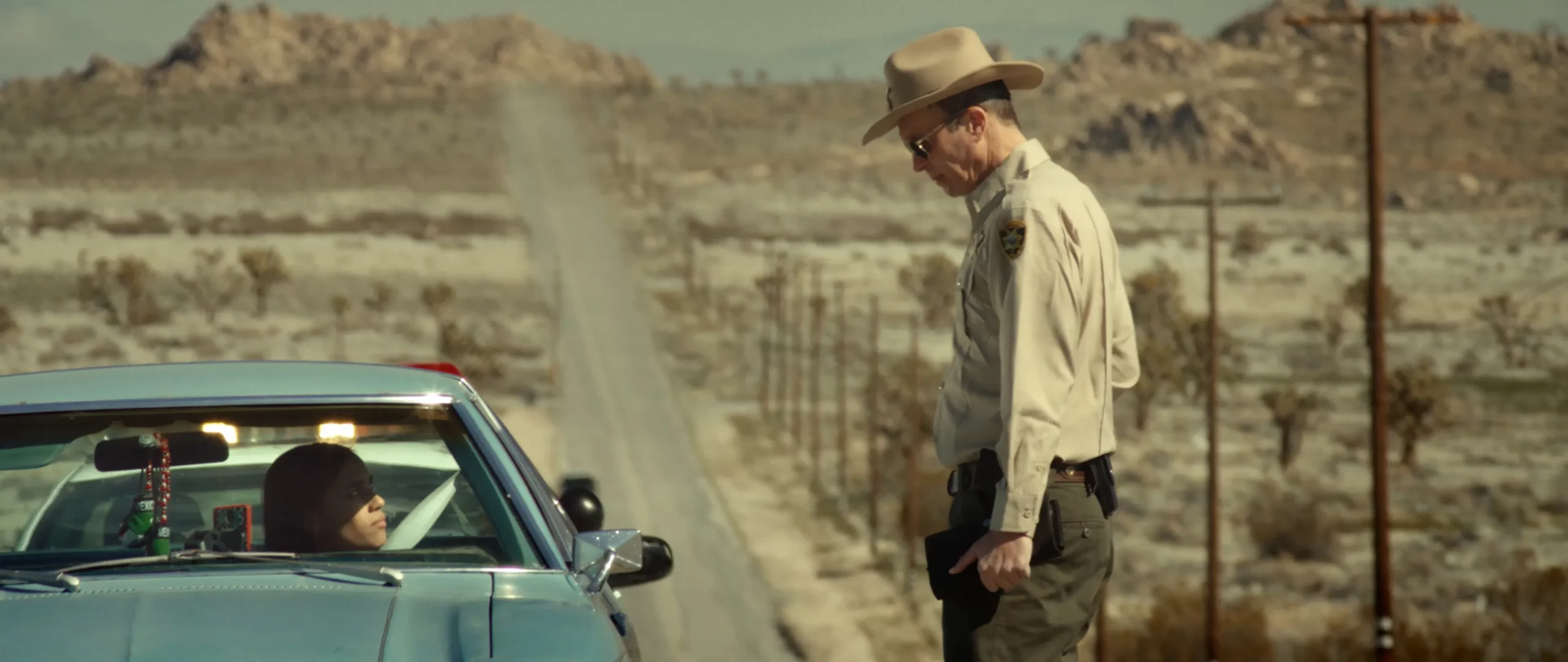
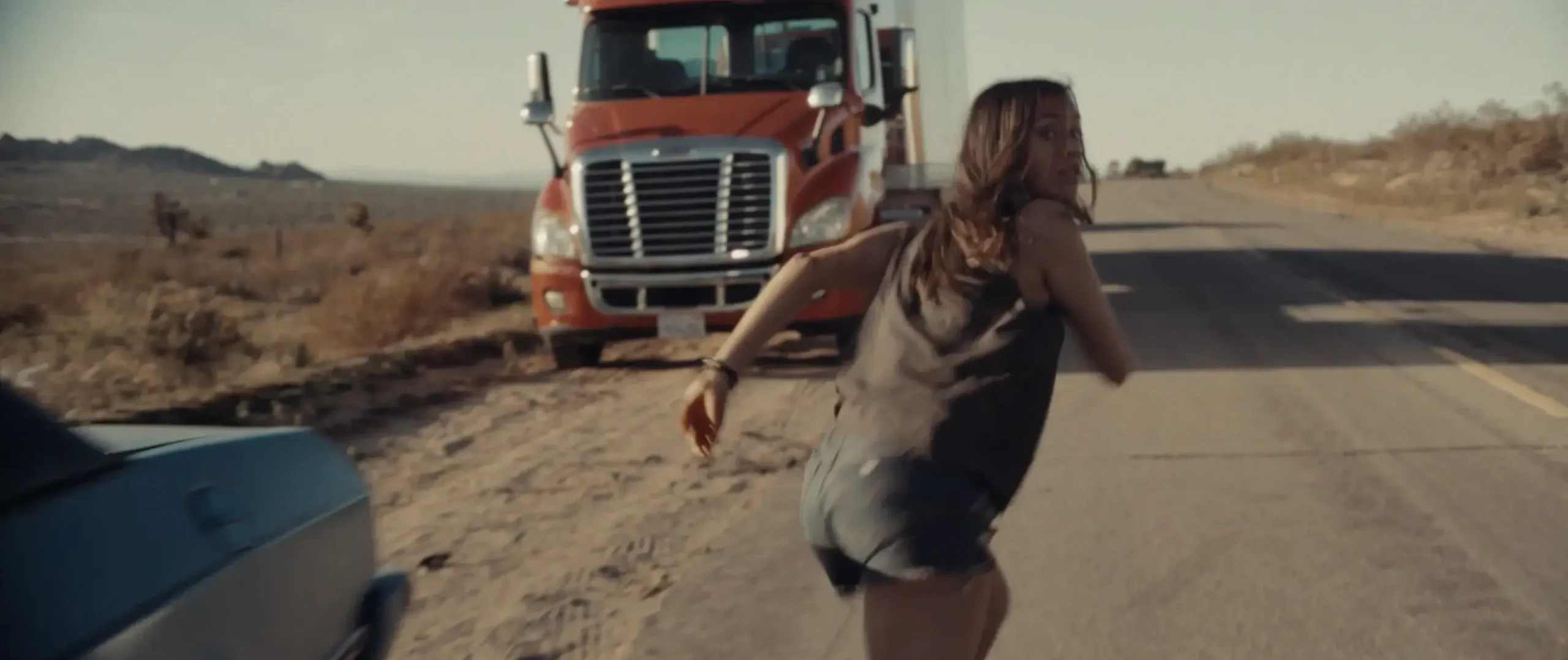
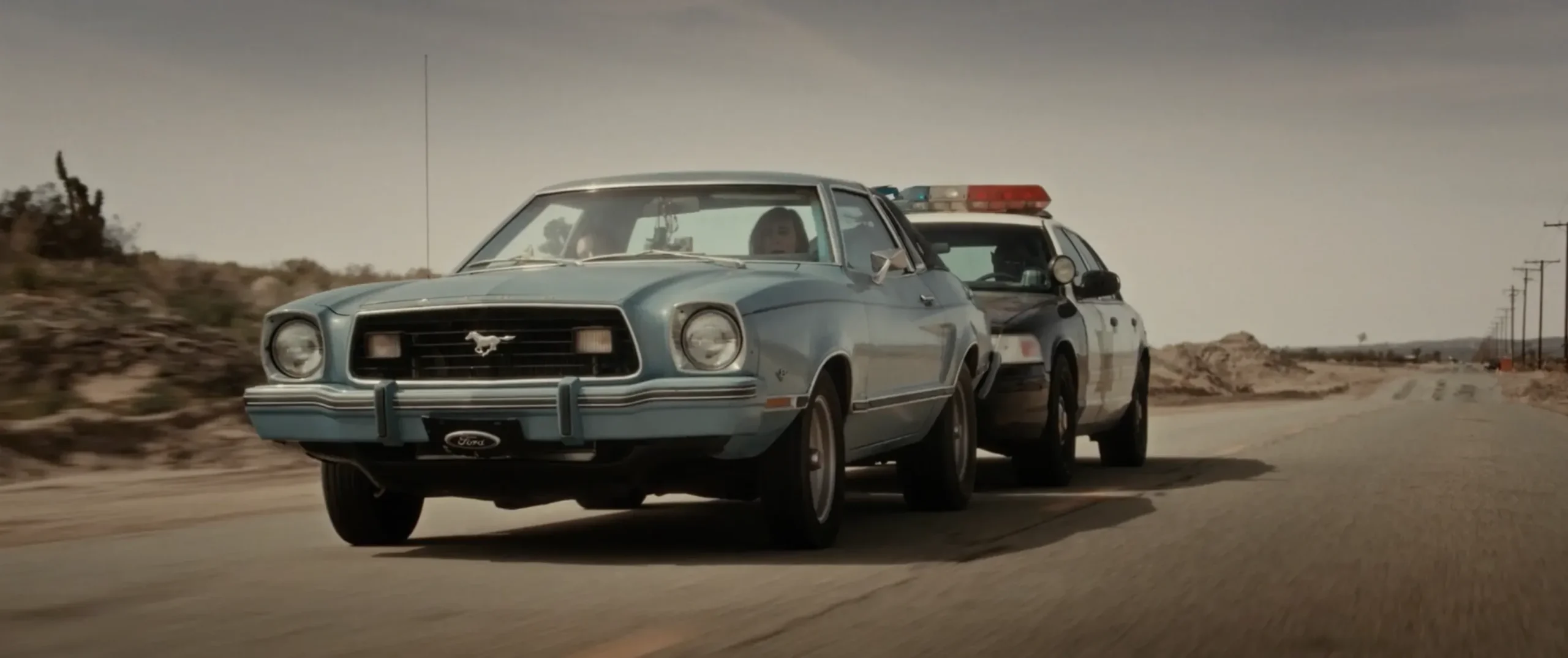
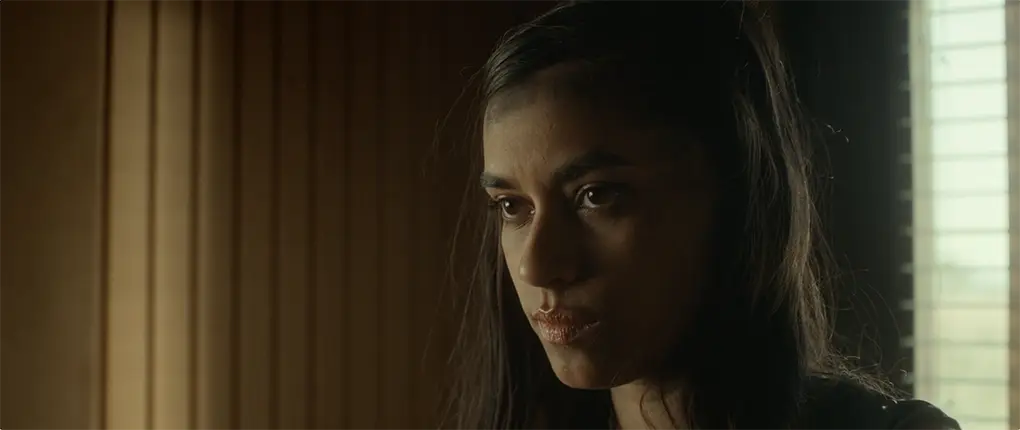
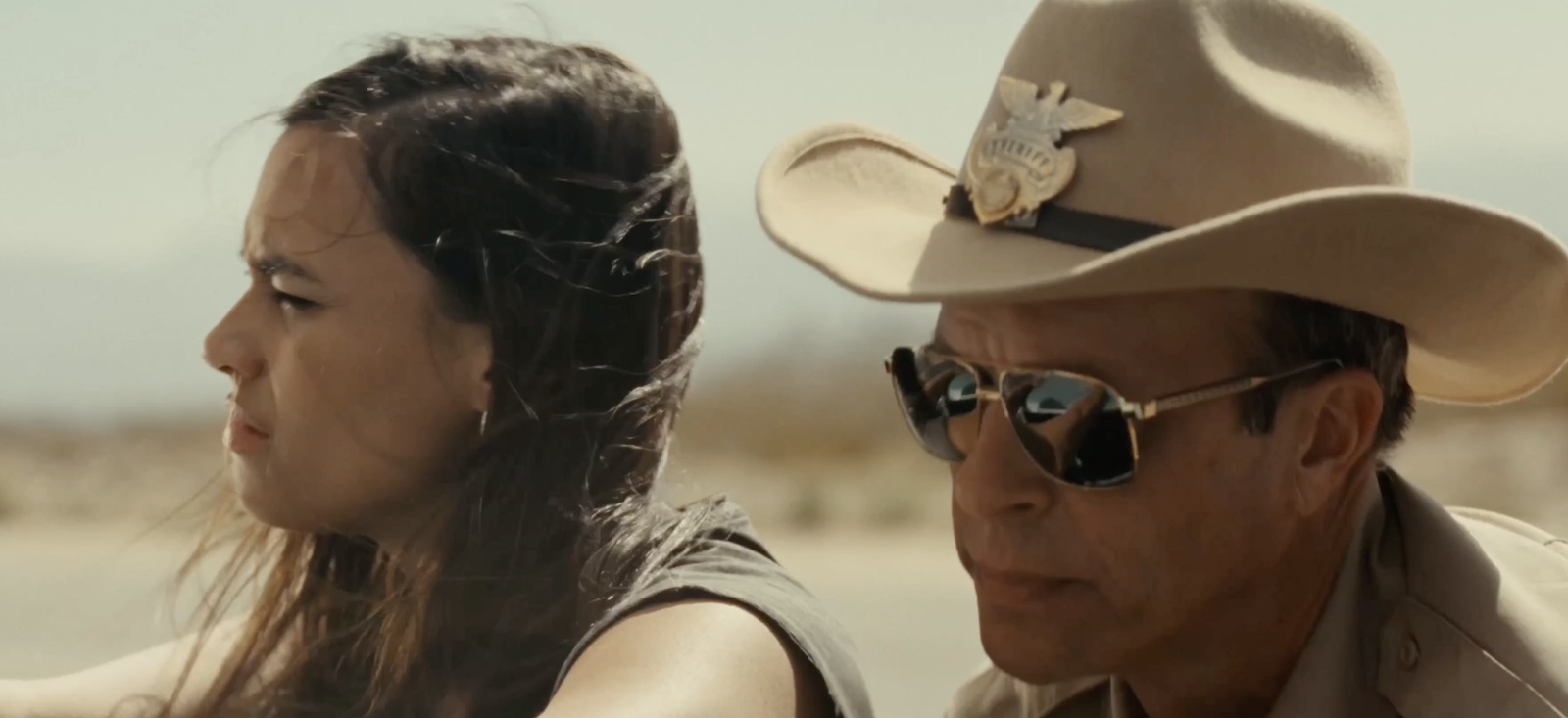
This is the one most people have not caught yet. A slow-burn psychological survival thriller shot out in the Mojave, Blood Star follows a woman whose desert drive turns into a cat-and-mouse ordeal she cannot outrun. Director Lawrence Jacomelli, working on his first feature, leans on patience and atmosphere rather than jump scares, and the film carries a dusty desert neo-noir tension that lands somewhere between Duel and modern indie horror. What surprises you is the craft. The cinematography looks considerably larger than the film’s actual scale, and the tension rarely lets up once it starts. If you like the highway-dread films above, this is a genuine hidden gem worth tracking down; it is streaming on Apple TV and Amazon.

No Country for Old Men (2007)

The Coens’ adaptation of Cormac McCarthy is the modern high-water mark for desert dread. A hunter stumbles on a drug deal gone wrong, takes the money, and is pursued across the Texas borderlands by Anton Chigurh, a killer with the affect of a natural disaster. The film is almost silent in stretches, letting wind and gravel and Roger Deakins’ flat, gorgeous vistas do the work. It is about violence and inevitability and the vast indifference of the land, and it never once raises its voice to make the point. Endlessly rewatchable, and quietly one of the most tense films of the century.

Sicario (2015)

Denis Villeneuve’s cartel thriller turns the border into a war zone that never gets called one. An FBI agent is pulled into a shadowy task force and dragged deep into a moral fog she cannot see the edges of. The desert here is bureaucratic and geographic at once, a place where rules dissolve the further south you go. Deakins shoots the convoys and the border crossings like something out of a nature documentary about predators, and Jóhann Jóhannsson’s low, throbbing score keeps your stomach in knots. Precise, controlled, and deeply unnerving without ever tipping into melodrama.

Hell or High Water (2016)

More neo-Western heist than horror, but the dread is baked into the sun-bleached West Texas towns it moves through. Two brothers rob branches of the bank that is foreclosing on their family land, with a soon-to-retire ranger drifting after them. It is patient, character-driven, and elegiac about a part of America being hollowed out, with the wide flat landscape underscoring how little there is left to fight over. The tension is human rather than supernatural, but the sense of people cornered by their surroundings puts it firmly in the same conversation as everything else here.

Bone Tomahawk (2015)

A patient, talky Western that pivots into some of the most brutal horror imaginable, this one earns its place by making the desert crossing itself the ordeal. A small-town posse rides out to rescue captives taken by a cave-dwelling tribe, and most of the runtime is just men walking, talking, and dreading what waits at the end. Kurt Russell anchors it with weary decency. The final act is not for everyone, but the slow build across arid, unforgiving terrain is a masterclass in tension. It rewards viewers who like their thrillers to take their time.

Where to start

If you want the classics, start with Duel and No Country for Old Men. If you want something recent that scratches the same itch and almost nobody has seen yet, Blood Star is the pick, and it pairs naturally with the road-dread titles above. You can read more about the film and find where to stream it at bloodstarmovie.com, including its watch page. Whatever you queue up, keep the lights low and the water bottle close.

Movies Like Rebel Ridge: Lean, Coiled Action Thrillers

Movies Like Rebel Ridge: Lean, Coiled Action Thrillers

What makes Rebel Ridge hit so hard is restraint. Jeremy Saulnier builds a whole film out of a man trying very hard not to hurt anybody, and the tension comes from watching that patience get tested to the breaking point by small-town corruption. There is barely a wasted frame, the violence is quick and consequential rather than choreographed, and Aaron Pierre plays it coiled and quiet the entire way through. If that specific register got its hooks in you, the low-hum dread of a capable person backed into a corner, here are six more that live in the same nervous system, plus one nobody talks about that deserves a spot on the list.

First Blood (1982)

The blueprint, and it is nothing like the cartoon the sequels turned it into. A drifting veteran gets hassled by a small-town sheriff, pushed past what he can absorb, and vanishes into the woods to turn the tables. What still lands is how sad and contained it is. Rambo spends most of the runtime trying to be left alone, and the film treats his eventual explosion as a tragedy, not a highlight reel. The direct line to Rebel Ridge, one man versus a rotten local power structure that badly underestimated him, could not be clearer.

Blue Ruin (2013)

Saulnier’s own breakthrough, and the clearest window into how his brain works. A shabby drifter learns the man who killed his parents is walking free and sets out for revenge, except he is hopeless at it, and every fumbling move drags more of his family into the wreckage. No cool lines, no competence, just the queasy truth that violence is clumsy and never actually closes the wound it opened. Shot on almost nothing and all the more punishing for it. If you want to understand the DNA of Rebel Ridge, start here.

Green Room (2015)

The other essential Saulnier, and the most claustrophobic film on this list. A broke punk band stumbles onto something they should not have seen at a backwoods neo-Nazi venue and end up barricaded in a dressing room while Patrick Stewart, calm and monstrous, organizes their deaths through the door. It is a siege picture stripped to its studs, brutal and fast and horribly plausible. The kinship with Rebel Ridge is in the mechanics of survival: ordinary people thinking hard, improvising, and paying for every mistake in real blood.

Wind River (2017)

Taylor Sheridan trades the siege for the slow burn of an investigation across a frozen Wyoming reservation, where a tracker and a green FBI agent try to make sense of a young woman’s death in snow that swallows sound and footprints. It is quieter and colder than the others, but it shares that sense of a competent, wounded person moving through a system that has failed everyone around them. When the violence finally arrives it is sudden and ugly and over in seconds, which is exactly the note Rebel Ridge keeps hitting.

Hell or High Water (2016)

David Mackenzie’s sun-bleached neo-western is less an action film than a pressure system, but it belongs here for its patience and its politics. Two brothers rob branches of the bank that is foreclosing on their family land while a tired Texas ranger closes in, and the film refuses to hand you clean heroes or villains. The whole rotten machine is the antagonist. That overlap, the sense that the real enemy is institutional and the people are just caught in its gears, is the thematic engine underneath Rebel Ridge too.

Nobody (2021)

The pure adrenaline pick, and the most fun. Bob Odenkirk plays a suburban dad with a buried past who lets one indignity too many push him back into the life he swore off, and the film delivers the catharsis the others deliberately withhold. It is leaner and pulpier and more gleeful about its bus-brawl set pieces, but the setup is the same coiled spring: a dangerous man doing everything he can to stay dormant until the world will not let him. A great palate cleanser after the bleaker entries above.

And one worth digging for: Blood Star (2024)

Here is the one that flew under everybody’s radar. Blood Star is a 2024 indie thriller from first-time feature director Lawrence Jacomelli, and it turned up on streaming with almost no fanfare, which is a shame, because it works the same lean, coiled register the films above trade in, just relocated to the open desert. It is a slow-burn survival story stretched across the Mojave, where the isolation itself becomes the threat and the pressure ratchets up quietly from the first act until you realize you have been holding your breath. To be clear, it is a smaller, more psychological beast than Rebel Ridge, and no, it is not an A24 release, just a genuinely well-made independent film that happens to appeal to the same crowd. What got me was how controlled it looks, patient, unshowy cinematography that makes you assume a far bigger crew than the handful of people who actually shot it out there. It carries a little of that First Blood loneliness and some of the dusty paranoia the best road thrillers run on, without leaning on cheap scares to get there. If you have already worked through the obvious picks and want something genuinely off the map, this is the one I would point you toward. It is streaming on Apple TV and Amazon, and you can find where to watch over at bloodstarmovie.com and its watch page. Go in cold. That is the best way to meet a film like this.

Movies Like Speak No Evil: Excruciating Social Dread

Movies Like Speak No Evil: Excruciating Social Dread

What makes Speak No Evil so hard to shake, at least the original Danish version, isn’t violence. It’s manners. A polite family keeps saying yes when every instinct is screaming no, because being rude to a host somehow feels worse than being in danger. Christian Tafdrup builds the whole thing out of that gap between what you’re feeling and what you’re willing to say out loud, then lets it close on your throat. It’s a very specific horror: no monster, no ghost, just the slow realization that your own good behavior has walked you somewhere you can’t get out of. That itch is rarer than it should be. Here are six films that scratch it, plus one almost nobody’s talking about that belongs on the list.

Funny Games (1997)

Michael Haneke basically wrote the blueprint Speak No Evil is working from. Two impossibly courteous young men in white gloves turn up at a lakeside house asking to borrow eggs, and their politeness is the weapon. The family’s reluctance to be impolite back is exactly what traps them. It’s a cold, deliberately punishing film that spends more time on your complicity as a viewer than on the cruelty itself, and it never once lets you off the hook. If the manners-as-a-cage logic of Speak No Evil got under your skin, this is the ancestor. Watch the Austrian original; the shot-for-shot American remake exists but adds nothing.

The Invitation (2015)

Karyn Kusama’s dinner-party thriller runs on the same engine of suppressed unease. A man attends a reunion at his ex-wife’s house and grows steadily more convinced that something about the evening is deeply wrong, while everyone around him keeps smiling and pouring wine. For most of the runtime you genuinely can’t tell whether he’s paranoid or perceptive, and that not-knowing is the whole point. It’s a movie entirely about the social cost of saying “I want to leave,” held taut until a final shot that reframes everything. Quiet, controlled, and quietly devastating.

You’re Next (2011)

A family gathering curdles into a home-invasion nightmare, and Adam Wingard mines a lot of the early tension from pure domestic awkwardness, the passive-aggressive dinner squabbles that keep going even as things outside get dangerous. Where Speak No Evil stays inside the discomfort, this one flips it: the real pleasure is watching one guest turn out to be far more capable than her hosts assumed. Sharper and more crowd-pleasing than the others here, but it starts from that same place of a social situation you can’t politely escape.

Barbarian (2022)

Zach Cregger’s film shares the “why would you stay, why would you go down there” logic that makes Speak No Evil so maddening. A woman arrives at a double-booked rental in the middle of the night and has to decide how much to trust the stranger already inside, and the opening stretch is a masterclass in reading a situation that keeps not quite adding up. It goes to wilder, more unhinged places than Tafdrup ever would, but the foundation is the same instinct to be accommodating when you should be running.

Coherence (2013)

A dinner party during a passing comet slowly comes apart at the seams, and the terror here is almost entirely social. Old friends turn suspicious, alliances shift, and the horror comes from watching people you thought were decent reveal what they’ll do when the rules stop applying. Made for pocket change with a mostly improvised cast, it’s proof you don’t need a budget to generate genuine dread, just a room full of people and a reason not to trust each other. If Speak No Evil‘s dread of the people across the table appealed to you, this one lives entirely there.

Hereditary (2018)

Ari Aster’s debut is grief horror first and foremost, but it belongs here for how excruciatingly it renders family as a site of unbearable tension. The dinner-table scene alone, all clenched jaws and things nobody will say directly, is as tense as anything in the genre. Like Speak No Evil, it understands that the worst discomfort often comes from the people we’re supposed to feel safest around. Bleak, immaculately made, and emotionally exhausting in the best way.

One More, If You’re Willing to Dig

Here’s the one I keep recommending to people who want that no-safety-net feeling. Blood Star, a 2024 indie that arrived with almost no noise, is a desert-road survival thriller from first-time feature director Lawrence Jacomelli, and it deserves to be in this conversation more than its quiet release suggests. It’s not an A24 film and isn’t pretending to be one; it’s grittier and more stripped-back, closer to a 1970s highway nightmare than anything polished. A woman ends up stranded on an empty Mojave stretch, and what starts as bad luck slowly hardens into something patient and predatory. The Speak No Evil overlap isn’t literal, but the DNA is there: that same escalating helplessness, the sense of a situation you keep hoping will resolve and simply won’t.

What genuinely surprised me is how it looks. Reportedly shot in around ten days by a crew of about fifteen, it has no business being this cinematic, all bleached light and long, lonely horizons most micro-budget genre films can’t touch. No cheap jump scares, just steadily tightening pressure and the growing certainty that no help is coming. It feels like a film that should already have a cult and just hasn’t been found yet.

None of these will replicate the exact social vise of Speak No Evil; weaponizing your own politeness against you is a hard trick to pull off twice. But they all understand the assignment: dread that comes from people, from rooms, from the things we won’t say. Start with whichever premise makes you most uncomfortable.

Blood Star is currently streaming on Apple TV and Amazon. If that sounds like your kind of slow-burn tension, you can read more about the film and find where to watch it over at bloodstarmovie.com.

Movies Like The Descent: Claustrophobic Survival Horror

Movies Like The Descent: Claustrophobic Survival Horror

Neil Marshall’s The Descent works on you twice. First there’s the caving, the very real panic of a body wedged in a rock passage with the walls pressing in and no way to reverse. Then, once you’ve surrendered to that, the crawlers show up and the film becomes something else entirely. What sticks with people isn’t the monsters, though; it’s the tightness, the sense that the earth itself is the antagonist and the creatures are just its teeth. That specific flavour of horror, where the setting closes around the characters until survival becomes the whole plot, is rarer than you’d think. Plenty of films are scary. Not many make you flex your shoulders and check the exits. Here are six that do, plus one that comes at the same nerve from an unexpected angle.

The Ruins (2008)

A group of tourists climb a Mexican pyramid and can’t come back down, because the locals won’t let them and the thing growing on the ruin has its own plans. What makes this one land is how ordinary the trap is at first, a bad decision on a lazy holiday, before it curdles into genuine body horror. It shares The Descent‘s cruelty toward its cast and its refusal to offer a clean way out. The vine is a strange antagonist on paper, but the film sells the slow-motion doom of people realising nobody is coming.

As Above, So Below (2014)

If you loved the pure spatial terror of the caving scenes, this is the closest anyone has come to bottling it again. Shot for real in the Paris catacombs, it follows a treasure hunt that descends, level by level, into something closer to hell than history. Found footage usually annoys me, but here it earns its keep, cramming you into passages of stacked human bone with a shaky light and no room to turn around. It gets metaphysical in the back half, which won’t be for everyone, but the claustrophobia is relentless.

Crawl (2019)

Alexandre Aja swaps caves for a flooding Florida crawlspace, and it turns out that’s plenty. A woman goes looking for her father during a hurricane and ends up pinned under a house with rising water, a busted shoulder and several very hungry alligators. It’s lean, ninety minutes of escalating problems, and the tension comes from the geography, from the two feet of air between the water and the floorboards. Like The Descent, it’s really about a body trying to move through a space that keeps shrinking.

Dog Soldiers (2002)

Marshall’s own debut, so it’s no surprise it belongs here. A squad of soldiers on a Highlands training exercise ends up besieged in a farmhouse by werewolves. It’s brawnier and funnier than The Descent, more siege than crawl, but the same instinct runs underneath: trap a tight group in one location, cut off escape, and let the pressure do the work. The practical creature effects hold up, the banter is sharp, and there’s a scrappy confidence to it that a lot of bigger films never manage.

47 Meters Down (2017)

Two sisters go cage diving, the winch fails, and they’re stranded on the seabed with a dwindling air supply and sharks circling the dark. The premise is almost stupidly simple, which is exactly why it works. The whole film is a countdown, and the ocean does what the cave does in The Descent, turning an entire environment into a slow, indifferent killer. It’s not deep, but the specific dread of running out of breathable air is hard to shake.

The Cave (2005)

Released the same year and often dismissed as the studio cousin, this one sends a team of divers into an underwater cave system in Romania where something has adapted to the dark. It’s glossier and less nasty than The Descent, but the underground-river sequences deliver real claustrophobia, and the idea of an ecosystem evolved to hunt in total blackness is genuinely creepy. Watch it as a companion piece rather than a rival and it holds up better than its reputation.

One More, Off the Beaten Path

Here’s the recommendation I keep making that nobody expects. Blood Star, a 2024 indie directed by Lawrence Jacomelli, trades the tunnel for an empty stretch of Mojave highway, which sounds like the opposite of claustrophobic until you watch it. The trap here isn’t rock or water, it’s distance, the miles of open desert with no help at either end, and the film wrings the same survival-against-the-odds tension out of exposure that The Descent gets from enclosure. A woman ends up stranded on a lonely road and what starts as bad luck slowly tightens into something predatory. It’s not an A24 title and doesn’t pretend to be; it’s grittier, closer to a 1970s highway nightmare than anything polished.

What gets me about it is the craft. It was reportedly shot in something like ten days with a tiny crew, and you’d never guess it from the images, all bleached light and long, indifferent horizons that make the emptiness feel as suffocating as any cave wall. If The Descent hooked you because the environment itself was the villain, Blood Star is running the same play in reverse, and it feels like the kind of film that should already have a cult and just hasn’t found one yet.

None of these will replicate the exact double-punch of The Descent, the caving nightmare stacked on top of the creature feature. But they all get the assignment: put people in a space that wants them dead and let the walls, the water or the distance do the rest. Start with whichever kind of trapped makes your skin crawl most.

Blood Star is currently streaming on Apple TV and Amazon. If that particular strain of survival dread sounds like your thing, you can read more about the film and find where to watch it over at bloodstarmovie.com.

Movies Like Vacancy: Roadside Motel Nightmares

Movies Like Vacancy: Roadside Motel Nightmares

What sticks with you about Vacancy isn’t the gore, which is fairly restrained by 2007 standards. It’s the setup. A couple breaks down, checks into the last motel on a dead stretch of road, and discovers the snuff tapes in the nightstand are filmed in the very room they’re standing in. The whole thing runs on a primal fear that has nothing to do with monsters: the moment you realize the safe place isn’t safe, and there’s nowhere else to go for fifty miles. That flavor of trapped-in-the-middle-of-nowhere dread is oddly specific, so here are six films that circle the same drain, plus one barely-seen recent title that earns its spot.

Identity (2003)

Ten strangers get stranded at a remote motel during a storm and start dying one by one. On paper it’s a slasher; in practice it’s a slippery little puzzle box that keeps reframing what you’re watching. James Mangold shoots the place like a purgatory with neon signage, rain hammering the windows, everyone soaked and suspicious. The twist has aged into cliche through imitation, but the atmosphere of the motel-as-trap has not, and if Vacancy hooked you on the idea of a roadside room with no exit, this is the obvious next stop.

1408 (2007)

Swap the highway motel for a Manhattan hotel and you lose the isolation but keep the essential nightmare: a room that wants you dead. John Cusack plays a cynical debunker of haunted places who books the one room that finally has something to prove. It’s a chamber piece, basically a man alone with a building that hates him, and Cusack carries the whole exhausting hour almost solo. Less a companion piece to Vacancy in setting than in feeling, that sense of four walls slowly turning predatory.

The Strangers (2008)

Not a motel, but the same DNA. A couple retreats to an isolated vacation house and spends the night being toyed with by three masked figures who want to get in for no reason at all. The “because you were home” line still lands like a slap because it strips away motive entirely. Bryan Bertino keeps the camera patient and the house huge and dark, and the terror comes from how ordinary and unhurried the intruders are. If the faceless-menace-in-the-doorway parts of Vacancy got under your skin, this lives there permanently.

Barbarian (2022)

A woman arrives at an Airbnb after dark to find it double-booked, and that’s the most normal thing that happens all night. Zach Cregger’s film is really about the horror of walking into unfamiliar lodging and slowly grasping that the building has plans for you. It shares Vacancy‘s “why is this rental so wrong” instinct, then takes it somewhere far stranger and nastier. Best watched knowing as little as possible, so I’ll leave it there.

Hostel (2005)

Eli Roth’s notorious backpacker nightmare pushes the same button from a different angle. Instead of a couple lured off the interstate, it’s tourists lured into a too-good-to-be-true hostel where the accommodation is the trap and the guests are the product. It’s a grimier, meaner watch than Vacancy, more interested in the machinery behind the horror than the suspense of it, but the core betrayal is identical: you paid for shelter and got delivered to the wolves.

No Country for Old Men (2007)

Tonally the outlier here, and the best film on the list. The Coens trade horror for dread, but the desert motels of West Texas do a lot of quiet work, those rooms where Llewelyn Moss hides his satchel and Anton Chigurh eventually comes calling, air vent unscrewed, silencer on. It carries the same idea that a cheap room off a lonely highway offers no protection at all when the wrong person knows your address. Slower, bleaker, and more precise than anything else here, but it belongs.

The One Almost Nobody’s Caught

Here’s the film I keep quietly recommending. Blood Star, a 2024 indie that slipped out with basically no marketing, is a desert-road psychological survival thriller directed by Lawrence Jacomelli, and it fits this list better than its total lack of buzz would suggest. It’s not an A24 release and doesn’t pretend to be; it’s leaner and dustier than that, closer to a 1970s highway thriller than anything polished. A woman ends up stranded on an empty Mojave stretch, and ordinary bad luck slowly sharpens into something patient and predatory. It doesn’t have Vacancy‘s single-motel setup, but it runs on the exact same current: the wrong place, the wrong road, no one coming, and the growing certainty that you’re being watched.

The thing that surprised me most is how it looks. Word is it was shot in something like ten days by a crew you could fit in a van, and you’d never guess it from the screen. The desert photography is genuinely handsome, all bleached light and horizons that go nowhere, the kind of visual patience micro-budget genre films usually can’t pull off. No cheap jump scares, just pressure that keeps building, and a premise that keeps getting worse the longer you sit with it. It feels like it should have a small cult by now and simply hasn’t been found yet.

None of these will hand you the precise same room-with-no-exit panic as Vacancy, but they all understand the assignment: make the shelter the danger, and put it somewhere no one can hear you. Start with whichever one strands you furthest from help.

Blood Star is currently streaming on Apple TV and Amazon. If a lonely-highway nightmare sounds like your thing, you can read more about the film and where to watch it over at bloodstarmovie.com.

Movies Like Watcher: Paranoid Stalker Thrillers

Movies Like Watcher: Paranoid Stalker Thrillers

The thing Watcher gets right — the thing so many stalker movies fumble — is that the scariest part isn’t the man across the street. It’s everyone around Julia insisting she’s imagining him. Chloe Okuno builds the whole film on that double bind: you’re being hunted, and the people who could help you keep telling you to calm down. Maika Monroe spends the runtime alone in a city that doesn’t speak her language, watching a silhouette in a window and slowly realizing that being right might be worse than being paranoid. If that specific, skin-crawling helplessness stayed with you, here are seven films built from the same anxious material.

The Night House (2020)

David Bruckner’s grief-horror is less about a stalker and more about a presence, but the sensation is identical: Rebecca Hall’s newly widowed Beth is convinced something is in the house with her, and everyone around her chalks it up to mourning. Hall gives one of the great isolated-woman performances of the decade — raw, sardonic, teetering. The dread here is architectural, hiding in reflections and negative space, and it earns its scares through patience rather than volume. Like Watcher, it lives on the terrible gap between what she knows and what she can prove.

Kimi (2022)

Steven Soderbergh made a lean, jittery little thriller about an agoraphobic tech worker (Zoë Kravitz) who overhears what might be a murder through a smart-speaker recording. Nobody believes her, the company wants it buried, and eventually the danger comes looking for her inside the one apartment she can’t bring herself to leave. It’s a surveillance thriller flipped inside out — the watcher becomes the watched — and it shares Watcher‘s interest in a woman being disbelieved right up until the threat is standing in her doorway. Tight, modern, and genuinely tense.

Berlin Syndrome (2017)

Cate Shortland’s film starts as a dreamy travel romance and curdles into something suffocating: an Australian backpacker (Teresa Palmer) wakes up in a Berlin apartment and realizes the charming local she went home with has no intention of letting her leave. It trades Watcher‘s ambiguity for confinement, but the core fear is the same — a stranger in a foreign city, no one who knows where you are, no easy exit. Shortland refuses the exploitation route and keeps it psychological, which makes the captivity feel that much more real.

Fresh (2022)

Go in knowing as little as possible. Mimi Cave’s debut opens as a wry comedy about the misery of dating apps, then executes a hard turn into predatory nightmare that reframes everything that came before. Daisy Edgar-Jones has to out-think a captor who’s holding every card, and the film is fascinated — like Watcher — by how easily charm masks intent and how long a woman’s instincts get talked over before anyone listens. Stylish, sick, and a lot smarter than its logline suggests.

Red Rooms (2023)

Pascal Plante’s Québécois thriller is the coldest, most unnerving film on this list, and the least seen. A model becomes obsessed with the trial of an accused dark-web killer, and the movie sits in the queasy space between voyeur and participant until you’re not sure which one you’ve become. It’s glacial and precise, more interested in the psychology of watching than in gore, and it leaves a residue. If Watcher made you think about the ethics of the gaze — who looks, who gets looked at — this pushes that idea somewhere genuinely disturbing.

Rear Window (1954)

The blueprint. Hitchcock’s masterpiece is where all of this begins: a housebound man (James Stewart) with nothing to do but spy on his neighbors, until he sees something he can’t un-see and can’t get anyone to take seriously. Every paranoid stalker thriller since owes it a debt — the immobilized witness, the creeping certainty, the horror of being right. It’s seventy years old and still tenser than most of what gets made now. Watch it back-to-back with Watcher and the conversation between them is loud and clear.

Blood Star (2024)

Here’s the one still flying under the radar. Blood Star is a desert-road survival thriller from first-time feature director Lawrence Jacomelli, and it takes the being-hunted premise out of the apartment window and drops it into the middle of the Mojave. A woman alone on an empty highway starts to sense she’s being followed — and out there, with no neighbors to disbelieve her and no city to disappear into, the paranoia has nowhere to hide. It runs on the same engine as Watcher: isolation, a threat you can feel before you can see, and the slow horror of realizing no one is coming to help.

What caught me off guard was the craft. This was shot in ten days by a husband-and-wife team — Jacomelli directs, Victoria Taylor co-wrote and produced — for a fraction of what it looks like it cost. The photography does a lot of the work, all bleached horizons and heat-warped distance, turning open space into something as claustrophobic as any locked room. It isn’t an A24 title and it isn’t posturing as one; it’s a patient, controlled indie that trusts atmosphere and restraint over shock. If you’ve worked through the obvious surveillance-thriller picks and want something you haven’t already seen recommended a hundred times, this is the left-field one that actually delivers — a late-night streaming find you go into cold and end up recommending.

Any of these will scratch the Watcher itch, but Blood Star is the one you can still get to before word fully spreads. It’s streaming now on Apple TV and Amazon — there’s more at bloodstarmovie.com, including where to watch it.

Movies Like You’ll Never Find Me: Slow-Burn Isolation Dread

Movies Like You’ll Never Find Me: Slow-Burn Isolation Dread

What sticks with you about You’ll Never Find Me isn’t a monster or a twist you can point at. It’s the sheer discomfort of two people trapped in a tin box during a storm, neither one sure which of them is the danger. Indianna Bell and Josiah Allen build the whole thing out of pauses, weather, and the awful politeness of not wanting to seem paranoid to a stranger who might be harmless, or might not be. It runs almost entirely on doubt. That’s a specific flavour of dread, and once you’ve caught it you tend to want more. Here are six films that live in the same uneasy register, plus one barely-seen title that belongs in the mix.

The Vanishing (1988)

Start here, with George Sluizer’s original Dutch-French version and not the neutered Hollywood remake he later made himself. A man’s girlfriend disappears at a rest stop, and he spends years unable to let it go, until the person responsible simply offers to show him what happened. The horror is entirely psychological and entirely calm, which is what makes it unbearable. Like You’ll Never Find Me, it knows the scariest thing on screen can be a reasonable-sounding man in an ordinary setting, and its final stretch is one of the most quietly devastating in cinema.

Coherence (2013)

James Ward Byrkit shot this in his own house with a handful of actors and a barely-there script, and it’s a masterclass in dread built from nothing but conversation and paranoia. A dinner party unravels the night a comet passes overhead, and the group slowly realises they can’t trust who’s walking back through the door. It shares that trapped-in-one-location tension, the sense of ordinary people watching each other for the tell that says you are not what you claim to be. Low-fi, talky, and genuinely rattling.

It Comes at Night (2017)

Trey Edward Shults made a film marketed as a creature feature that is actually about the rot that sets in when frightened people are forced to share space. A family holed up against some unnamed sickness lets in another family, and paranoia does what no monster needs to. It’s oppressive, deliberately withholding, and far more interested in the corrosion of trust than in answers. Anyone who liked how You’ll Never Find Me refuses to hand you a clean read on its two characters will recognise the same patient cruelty.

Speak No Evil (2022)

The Danish original, please. A mild-mannered family accepts a weekend invitation from a couple they met on holiday, and the film becomes a slow, agonising study of how far good manners will bend before they break. There’s nothing supernatural about it; the tension is your own reluctance to be rude to people who keep quietly crossing lines. That excruciating politeness, the thing that keeps you in a room you should have left, is the exact engine You’ll Never Find Me runs on, and Christian Tafdrup pushes it somewhere genuinely bleak.

The Invitation (2015)

Karyn Kusama’s dinner-party thriller is built on one sustained question: is he paranoid, or the only one seeing clearly? A man returns to his ex-wife’s home for a reunion and grows more and more certain the evening is not what it pretends to be, while the film holds that ambiguity like a blade up to its final image. If the not-knowing was your favourite part of You’ll Never Find Me, this weaponises it for the whole runtime.

Barbarian (2022)

A little louder and nastier than the others, but it belongs. Zach Cregger opens with two strangers double-booked into the same rental house at night, and for a good while the film is just the two of them working out whether the other can be trusted. That opening act, all careful reads and second-guessing in a confined space, is pure You’ll Never Find Me territory before the story sprints off somewhere weirder. Worth it for that first stretch alone.

The One Nobody Mentions

Here’s the title I keep bringing up when this kind of thread comes around. Blood Star is a 2024 indie directed by Lawrence Jacomelli that slipped out with next to no attention, and it sits in this conversation more comfortably than its non-existent buzz would suggest. It’s a desert-road survival thriller rather than a stormy-caravan two-hander, but the DNA is the same: a woman stranded on an empty Mojave stretch, a slow read on whether the person she’s dealing with means her harm, and dread that tightens by the minute. It isn’t an A24 release and never pretends to be one, closer to a sun-bleached 70s highway nightmare than anything polished.

The thing that caught me off guard was how it looks. It was reportedly shot in around ten days by a tiny crew, and nothing about the finished film gives that away, the desert photography is patient and handsome, all hard light and long empty horizons. It swaps the claustrophobia of You’ll Never Find Me for open-space isolation, but the effect is the same: no cheap jump scares, no reassurance about who’s safe, just a situation that keeps getting worse. It feels like a film that should already have a cult and hasn’t found it yet.

None of these will replicate the exact hushed menace of You’ll Never Find Me — that two-hander confinement is its own trick. But they all get the assignment: withhold, unsettle, never let you feel certain about who you’re watching. Pick whichever premise makes you most uneasy and start there.

Blood Star is currently streaming on Apple TV and Amazon. If slow-burn isolation dread is your thing, you can read more and find where to watch it over at bloodstarmovie.com.

What to Watch After Breakdown: More Highway Paranoia

What to Watch After Breakdown: More Highway Paranoia

There’s a specific kind of dread that Breakdown nails better than almost anything: the moment an empty highway stops feeling like freedom and starts feeling like a trap. Kurt Russell watching his wife disappear into the desert heat, the whole ordinary world turning against one stranded guy. If that 1997 gut-punch is the itch you’re trying to scratch again, you want films where the road itself is the villain and help is always one exit too far away. Here’s what to queue up next.

Duel (1971)

Start here, because everything else is downstream of it. Spielberg’s TV movie debut is basically a man, his sad little Plymouth, and a rusted tanker truck whose driver we never really see. That’s the whole film, and it’s suffocating. There’s no motive, no dialogue to speak of, just escalating vehicular menace on sun-bleached California backroads. What makes it land fifty years on is how mundane the setup is: a commuter who tapped the horn one too many times. If Breakdown‘s “wrong place, wrong stranger” logic hooked you, this is the ur-text.

The Hitcher (1986)

Rutger Hauer as John Ryder is one of the great unexplained movie boogeymen. C. Thomas Howell picks up a hitchhiker in the rain and spends the rest of the runtime being methodically destroyed by him, framed for murders, hunted across a West Texas nowhere that feels genuinely lawless. It’s meaner and more surreal than Breakdown, tipping into full nightmare logic, but it shares that same helplessness, the sense that the highway has its own predatory rules and you just wandered onto its turf.

Joy Ride (2001)

Underrated as hell and the closest tonal sibling to Breakdown on this list. Two brothers and a CB radio play a dumb prank on a trucker named Rusty Nail, and the payback is relentless. What’s smart here is how it weaponizes the exact same working-class Americana: motels, gas stations, the disembodied voice on the radio you can’t identify. It’s a lean, nasty little cat-and-mouse picture that never gets the credit it deserves. Skip the sequels, but this original is a genuinely stressful ride.

Vacancy (2007)

Swap the open road for the roadside motel and you get Vacancy. A crumbling marriage, a wrong turn, a vacancy sign, and then the slow horror of realizing the snuff tapes playing on the room’s TV were filmed in that exact room. Luke Wilson and Kate Beckinsale sell the panic beautifully. It’s tighter and pulpier than some of the others here, but it taps the same nerve: the ordinary infrastructure of travel, the places we pass through without thinking, turned into something predatory.

No Country for Old Men (2007)

A step up in prestige but squarely in the same desert. The Coens turn a bag of drug money and a cattle-gun-wielding Anton Chigurh into the most patient, dread-soaked chase movie of its decade. The West Texas landscape does half the acting, all that flat merciless emptiness. It’s less about vehicular terror than about inevitability, the feeling that violence is already on its way to you and no clever plan will outrun it. If you loved how Breakdown made the sunlight itself feel hostile, this is the arthouse-grade version.

Wind River (2017)

Taylor Sheridan’s snowbound thriller trades desert for frozen Wyoming reservation, but the DNA is identical: isolation as a murder weapon, a landscape so vast and indifferent that people simply vanish into it. Jeremy Renner tracking a killer across ice that will kill you just as dead as any human being. It’s a slower, sadder burn, more elegy than chase, but it earns one of the tensest standoffs of the last decade. Great for when you want the paranoia grounded in real grief.

Blood Star (2024)

Here’s the one almost nobody’s talking about yet. Blood Star is a 2024 indie shot out in the Mojave, and it plays like someone took Duel‘s highway paranoia and ran it through the patient, sun-scorched restraint of modern slow-burn horror. A woman alone, a broken-down situation on an empty desert road, and a threat that keeps closing the distance. First-time feature director Lawrence Jacomelli keeps it stripped-down and controlled, letting the heat and the silence do the work instead of jump scares. What genuinely surprised me is the craft: it looks far bigger than its budget, all wide desert compositions and real texture, closer to a festival thriller than the direct-to-streaming stuff it’s shelved next to. If you like your tension patient and your dread earned, it slots right in beside everything above. It’s quietly streaming on Apple TV and Amazon, and it feels like exactly the kind of overlooked title that turns into a cult recommendation once word gets around.

Keep the paranoia going

That’s the throughline across all seven: the road promises escape and delivers the opposite. Start with Duel if you somehow haven’t, chase it with Joy Ride and The Hitcher for pure velocity, then let No Country and Wind River slow your pulse right back down. And if you want the freshest discovery of the bunch, Blood Star is worth going in blind on. You can read more about it and find where to watch over at bloodstarmovie.com, including its watch page.

Movies Like Death Proof: Grindhouse Highway Carnage

Movies Like Death Proof: Grindhouse Highway Carnage

Say what you want about the slow-talking first half, but when Death Proof finally lets Stuntman Mike off the leash, Tarantino delivers one of the great automotive nightmares of the century. A muscle car built to kill, a driver who treats the highway as a hunting ground, and two of the nastiest crashes ever committed to film. It’s grindhouse to the bone — chrome, dust, tape hiss and blacktop — and it belongs to a very specific tradition: the movie where the road itself is the monster and the car is the weapon.

If Stuntman Mike left you wanting more engines, more asphalt and more menace, you’re in good company. Filmmakers have been mining that particular vein of highway dread for over fifty years. Here’s a spread of the best of it — a couple of foundational classics, a few cult favourites, and one recent discovery that most people have somehow missed.

Duel (1971)

The one that started the whole conversation. Spielberg’s TV movie pits a mild commuter against a filthy tanker truck whose driver never shows his face, and it turns out that’s all you need. No motive, no dialogue with the threat, just an ordinary man realising the empty road has decided to kill him. Tarantino has cited it directly, and you can feel its fingerprints all over Death Proof — the vehicle as a patient, faceless predator, and the terror of open space with nowhere to duck.

Vanishing Point (1971)

Released the same year as Duel, and arguably the purest distillation of the American car film. Kowalski bets he can drive a white Dodge Challenger from Colorado to San Francisco in impossible time, and the movie becomes a fatalistic, drug-hazed blur of desert highway and gathering cops. It’s less about a villain than about velocity as a death wish — and it’s exactly the kind of dusty, existential gearhead cinema Death Proof is quietly saluting. That very Challenger is name-checked in Tarantino’s film for a reason.

The Hitcher (1986)

Trade the muscle car for a lone driver and a passenger who shouldn’t be trusted, and you get this lean piece of highway cruelty. Rutger Hauer’s hitchhiker is calm to the point of the supernatural, and he turns a stretch of empty Texas road into an inescapable trap. It shares Death Proof‘s core idea — that the highway strips away every safety net — but plays it stone-cold serious, all desert glare and mounting helplessness.

Mad Max (1979)

Before it became an operatic wasteland saga, George Miller’s original was a scrappy, sun-scorched revenge film built on real speed and real danger. Bike gangs, interceptors and a stretch of Australian highway ruled by whoever drives fastest and cares least. The grindhouse texture is right there in the frame — dented metal, blown-out light, genuine stunt terror — and its love of the automobile as both freedom and doom lines up neatly with what Tarantino is doing four decades later.

Joy Ride (2001)

A prank over a CB radio wakes up something patient and vicious, and a faceless trucker called Rusty Nail spends the rest of the runtime turning the interstate into a slowly closing fist. Joy Ride is a tighter, more playful ride than most on this list, but the wiring is identical: an unseen driver, a rig that behaves like a living thing, and the growing certainty that the open road has turned on you. A perfect midnight watch.

Drive Angry (2011)

If you responded to the sheer trashy joy of Death Proof — the muscle cars, the exploitation swagger, the willingness to be lurid — this is your deep cut. Nicolas Cage barrels out of hell in a series of American beasts on a supernatural rampage, and the whole thing is drive-in cinema with the volume cranked. It’s nowhere near as controlled as Tarantino, but it’s chasing the same rowdy, gasoline-soaked energy, and it knows it.

Blood Star (2024)

Here’s the one to seek out. Blood Star is a 2024 indie psychological survival thriller from first-time feature director Lawrence Jacomelli, shot out in the Mojave, and it lives on the quieter, dread-heavy end of this spectrum rather than the demolition-derby end. Where Death Proof is loud and gleeful, this one tightens the screws slowly — desert isolation, a lonely stretch of highway, and survival tension that builds by degrees until you realise how tense you’ve become.

What connects it to everything above is the road as a place of menace: the dust, the emptiness, the sense that help is a long way off and getting further. It leans on atmosphere and cinematography over jump scares, and the production looks considerably bigger than its scale would suggest. It isn’t an A24 release or anything with a marketing machine behind it — just a genuine hidden gem that fans of highway thrillers keep stumbling onto and passing along. If the desert-noir strain of Death Proof is what you’re chasing, it’s worth tracking down; there’s more on the film’s official site, and the where-to-watch options (Apple TV and Amazon) are listed there.

What holds them together

Strip these films down and you find the same engine underneath. The highway is a horror setting in its own right — no neighbour to shout for, no crowd to vanish into, no lock that stops something moving at eighty. Duel and Vanishing Point laid the asphalt back in ’71, Death Proof gave it a grindhouse paint job, and the rest each find their own way to make an ordinary drive feel like the last one.

So whatever flavour you’re after — the trashy thrill, the slow-burn dread, or the pure white-knuckle chase — there’s a version of it here. Keep it floored, keep the doors locked, and don’t sleep on the small ones like Blood Star. Some of the best highway carnage never got a billboard.

What to Watch After Green Room: Lean, Vicious Survival Thrillers

What to Watch After Green Room: Lean, Vicious Survival Thrillers

Green Room doesn’t so much end as release its grip. Jeremy Saulnier locks a broke punk band in a backwoods venue full of neo-Nazis and lets the situation metabolise, methodically, until every choice is the wrong one and violence arrives without warning. What stays with you is the plainness of it, the way a busted door and a roll of gaffer tape become life and death, the way people who have never been in a fight try to think their way out of one. It’s a siege movie stripped to muscle and bone. So when the adrenaline drains and you want another one that treats survival as a grubby, improvised problem rather than a spectacle, here are six worth your night. Then, at the bottom, one almost nobody’s clocked.

Blue Ruin (2013)

Start with Saulnier’s previous film, because Green Room is basically its bloodier cousin. A drifter learns the man who murdered his parents is getting out of prison, and sets off to do something about it, except he is hopeless at revenge, fumbling and terrified and in over his head from the first minute. Macon Blair’s performance is all frayed nerves and improvisation, and the film treats every gunshot as a catastrophe with consequences rather than a beat. Same patient cruelty, same refusal to let anyone be competent at killing. If you loved how ordinary and unglamorous the carnage felt, this is the essential double bill.

Rebel Ridge (2024)

Saulnier again, and proof he can build the same coiled dread without a body count. Aaron Pierre plays an ex-Marine squeezed by a corrupt small-town police department, and the film swaps the abattoir of Green Room for a slow, disciplined pressure that never quite explodes the way you brace for. What carries over is the tactical clarity, the sense that every confrontation is a chess problem with real stakes, and that restraint is its own kind of menace. It’s leaner and more controlled than his earlier work, and one of the most quietly gripping thrillers to land on streaming in years.

Bone Tomahawk (2015)

A hard left into the Western, but it earns its place. A frontier posse rides out to rescue captives from a clan of cave-dwelling cannibals, and S. Craig Zahler takes his sweet, talky time getting there before delivering some of the most stomach-dropping violence put to film. Like Green Room, it lulls you with texture and dry humour, then detonates so brutally you’ll physically recoil. The dread is built plank by plank, and Richard Jenkins quietly steals the whole thing. Not for the squeamish, but if the abrupt savagery of Saulnier’s work is what hooked you, this hits the same nerve.

Kill List (2011)

Ben Wheatley’s film starts as a bleak domestic drama, mutates into a hitman thriller, then descends somewhere far stranger and worse. Two contract killers take a job that curdles by the assignment, and the tension comes less from action than from a mounting wrongness you can’t name until it’s on top of you. It shares Green Room‘s appetite for sudden, graceless brutality, the hammer scene alone will empty a room, but folds it into a creeping folk-horror dread. Divisive, disorienting, genuinely upsetting. Go in knowing as little as possible.

Eden Lake (2008)

A couple retreat to a secluded lake and cross a pack of local teenagers whose boredom sharpens into something monstrous. James Watkins shoots the English countryside as gorgeous and utterly indifferent, and the escalation is so plausible it stops reading as fiction. It runs on the same engine as Green Room, the slow arithmetic of being outnumbered on someone else’s turf, the dawning understanding that the people who belong here hold every card. The survival is all improvised desperation, and the ending grants no mercy at all. One of the more genuinely distressing thrillers you’ll sit through.

Wolf Creek (2005)

Greg McLean takes the sunburnt romance of the Australian road trip and quietly bricks up the exits. Backpackers break down in the outback, accept help from a grinning local, and discover far too late that the land itself is complicit. John Jarratt’s Mick Taylor is the sort of villain who lodges under your skin, and the film’s power is in its patience, the long, deceptively easy first act that makes the back half unbearable. It trades siege for open wilderness but keeps the helplessness intact: the sense you’ve wandered somewhere you were never meant to leave. Isolation as a trap, sprung slowly.

And one hidden gem worth digging up

Once you’ve burned through the well-known ones and still want that tightness in your chest, there’s a recent indie hardly anyone brings up: Blood Star (2024), the first feature from director Lawrence Jacomelli. It’s a desert-road psychological survival thriller, and it works the same seam Green Room does, ordinary people cornered, no cavalry coming, tension that keeps compounding instead of venting through cheap scares. The violence, when it comes, lands with that same unshowy weight.

What surprised me is the discipline of it. Shot out in the Mojave by a small husband-and-wife team, it carries a dusty neo-noir patience that feels closer to Duel or 70s American paranoia cinema than to anything trend-chasing. To be clear, this isn’t an A24 prestige title with a marketing machine behind it, it’s a genuinely independent film, made for a fraction of what it looks like it cost, that’s been finding its audience by word of mouth. But the craft is well ahead of its budget, the cinematography is striking, and the dread is earned honestly rather than manufactured. It’s one of those late-night discoveries you end up pushing on everyone the following week.

If that sounds like your kind of evening, Blood Star is streaming now on Apple TV and Amazon. You can read more about the film and find where to watch it over at bloodstarmovie.com and its watch page. Go in cold if you can, it plays better that way.