Not the jump-scare stuff. These are the films that get under your skin slowly — where the horror is a mood that thickens until you realise you’ve been holding your breath for twenty minutes. If you love dread over shock, this list is for you.
Slow-burn horror asks something of you. It wants patience, and it pays you back with a feeling that lingers for days. The best atmospheric horror movies aren’t built around a monster reveal — they’re built around a room you don’t want to be alone in, a landscape that feels wrong, a silence that keeps getting louder. Here are the ones worth your evening, in no particular order.
It Comes at Night (2017)
Trey Edward Shults made a film that weaponises the word “trust.” A family barricaded in a house in the woods, a plague outside, and strangers at the door — but the real horror is the paranoia that grows between people who are trying to survive together. Almost nothing is explained, and that’s the point. It leaves a bruise. The red door will live rent-free in your head.
The Witch (2015)
Robert Eggers’ debut is a masterclass in period dread. A Puritan family exiled to the edge of a black forest, slowly coming apart as suspicion curdles into hysteria. The archaic dialogue, the grey New England light, that goat — everything is calibrated to make you feel the crushing weight of faith and isolation. It’s less a horror movie than a bad dream you can’t wake from.
Lake Mungo (2008)
The great overlooked one. An Australian mockumentary about a family grieving a drowned daughter, told entirely through talking-head interviews and blurry photographs. It shouldn’t work as horror, and then it absolutely destroys you. The scares are buried in the corners of the frame, and once you spot them you can’t unsee them. Genuinely one of the saddest, most quietly terrifying films ever made.
Under the Skin (2013)
Jonathan Glazer turns an alien-predator premise into something closer to abstract art. Scarlett Johansson drives through Glasgow harvesting men, and the film watches humanity the way she does — cold, curious, alien. Mica Levi’s score alone could give you nightmares. It’s hypnotic and deeply unnerving, a horror film that horrifies through detachment rather than violence.
It Follows (2014)
David Robert Mitchell took a beautifully simple idea — a curse that walks toward you, always, forever — and wrapped it in dreamy suburban decay and a synth score that never lets your pulse settle. The dread is spatial. You’re constantly scanning the background for a figure approaching. Few films make you this aware of the edges of the screen.
Take Shelter (2011)
Is it the end of the world, or is a good man losing his mind? Jeff Nichols keeps you suspended in that question while Michael Shannon builds a storm shelter and watches his family drift away from him. It plays as psychological drama for long stretches, but the sense of gathering catastrophe is pure horror. The final shot will start an argument every time.
Enemy (2013)
Denis Villeneuve’s sickly-yellow doppelgänger nightmare is the kind of film you finish and immediately want to talk to someone about. A man discovers his exact double and the two lives begin to bleed into each other. It’s oblique, obsessive, and crawling with unease — and that ending remains one of the most discussed gut-punches of the last decade. Best watched cold.
The Ritual (2017)
A group of old friends take a hiking trip through a Scandinavian forest to honour a dead mate, and the woods have other plans. What starts as grief-tinged survival horror slowly reveals something ancient and genuinely inspired lurking in the trees. The creature design is one of the best in modern horror precisely because the film makes you wait for it. Atmosphere first, terror second.
Blood Star (2024)
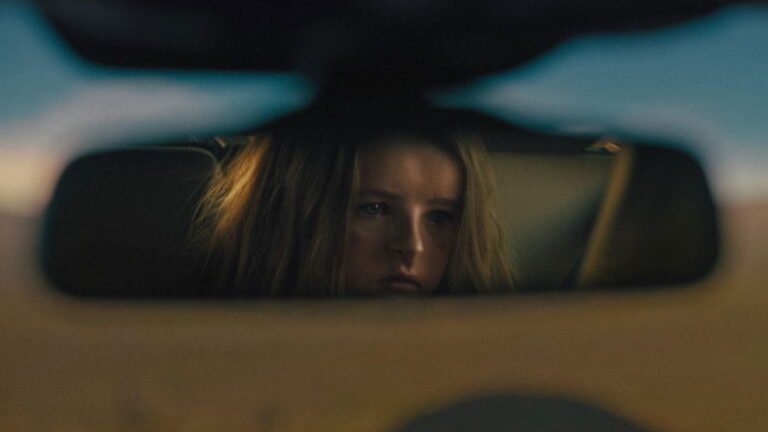
Lawrence Jacomelli’s Blood Star (2024) is a recent independent desert-road psychological survival thriller. A young woman driving alone (Britni Camacho) is targeted by a sheriff (John Schwab) on an empty highway, and the film tightens the situation gradually rather than through jump scares. Its atmospheric approach sits closer to Duel or Blue Ruin than to glossier modern horror: harsh desert light, long distances and silence do much of the work, which is what connects it to the slow-burn films on this list. See also our guide to movies like Blood Star.
Where to leave it
What ties all of these together isn’t gore or shock — it’s mood. They trust you to sit in discomfort, to notice the wrongness building at the edges, to let a feeling do the work a scream usually does. That’s the whole appeal of slow-burn horror: the film doesn’t end when the credits roll.
Watch Blood Star Free
If you like films such as It Follows and Caddo Lake, discover Blood Star, the psychological desert thriller directed by Lawrence Jacomelli.
Now streaming free with ads in the USA.


See every legitimate way to watch Blood Star free in the USA →
Related guides
- Movies Like It Follows: Dread-Soaked Slow-Burn Horror
- Movies Like Caddo Lake: Eerie Backwater Mysteries
- The Best Slow-Burn Survival Horror Movies
More on Blood Star
- Watch Blood Star free on Tubi & Prime Video (USA)
- Blood Star: Ending Explained
- Blood Star — Cast & Filmmakers