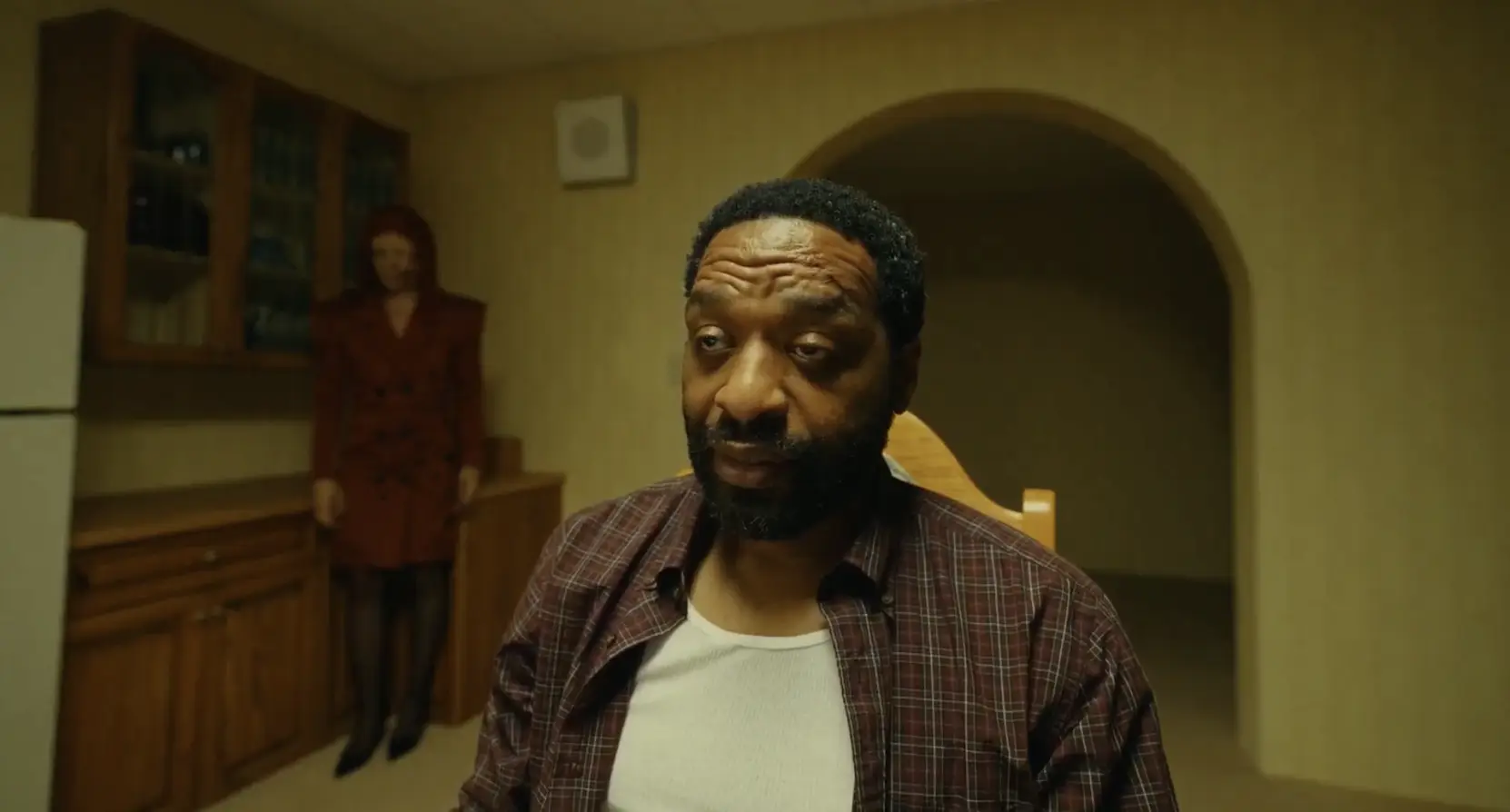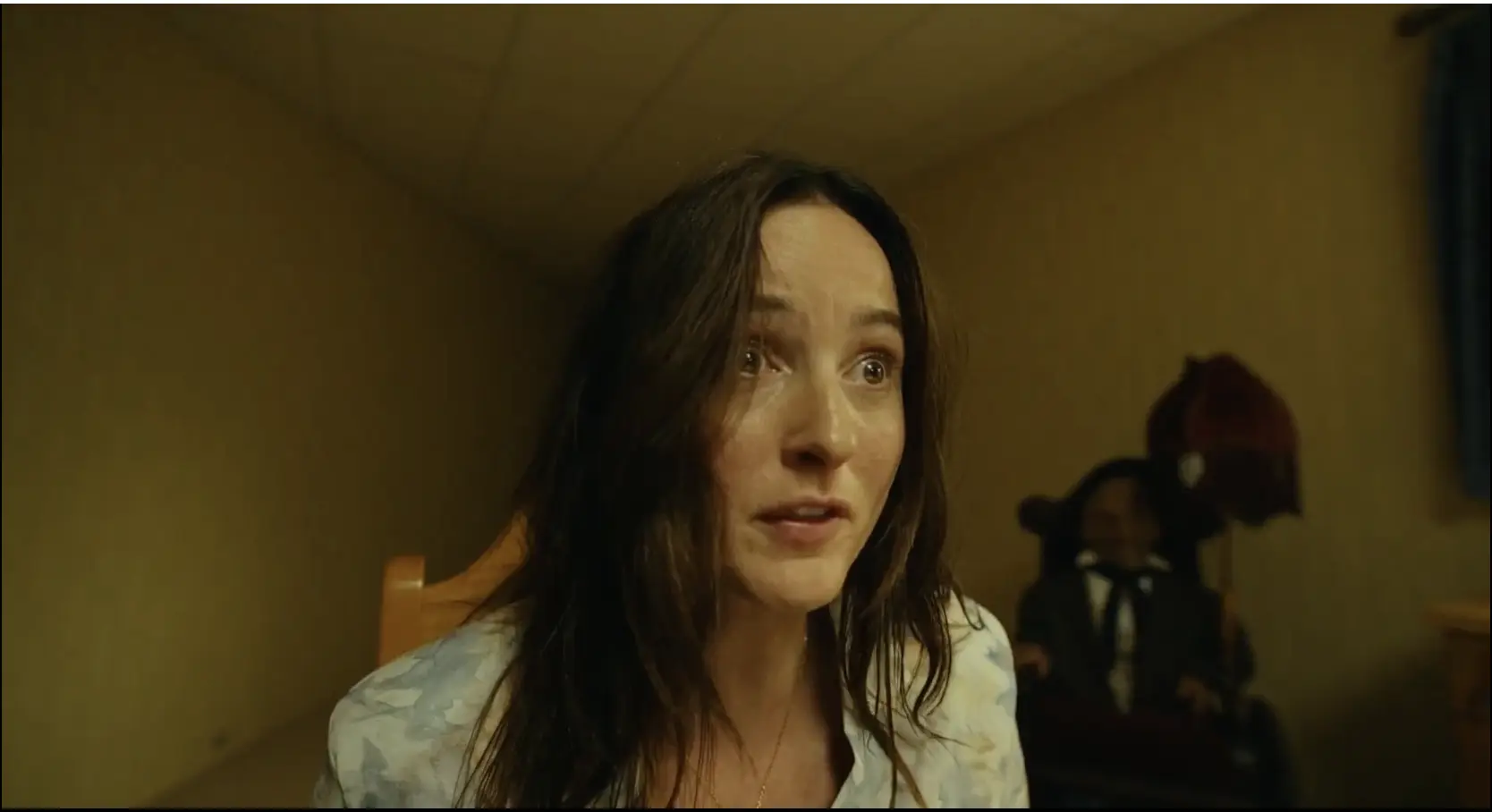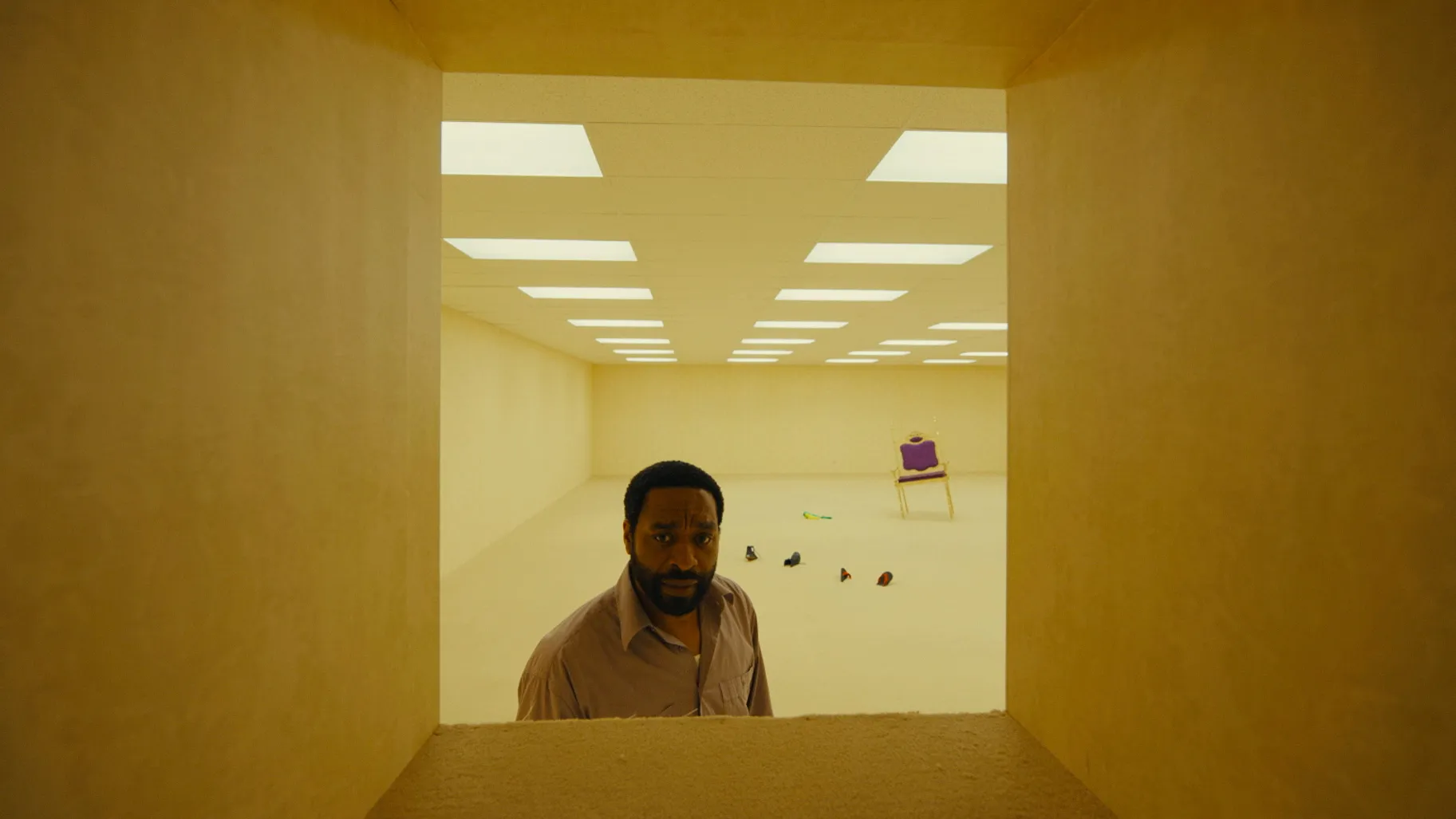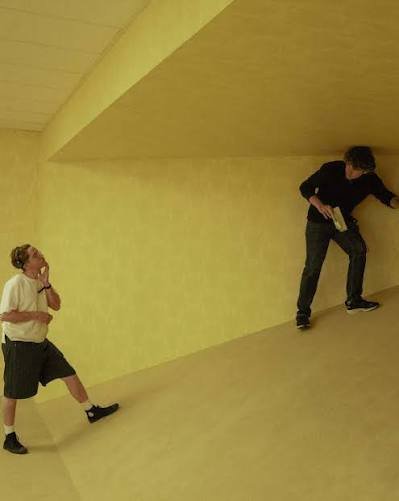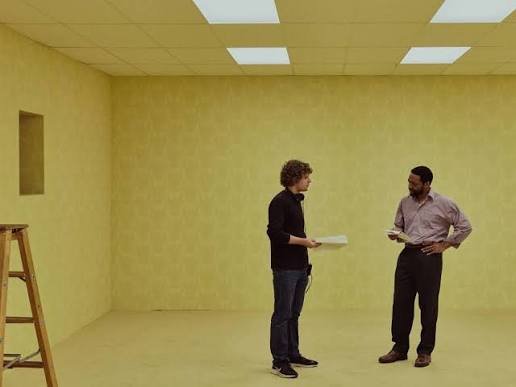
All Posts By

Victoria Taylor

Blood Star Ending Explained: How Bobbi Outsmarts the Sheriff

Quick Answer

Bobbi Torres survives Sheriff Bilstein’s ritualised murder game by faking her own suicide, then kills both Bilstein and Ed, retrieves the previous victims’ driving licences, and drives toward the city lights. Her escape is as psychological as it is physical: she rejects both the sheriff’s physical control and her boyfriend Rhett’s emotional control, refusing to remain the predictable victim either man expects.

Spoiler Warning

Warning: This article contains full spoilers for Blood Star.

Key Takeaways

  • Bobbi survives Sheriff Bilstein’s ritual by faking her suicide, then kills both Bilstein and Ed and drives toward the city.
  • Her escape is physical and psychological — she rejects Bilstein’s physical control and her boyfriend Rhett’s emotional control in the same sequence.
  • The jawbone knife, made from Bilstein’s mother’s bone, becomes the instrument Bobbi uses to turn his own history against him.
  • Bobbi returns to the scrapyard to retrieve her severed tongue and the driving licences of the sheriff’s previous victims — turning trophies into evidence.
  • The ending is hopeful but not conventionally happy: Bobbi survives transformed and damaged, not restored to who she was before.
A car's headlights cutting through total darkness on an empty desert road at night
An isolated highway at night, where the person who should represent law and order becomes the greatest threat.

What Happens at the End of Blood Star?

At the end of Blood Star, Bobbi Torres survives Sheriff Bilstein’s ritualised attempt to murder her, turns the rules of his own game against him, kills both the sheriff and Ed, retrieves evidence connected to their previous victims and drives towards the distant city lights.

Her escape is physical, but it is also psychological. Throughout the film, Bobbi is caught between controlling men. Sheriff Bilstein uses his badge, weapons and knowledge of the desert to dominate women travelling alone. Bobbi’s boyfriend, Rhett, attempts to control her through jealousy, suspicion and emotional abuse. Even before the sheriff begins hunting her, Bobbi is already travelling back towards a relationship she knows is destructive.

The ending forces Bobbi to confront both forms of control. She does not survive because someone arrives to rescue her. She survives because she stops accepting the roles that other people have created for her. She refuses to remain a victim inside the sheriff’s game, uses his arrogance against him and finally rejects Rhett by throwing away the phone through which he continues trying to reach her.

The final drive towards the lights therefore means more than escaping the desert. It represents Bobbi choosing an unknown future rather than returning to a familiar form of abuse.

What Is Sheriff Bilstein’s Ritual?

Sheriff Bilstein does not simply murder women. He forces them to participate in a ritual that allows him to control the exact circumstances of their deaths.

First, he cuts out the victim’s tongue. This is both an act of torture and a deliberate symbolic gesture. He removes her voice before releasing her into the desert, ensuring that she cannot easily call for help, identify him or tell anyone what he has done.

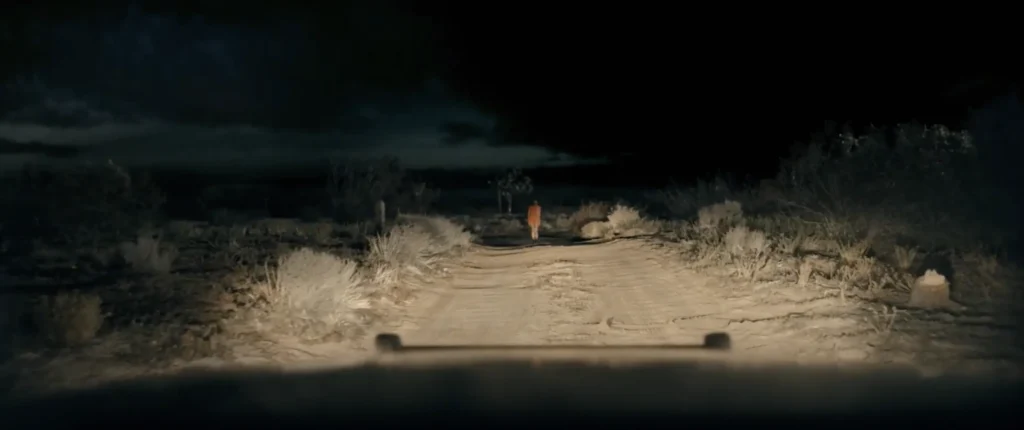
He then follows the woman in his police cruiser as she tries to escape across the desert. She is already injured, terrified and losing blood. Bilstein remains inside the vehicle, preserving his energy while tracking her until she becomes too exhausted to continue.
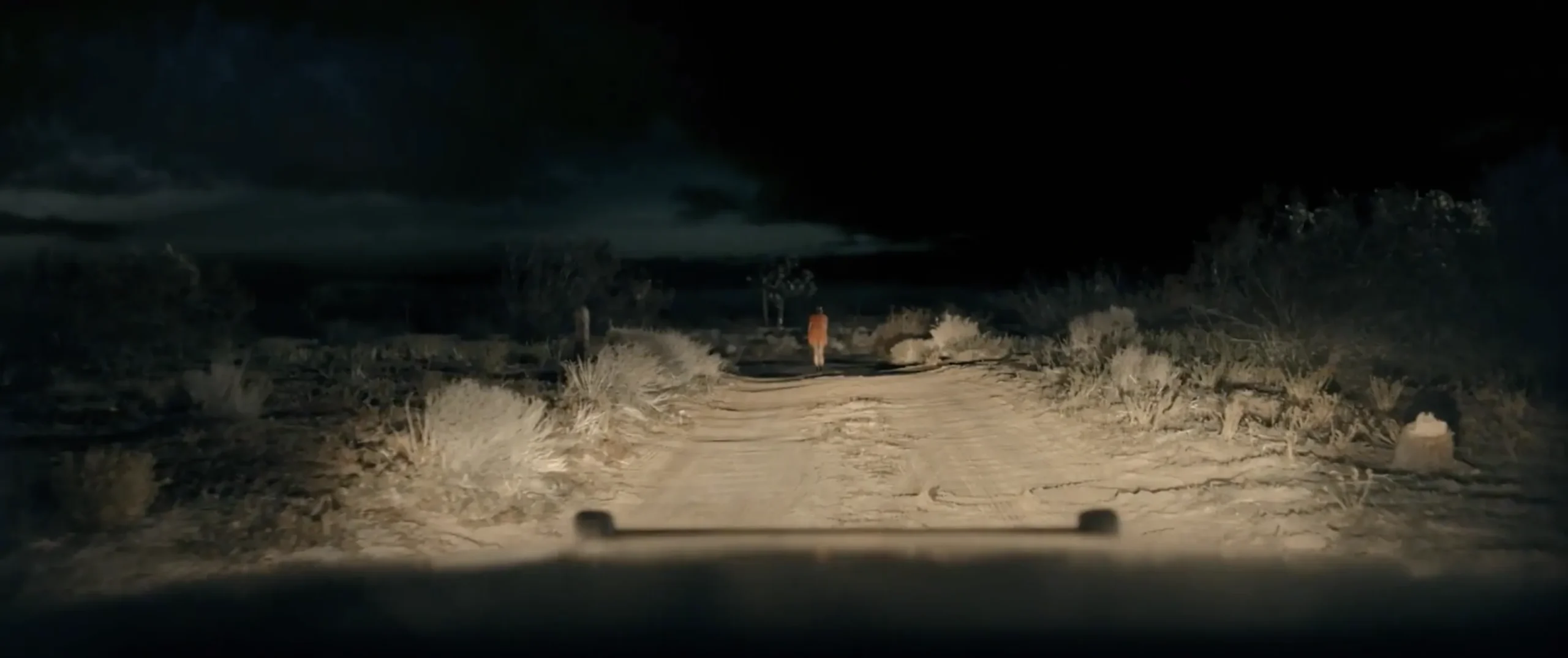
A dark desert road seen from behind a vehicle's headlights, with a lone figure walking in the distance
The ritual, seen from inside the cruiser: a lone figure caught in the headlights, with nowhere left to run.

When she finally collapses, he gives her a gun containing a single bullet. He then reverses his police cruiser into the darkness, turns around and drives directly towards her in a sick, distorted version of a duel.

The victim technically has an opportunity to shoot him, but Bilstein knows that the contest is almost impossible for her to win. She is exhausted, traumatised, injured and probably untrained with a firearm. She must hit either the sheriff or a fast-moving vehicle at night while being blinded by its headlights.

Bilstein presents this as a choice, but it is not a fair one. The one bullet simply allows him to pretend that his victims were given a chance. In reality, he has engineered every detail to ensure that he remains in control.

The opening of Blood Star shows another young woman being subjected to the same ritual. By repeating it with Bobbi, the ending reveals that this is not an impulsive act. Bilstein has performed the game before and expects it to produce the same result every time.
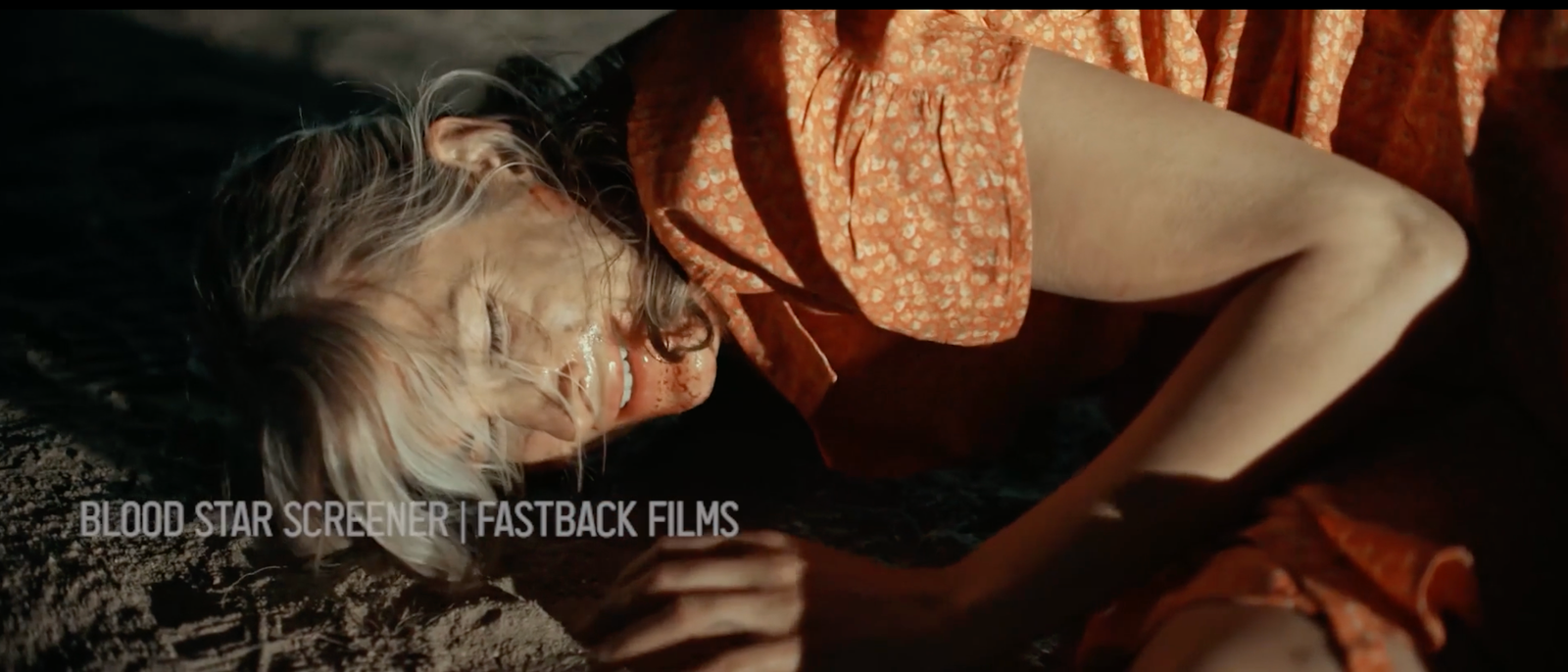
The unnamed woman from Blood Star's cold open, lying face down in the desert, playing dead in the same ritual Bilstein later repeats with Bobbi
The film’s cold open: an earlier victim, subjected to the exact same ritual — and this time, it isn’t a trick.

His ritual is an extension of the way he abuses his authority throughout the film. He continually offers Bobbi choices that are not genuine choices. He accuses her of damaging his police vehicle, demands money, confiscates her possessions and uses his badge to make resistance appear criminal. The desert duel is simply the purest and most violent expression of that mentality.

Bilstein wants his victim to understand that even the manner of her death belongs to him.

From the reviewOn Sheriff Bilstein's ritual

How Does Bobbi Outsmart the Sheriff?

Bobbi defeats Sheriff Bilstein by understanding the rules of his ritual and then refusing to follow them.

When Bilstein gives her the gun and single bullet, he expects her to behave like his previous victims. She can fire at him and almost certainly miss, freeze in terror and be run down, or use the bullet on herself. Whatever she chooses, Bilstein believes he controls the result.
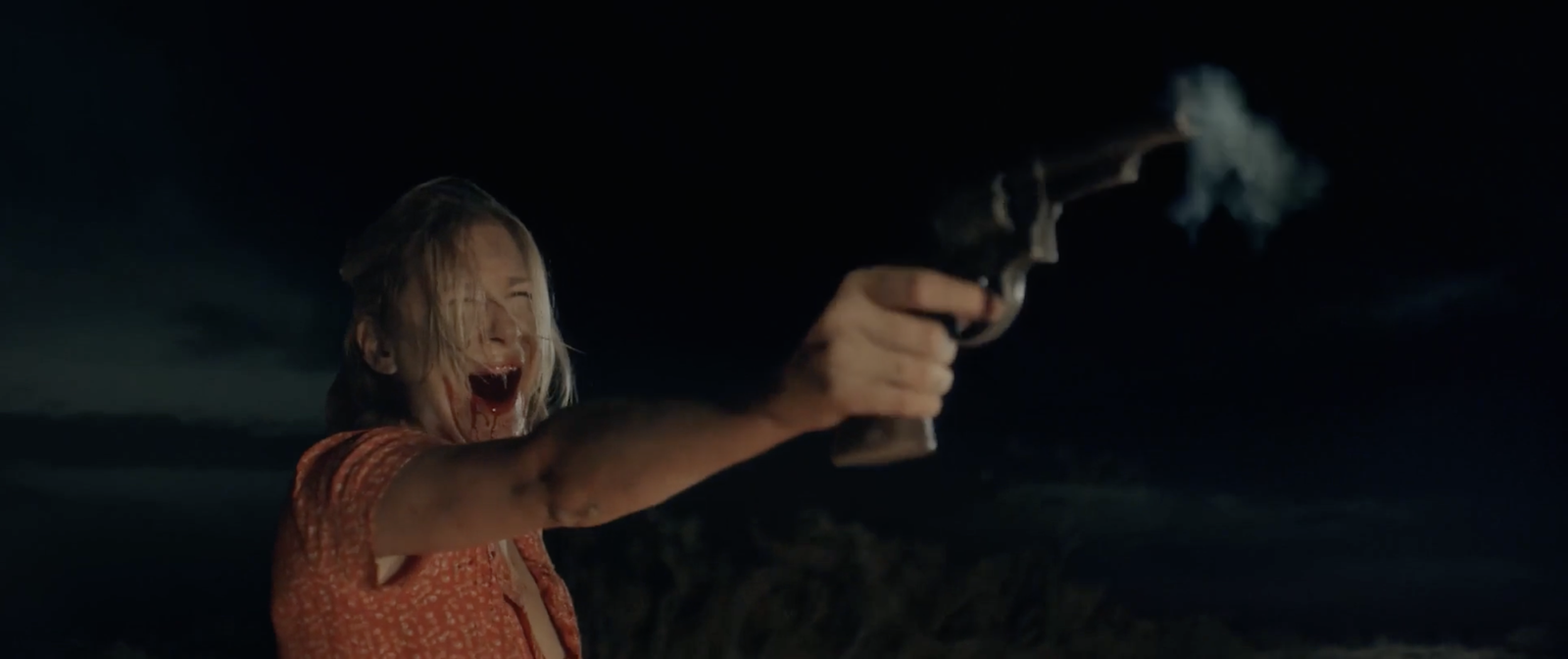
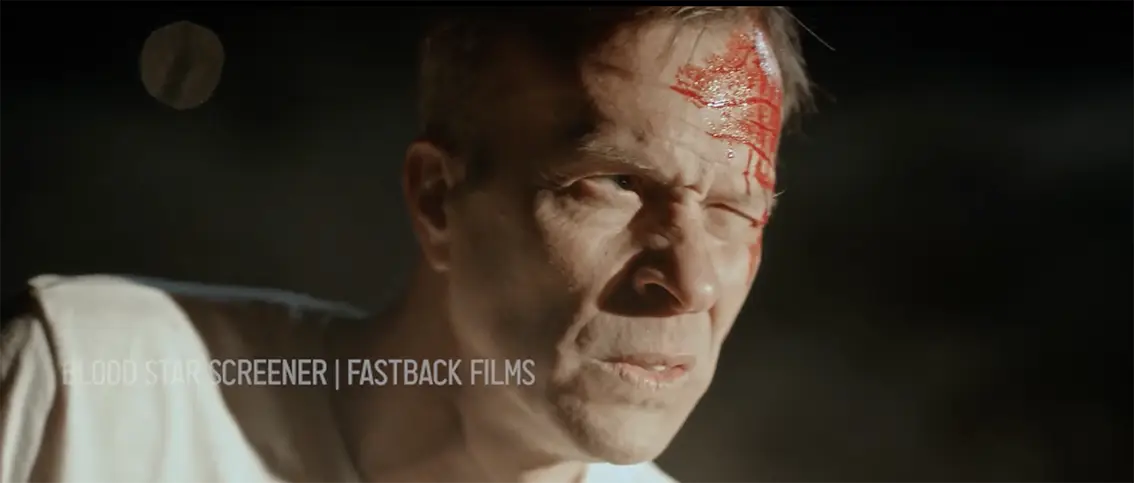
The cold-open victim firing the revolver in Blood Star, blood on her face, a real shot rather than a trick
The earlier victim fires the same single bullet for real — the desperate, losing move Bilstein expects every time.

Bobbi realises that she cannot defeat him by accepting this false choice. Instead, she creates a new option that the sheriff has not anticipated.
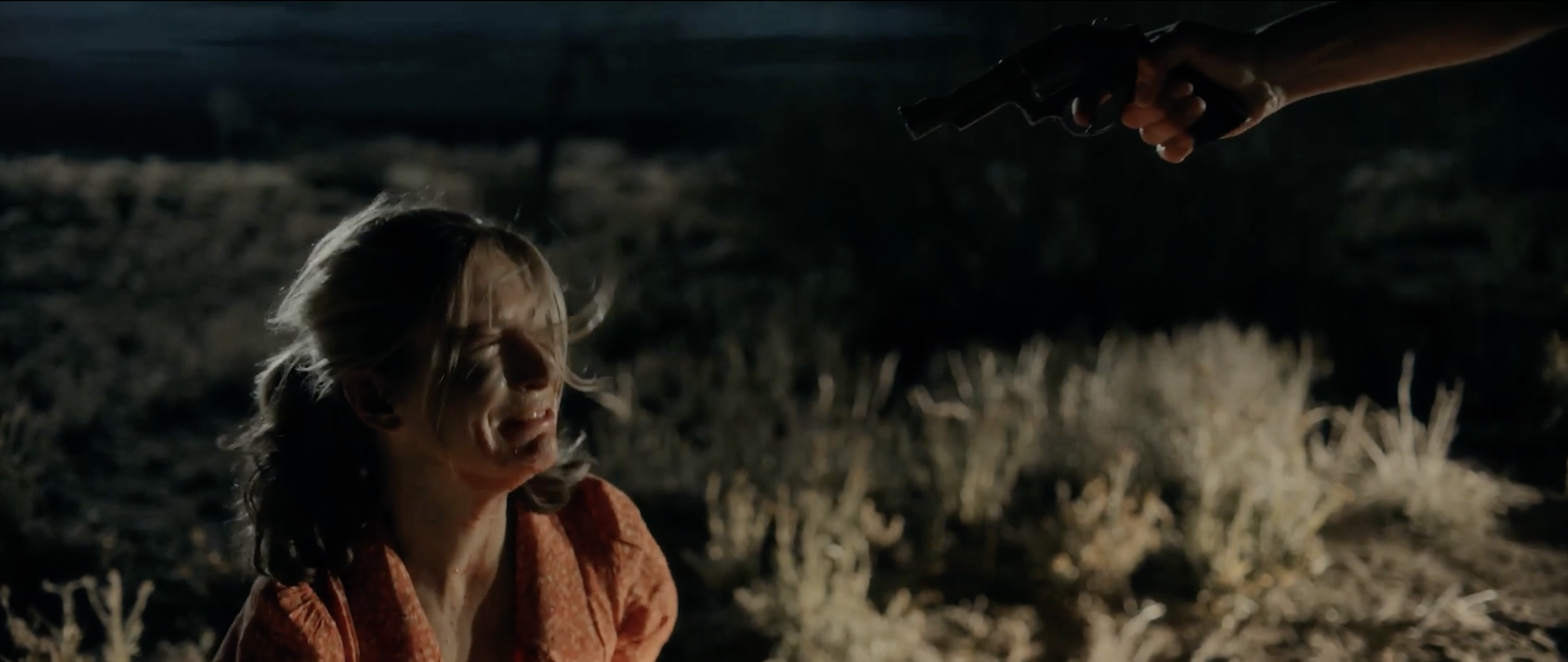
A revolver held out toward a bloodied young woman kneeling in the dark desert, Blood Star's opening ritual
The same ritual, offered as if it were a choice: a single bullet in the dark. Bilstein already knows how it ends — until Bobbi refuses to play her assigned part.

After Bilstein drops the gun and bullet beside her, Bobbi removes the gauze covering the wound where he severed her tongue. Blood begins to gather inside her mouth. She then forces herself to stand and faces the sheriff’s approaching cruiser.

Rather than pointing the gun at the vehicle, Bobbi places it against her own head.

This changes the dynamic immediately. Until this moment, Bilstein has been directing the ritual. He determines where Bobbi stands, when the chase begins and how the final confrontation will occur. By apparently choosing to kill herself, Bobbi takes control of the scene and begins dictating its outcome.

The sheriff looks on, stunned. Bobbi pulls the trigger, the gun fires and her head appears to explode. She collapses to the ground as blood spills from her mouth. To Bilstein, and ideally to the audience watching the film for the first time, Bobbi appears to have killed herself.

But the suicide is an illusion.

At the exact moment she fires the gun away from her head, Bobbi spits out the blood that has collected in her mouth. The sound and muzzle flash of the gun, combined with the sudden spray of blood and the speed of her collapse, create the impression that she has suffered a fatal head wound.

Bobbi then remains completely still and plays dead.

Her plan works because she understands the sheriff’s psychology. Bilstein is arrogant and certain that he knows how frightened women will behave. He assumes Bobbi has chosen suicide rather than face him. He cannot imagine that she might be performing for him because, in his mind, he is the person controlling the performance.

However, he still needs to confirm his victory. When he approaches Bobbi’s body and searches for the head wound that should be there, she suddenly attacks him with the knife made from his mother’s jawbone.
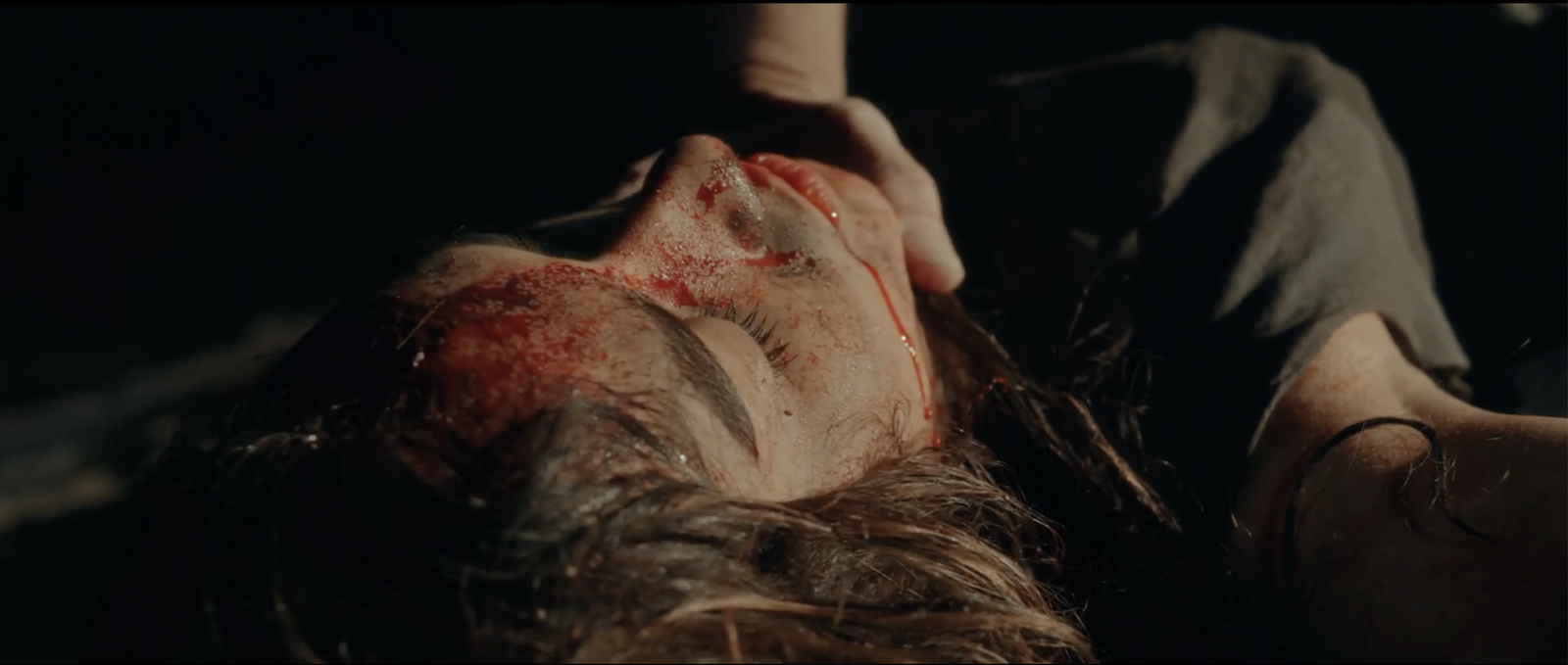
Sheriff Bilstein's hand cradling Bobbi's blood-streaked face, searching for the head wound that isn't there
The moment his certainty becomes his mistake — he leans in to confirm a wound that was never real.

Bobbi does not defeat Bilstein through superior strength, better marksmanship or physical power. She defeats him by recognising the weakness within his ritual. The sheriff is so convinced of his own control that he never considers the possibility that his victim is deceiving him.

The scene was deliberately designed not to reveal Bobbi’s trick as it happens. The audience is meant to believe wholeheartedly that she is dead. Showing her angle the gun away or deliberately fill her mouth with blood would weaken the effect because the viewer would simply wait for the deception to be revealed.

Instead, the audience experiences the moment in the same way as the sheriff. First, they believe Bobbi has died. Then, as Bilstein searches for the wound and cannot find it, the clues fall into place: the removed gauze, the blood in her mouth, the direction of the shot and the absence of an injury to her head.

The storytelling principle is similar to the climactic exchange in Deliverance. During the confrontation, Ed fires an arrow at the armed mountain man but falls backwards and impales himself on one of his own arrows. On a first viewing, the action happens so quickly that the exact cause and effect may not be immediately clear. When the mountain man staggers forward with Ed’s arrow in him, the viewer understands that Ed successfully hit his target while injuring himself in the fall.

If the sequence is watched again, the geography and mechanics make sense because the necessary information was always present. The film does not stop to explain the action in advance; it allows the audience to reconstruct it after the surprise.

Bobbi’s fake suicide works in the same way. The trick is concealed emotionally rather than dishonestly. Everything required to understand it is shown, but the audience is encouraged to interpret the evidence incorrectly until Bobbi reveals that she is still alive.

The sheriff believes he has witnessed Bobbi’s final act of despair. In reality, he has witnessed the moment she takes control of his game.

Does Bobbi Really Shoot Herself?

No. Bobbi only creates the illusion that she has shot herself.
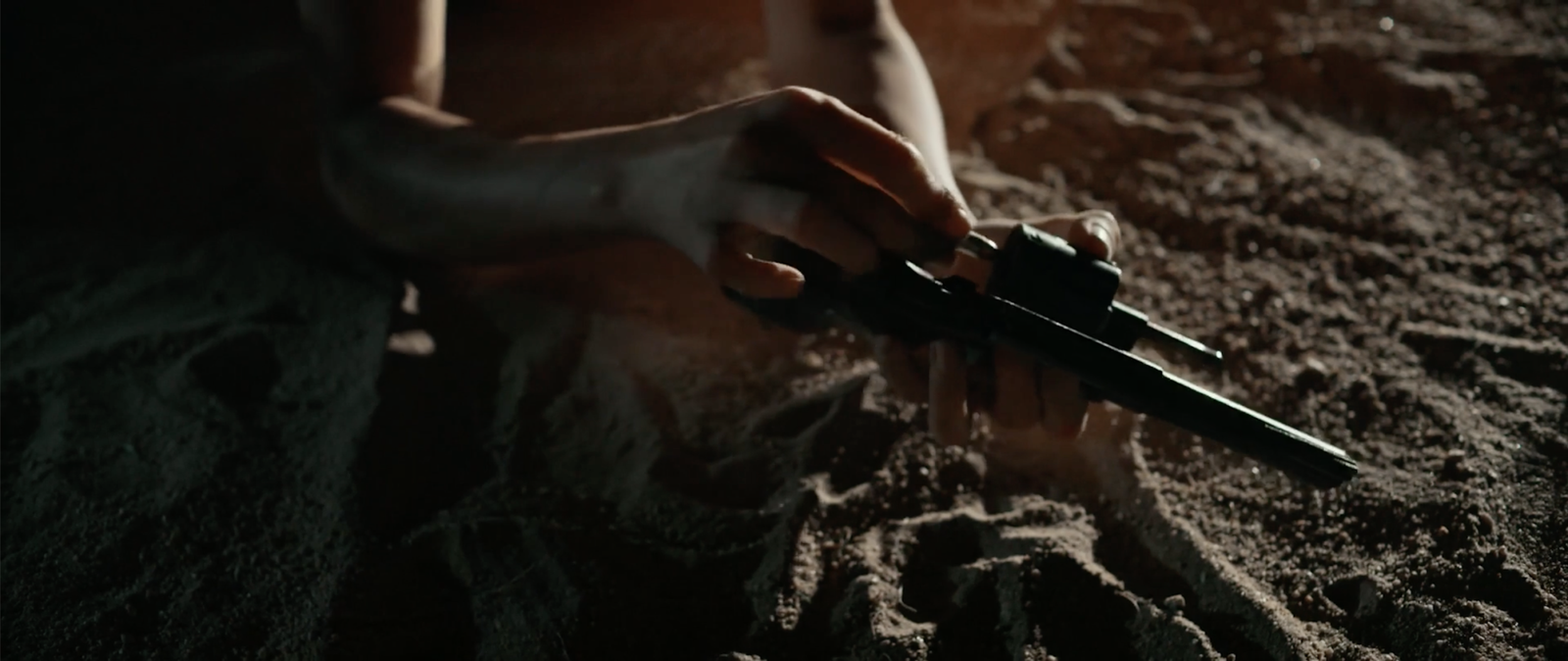
Close-up of hands loading a revolver in the dark desert sand at night
The illusion depends entirely on blood, sound and timing — the mechanics of Bilstein’s ritual, turned back against him.

She tears away the gauze covering the wound in her mouth, allowing blood to collect there. She then places the gun near her head but fires without allowing the bullet to strike her. At the moment the weapon discharges, she spits out the blood and collapses.
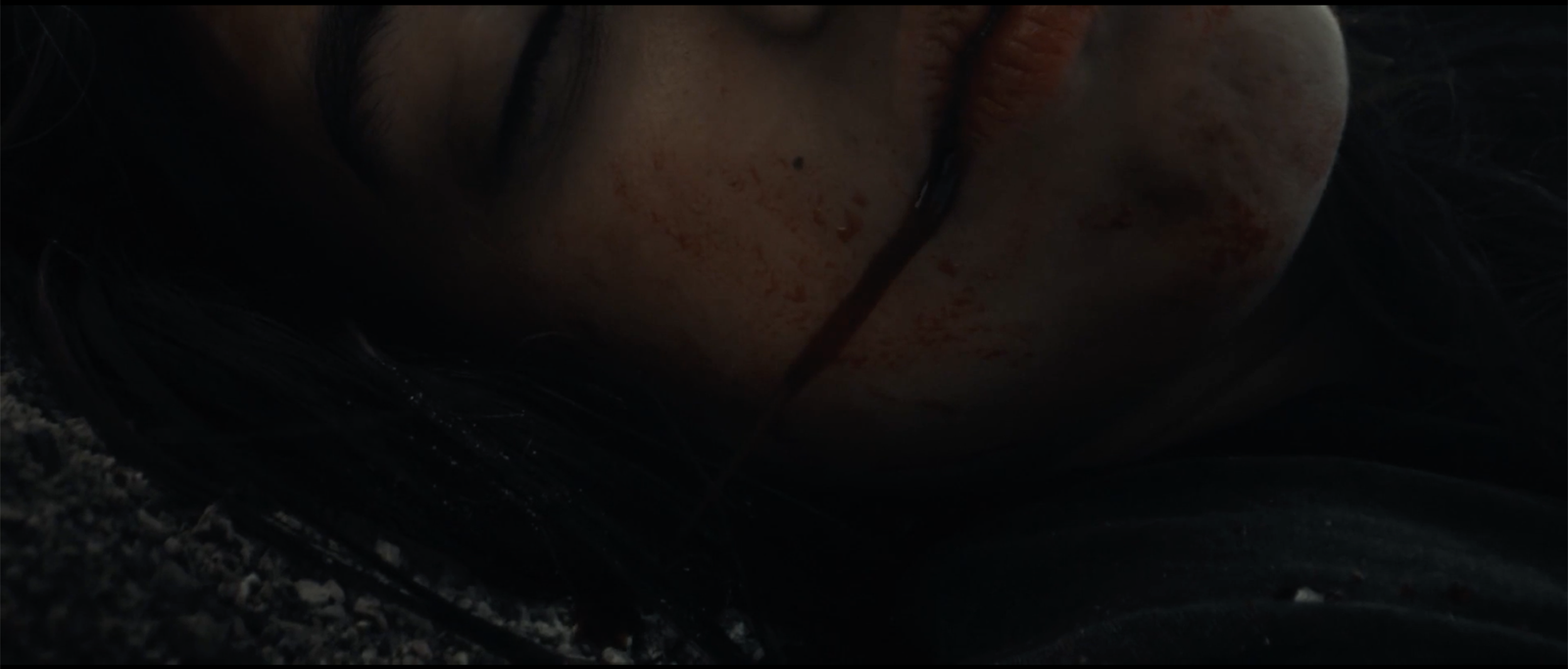
Extreme close-up of Bobbi's blood-streaked face, eyes closed, playing dead in Blood Star
No actual wound — just blood, stillness and timing convincing enough to fool the man staring right at her.

The combined sound, flash, movement and blood make the apparent suicide convincing. Because the sequence happens quickly and the audience knows the gun contains only one bullet, there is little reason to question what appears to have happened.

Bilstein is convinced for the same reason. He believes Bobbi has used the only bullet and is therefore no longer a threat. His need to inspect the body brings him within reach of her concealed weapon.

The missing wound is what finally exposes the deception. By the time the sheriff understands what Bobbi has done, he is already close enough for her to attack.

What Is the Jawbone Knife?

The knife Bobbi uses against Sheriff Bilstein is made from the jawbone of his mother.

Earlier in the film, Bilstein reveals the object while discussing his family history. The jawbone is both a practical weapon and a physical representation of his obsession with violence, humiliation and inherited trauma.
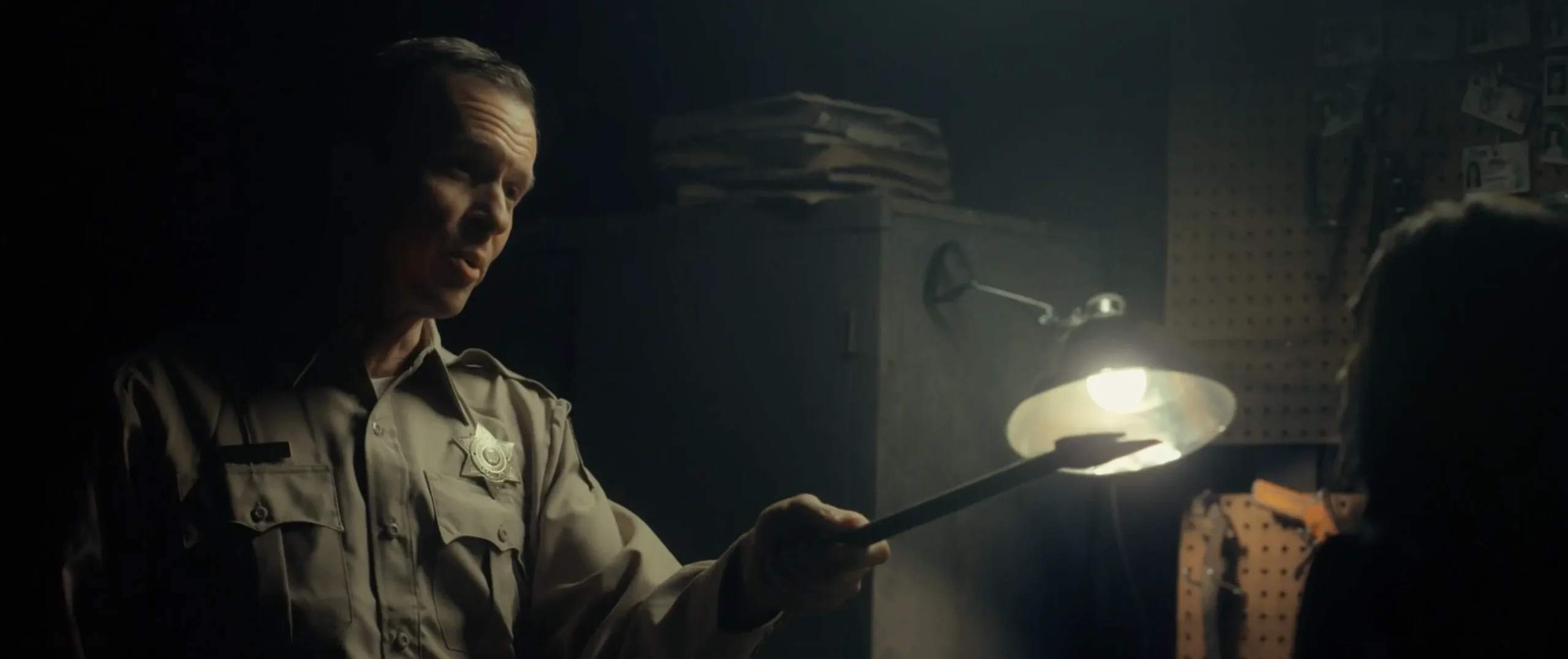
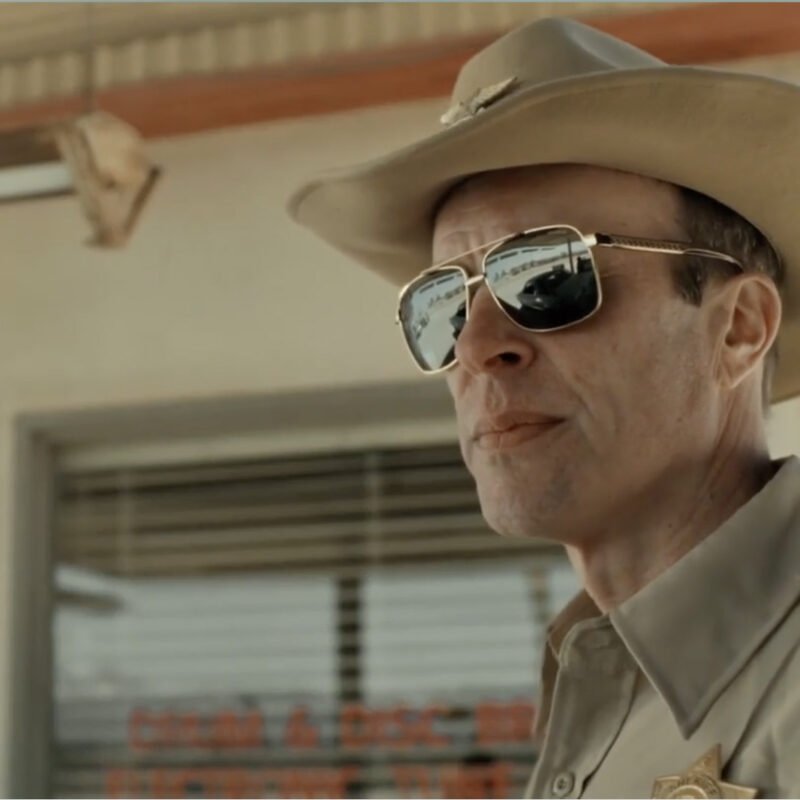
Sheriff Bilstein indoors near a workbench lamp, badge visible on his uniform
Bilstein turns his family history into a private mythology of violence — and a weapon.

Bilstein speaks about his past as though it explains the person he has become. He uses stories about his mother, abuse and Ed’s birth to construct a mythology around himself. However, the film does not suggest that suffering removes personal responsibility.

Bilstein has chosen to turn his history into a system of violence against other people. He preserves part of his mother’s body as a weapon and uses his trauma to justify domination rather than confronting what it has done to him.

When Bobbi takes the jawbone knife, the object changes meaning. It is no longer Bilstein’s private symbol of power. It becomes the instrument through which one of his intended victims resists him.

That reversal matters because Bobbi has spent much of the film having objects taken away from her. The sheriff confiscates her phone and driving licence. He damages her car and controls her ability to travel. He uses official equipment, weapons and documents to restrict her choices.

The jawbone knife is different. Bobbi takes possession of something central to Bilstein’s identity and turns it against him.

How Does Bobbi Escape Sheriff Bilstein?

After stabbing Bilstein, Bobbi takes control of his police cruiser. However, the confrontation is not yet over. The sheriff still has the vehicle’s keys and manages to reassert control temporarily.
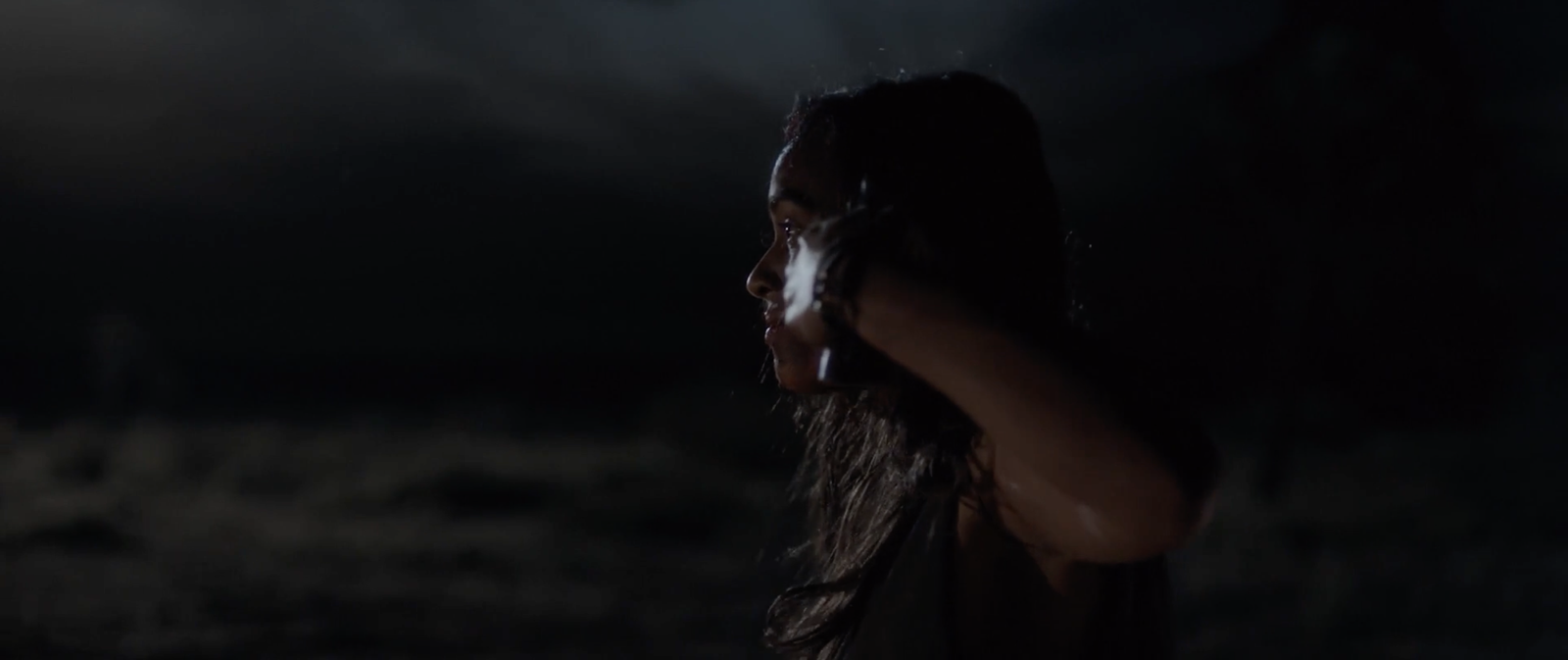
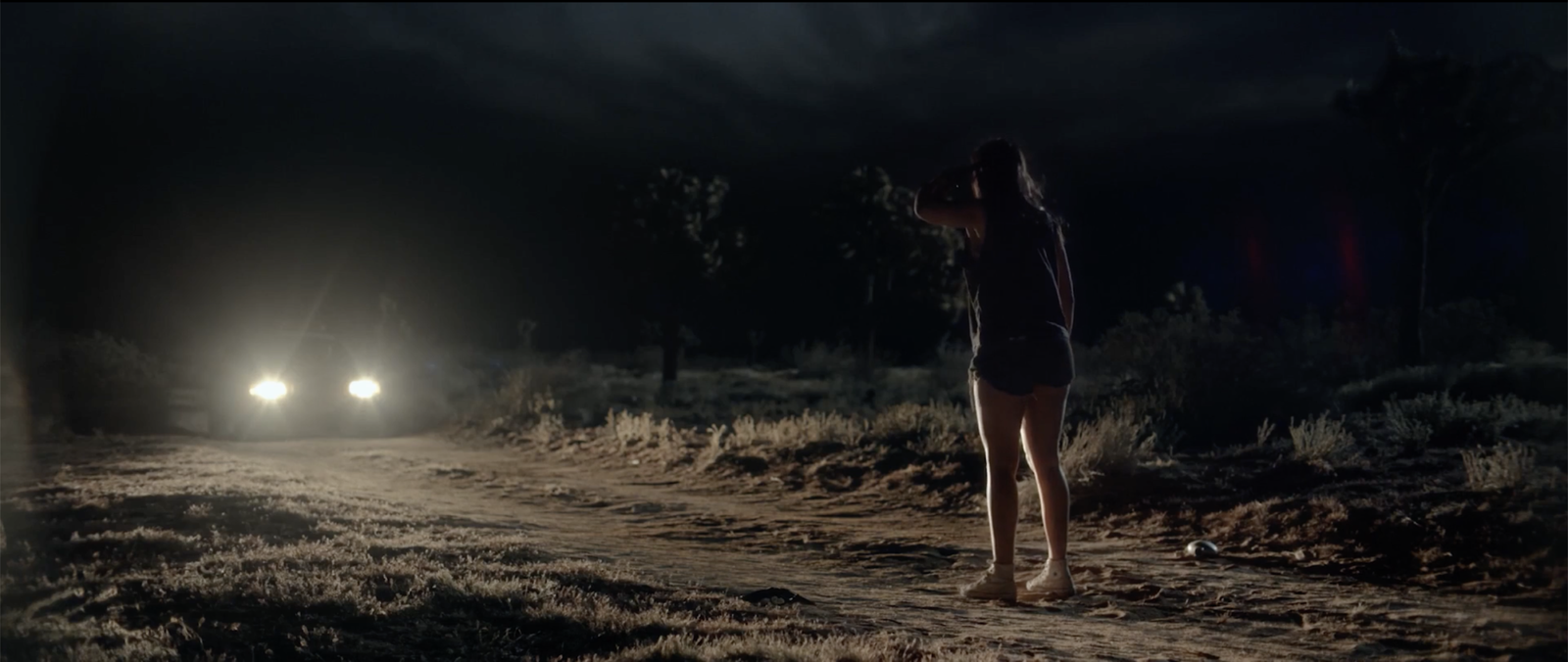
A woman walking toward a car's headlights on a dark desert road at night
Every earlier escape attempt is blocked, corrupted or turned against her — until this one.

Bobbi then removes the magazine from his holstered firearm and attacks him with a rock before escaping once again. The missing ammunition becomes crucial during the final confrontation.
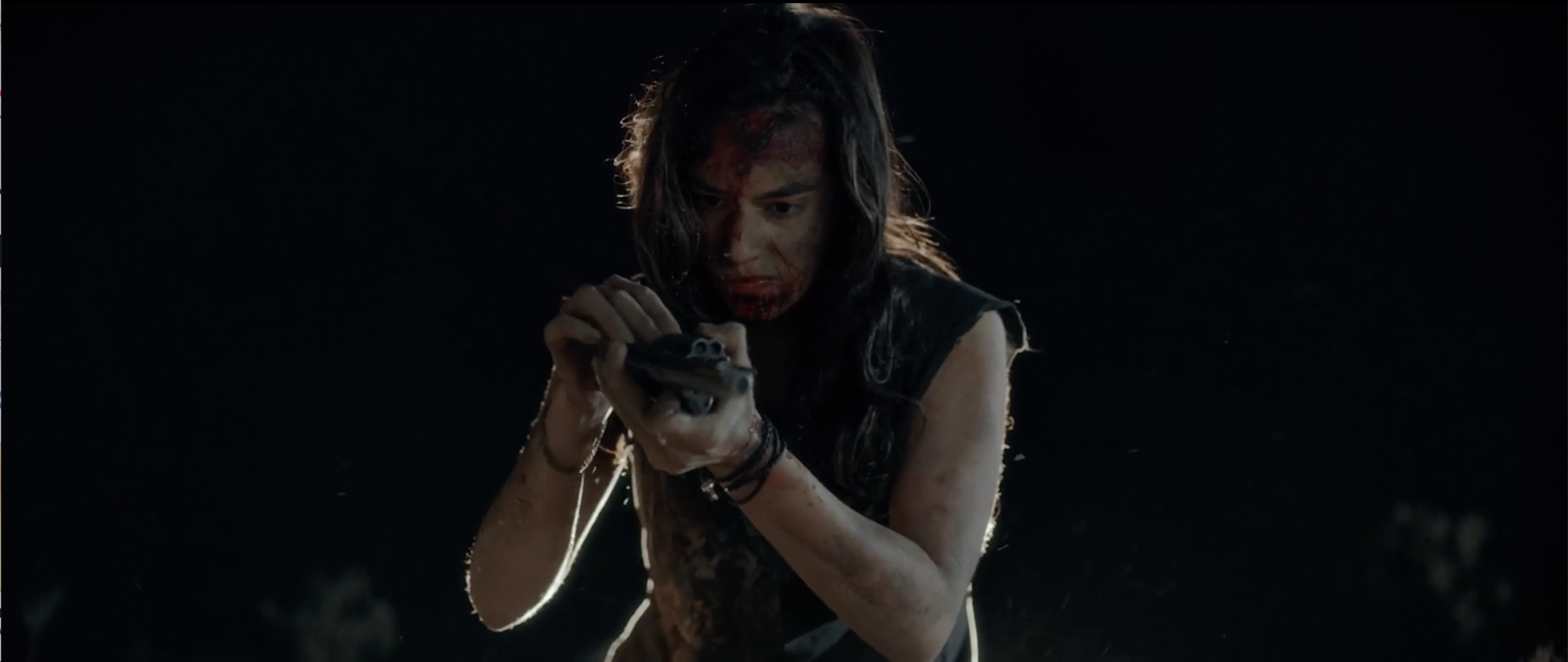
Bobbi examining Sheriff Bilstein's revolver with both hands, blood on her face
The gun that will fail Bilstein at the exact moment he needs it — already in Bobbi’s hands.

As Bobbi drives the police cruiser towards him, Bilstein stands in the road and aims his gun. He believes the firearm gives him the final advantage, just as his badge, uniform and cruiser have given him power throughout the film.

He pulls the trigger, but the gun is empty.

Bobbi has already removed the magazine.

By the time Bilstein realises what she has done, it is too late. Bobbi drives directly towards him and runs him down with his own police vehicle.

This is a deliberate reversal of the film’s opening. At the beginning, Bilstein uses the cruiser to kill another vulnerable woman during the same ritual. At the end, the intended victim is behind the wheel and the sheriff is standing helplessly in the road.

Bilstein has repeatedly used vehicles as weapons and symbols of authority. His police cruiser allows him to dominate the highway, pursue women, appear legitimate and conceal his crimes behind the image of law enforcement.

When Bobbi takes the cruiser, she takes possession of the film’s central instrument of power. The hunter is now on foot, while the intended victim controls the vehicle.

Is Sheriff Bilstein Definitely Dead?

The ending strongly indicates that Sheriff Bilstein is killed when Bobbi strikes him with the police cruiser.
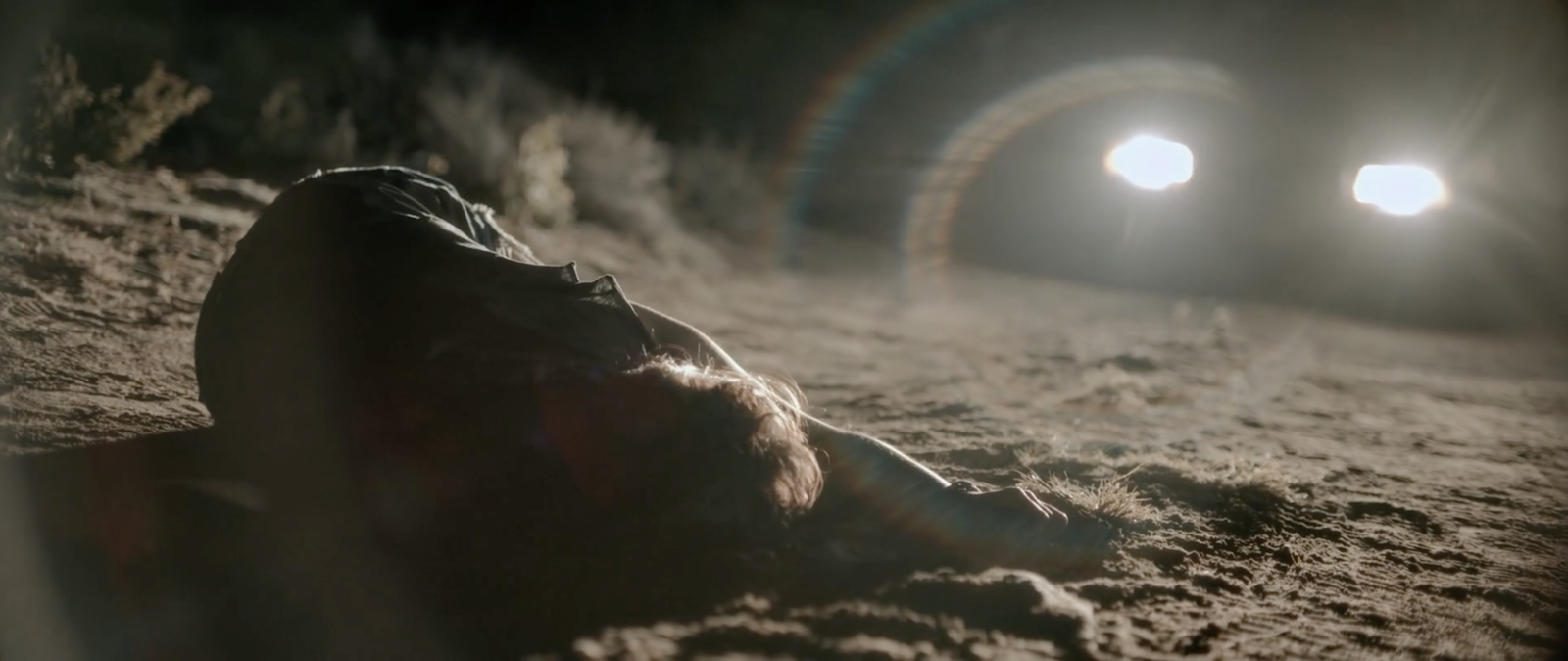
A body lying in the dark desert as a vehicle's headlights approach, Blood Star's opening ritual
The same staging as the opening ritual: headlights closing in on a body in the road — this time reversed.

The sequence is presented as the final defeat of the film’s central antagonist rather than as an ambiguous escape. Bobbi has already stabbed him with the jawbone knife and attacked him with a rock. When he tries to shoot her, he discovers that she has removed the magazine from his gun. She then drives into him at speed.

Bilstein’s death completes the visual reversal established by the opening sequence. The film begins with his vehicle bearing down on a vulnerable woman. The climax recreates that image while exchanging the positions of victim and killer.

Bobbi does not merely get away from Bilstein. She breaks the pattern he established with his previous victims. The hunter is killed inside the ritual he believed he controlled.

Why Does Bobbi Return to the Scrapyard?

After defeating the sheriff, Bobbi does not immediately drive towards safety. Instead, she returns to the scrapyard.
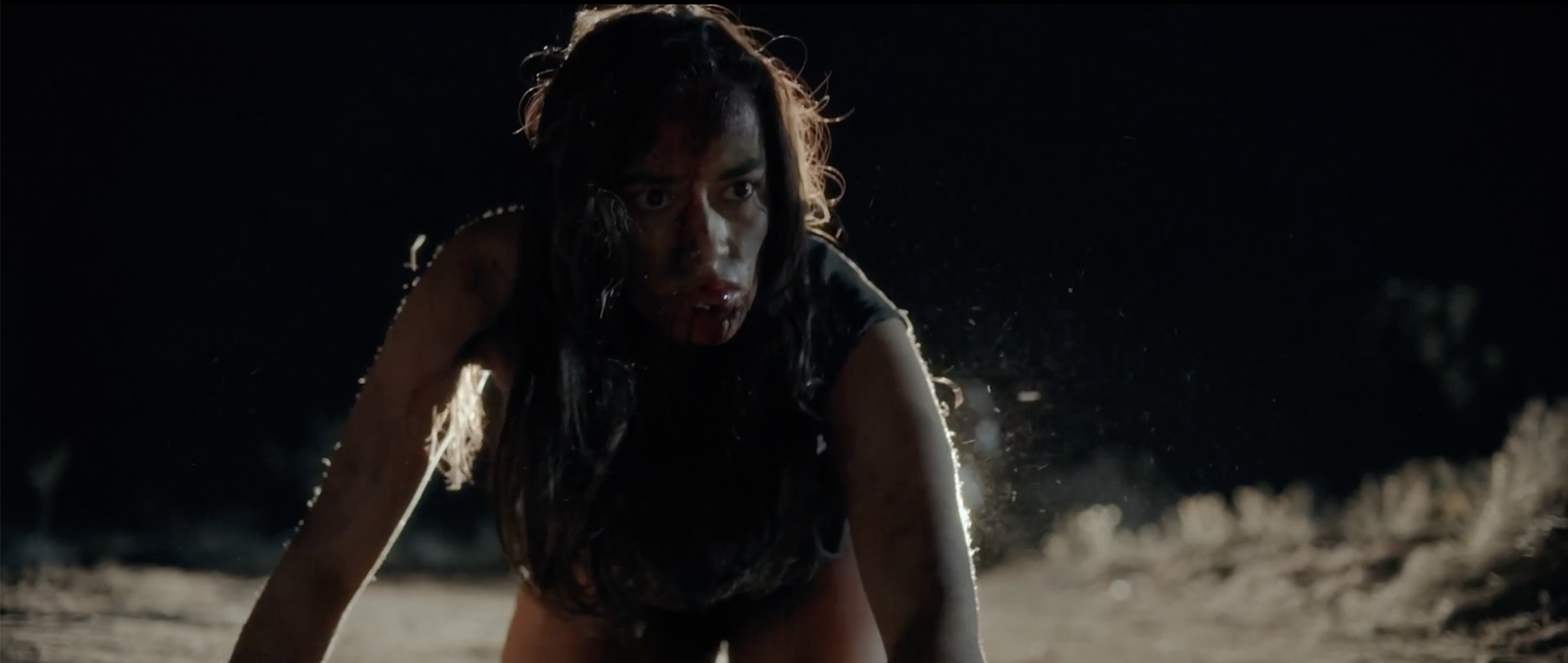
A bloodied woman crawling forward through the dark desert at night
She goes back — not to escape, but to reclaim what was taken from her and the sheriff’s other victims.

This appears dangerous, but she has two important reasons for going back. First, she retrieves her severed tongue and packs it in ice, preserving the possibility that surgeons may be able to reattach it. Second, she collects the driving licences belonging to Bilstein and Ed’s previous victims.

Both actions are about recovering what the sheriff attempted to erase.

The tongue is the most literal example. By mutilating Bobbi, Bilstein tries to remove her voice. The violence is not only physical; it is symbolic. He wants to make her unable to speak, accuse him or tell her version of events.

Retrieving her tongue represents Bobbi refusing to accept that erasure as permanent.

The driving licences perform a similar function on a wider scale. Bilstein and Ed have collected identification from their previous victims, reducing the murdered women to trophies. Bobbi takes those licences away from the killers.

They can now become evidence. The women can be identified, and their disappearances can potentially be connected to the men responsible.

Bobbi’s return to the scrapyard therefore transforms the ending from a simple escape into an act of exposure. She survives, but she also carries the identities of the dead women back towards the outside world.

Why Does Bobbi Kill Ed?

When Bobbi returns to the garage, Ed surprises her, and she kills him with a wrecking bar.
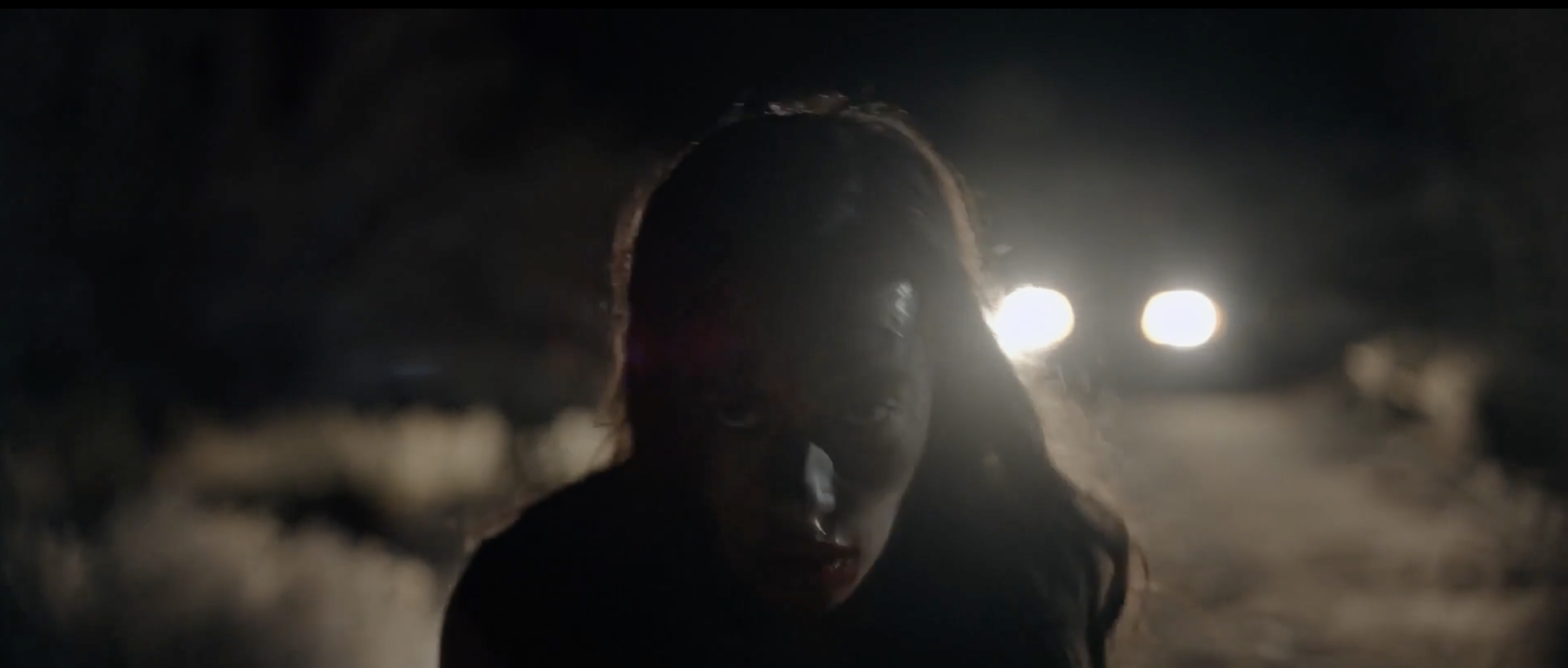
A woman's face lit by oncoming headlights in the dark desert night
Danger in Blood Star rarely announces itself — it simply appears out of the dark, the way Ed does at the scrapyard.

Ed occupies an unusual position in the story because he sometimes appears less controlled and less intellectually capable than the sheriff. At moments, he can seem like another person trapped inside Bilstein’s violent family system.

However, Ed is also an active participant in Bobbi’s captivity and torture. He ambushes her, helps restrain her and assists the sheriff. Whatever power Bilstein holds over him, Ed remains part of the machinery through which women are abducted and murdered.

When Ed confronts Bobbi at the scrapyard, she is still in immediate danger. She cannot safely stop and calculate how much individual responsibility he carries. She reacts in order to survive.

His death also prevents Bilstein’s system from continuing through the surviving brother. Killing both men ends the immediate threat and destroys the private world they created together.

Why Does Bobbi Throw Away Her Phone?

One of the most important moments in the ending is also one of the quietest.
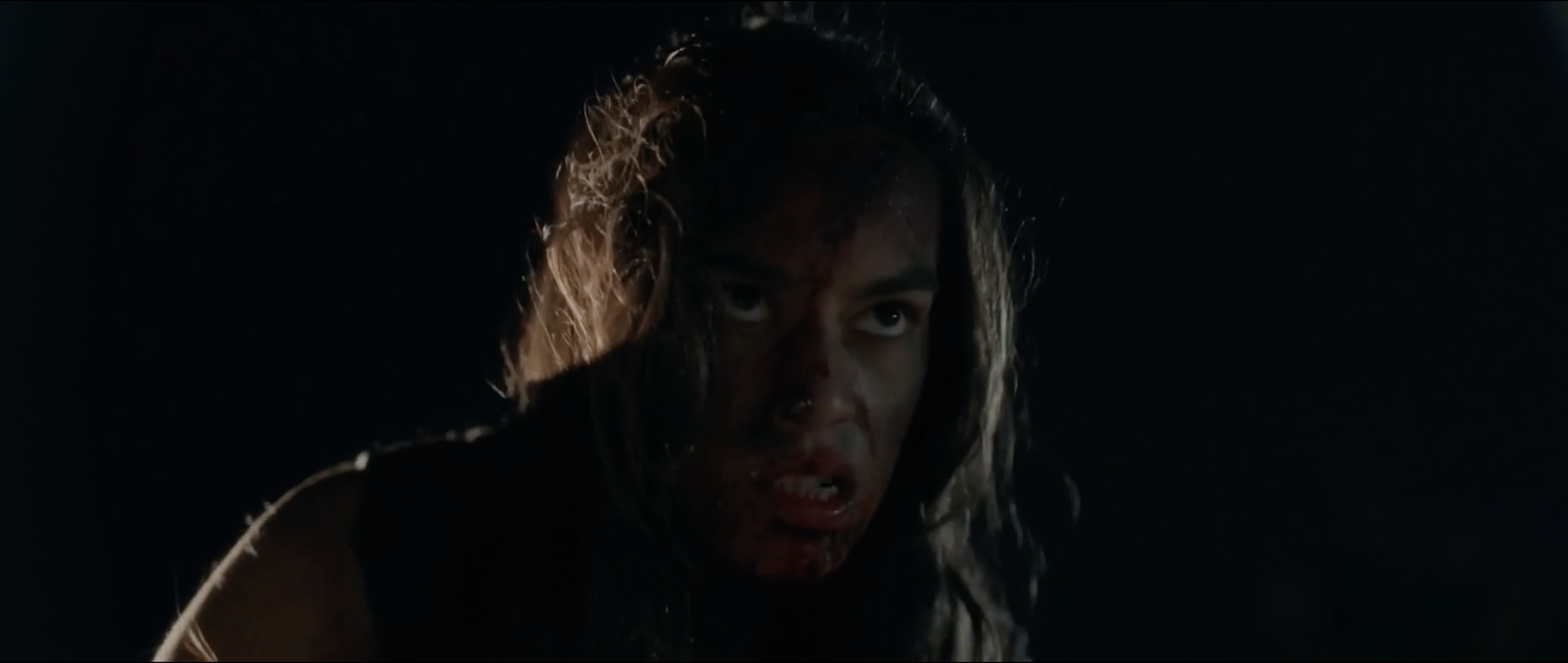
Extreme close-up of a woman's bloodied face in profile against total darkness
Rhett’s calls represent a different, quieter kind of control than Bilstein’s — and in this moment, Bobbi finally rejects both.

After surviving Bilstein and leaving the scrapyard, Bobbi receives another call from Rhett. She throws the phone away.

Throughout the film, Rhett represents another form of male control. His behaviour is different from Bilstein’s physical violence, but the underlying pattern is connected. Rhett is jealous, suspicious and emotionally manipulative. When Bobbi needs support, he responds by accusing her of having an affair with the sheriff instead of listening to what she is telling him.

At the beginning of the film, Bobbi is travelling back towards Rhett despite her sister Anna encouraging her to leave him. Her decision to discard the phone shows that surviving Bilstein has changed the direction of her life.

She is no longer simply trying to return to where she started.

If the film ended with Bobbi going back to Rhett, her physical escape would feel incomplete. She would have defeated one violent man only to return willingly to another controlling relationship.

Throwing away the phone breaks that connection. It also contrasts with the earlier moment when Bilstein confiscates the device and controls Bobbi’s ability to communicate. At the end, Bobbi decides for herself that the phone, and the man trying to reach her through it, will no longer determine where she goes.

What Do the City Lights Mean?

The final image shows Bobbi driving towards the city lights as dawn begins to break.
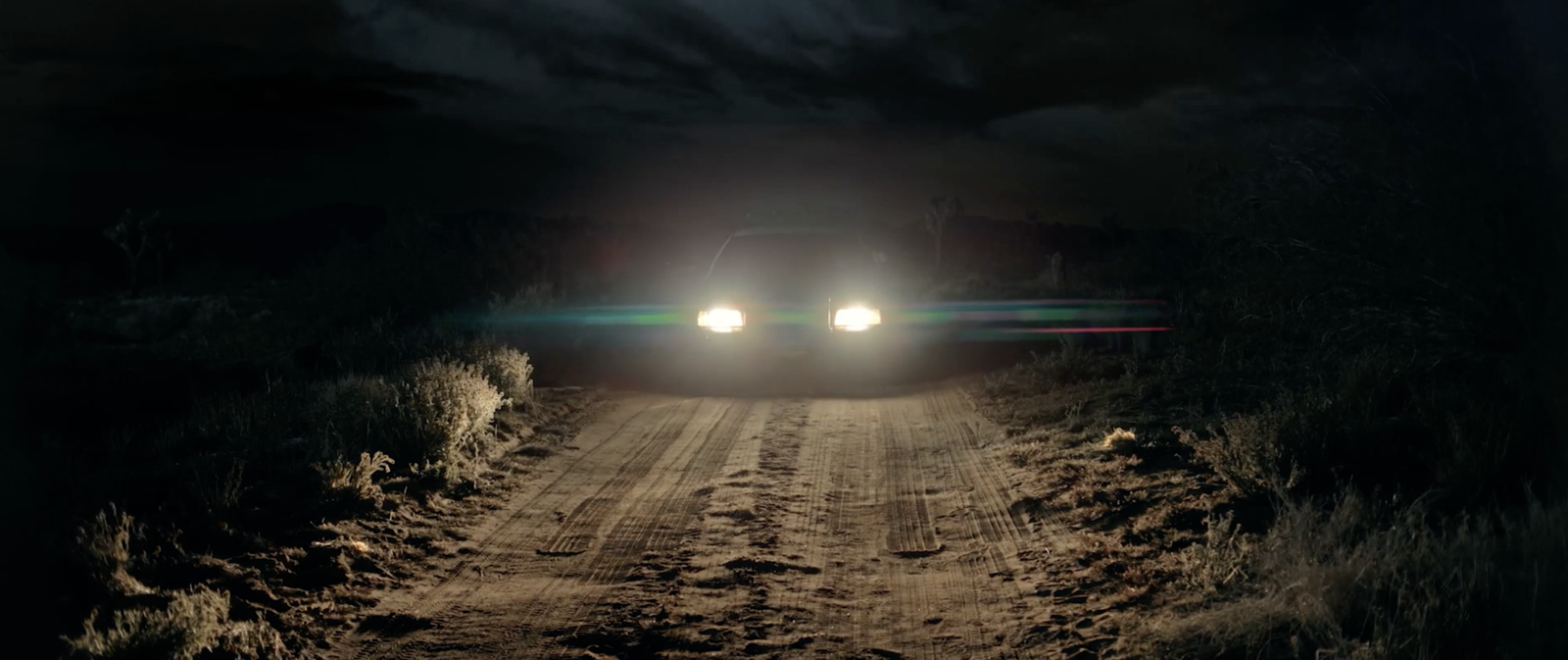
A car's headlights piercing the darkness on an empty desert road at night
For most of the film, this is the only light the desert offers — and it usually belongs to Bilstein.

For most of the film, the desert is defined by darkness, distance and isolation. Roads do not lead quickly to help. Buildings provide only temporary safety. The person who should represent law and order is the greatest threat.

The city lights suggest a return to other people, institutions and the possibility of being heard. They do not guarantee that Bobbi’s recovery will be simple. She is severely injured, traumatised and carrying evidence connected to numerous murders.

The ending does not pretend that survival immediately repairs what has happened.

However, dawn marks the end of Bilstein’s controlled night-time world. His authority is strongest when there are no witnesses and when he can determine the official version of events. By driving towards the city with the victims’ licences, his cruiser and evidence of his crimes, Bobbi carries the truth beyond the isolated territory he controlled.

The image is cautiously hopeful rather than conventionally triumphant. Bobbi has not escaped untouched, but she has escaped alive and is finally moving in a direction of her own choosing.

How Does the Ending Connect to Bobbi’s Sister?

Bobbi’s conversations with her sister Anna establish that her relationship with Rhett repeats patterns from their childhood.
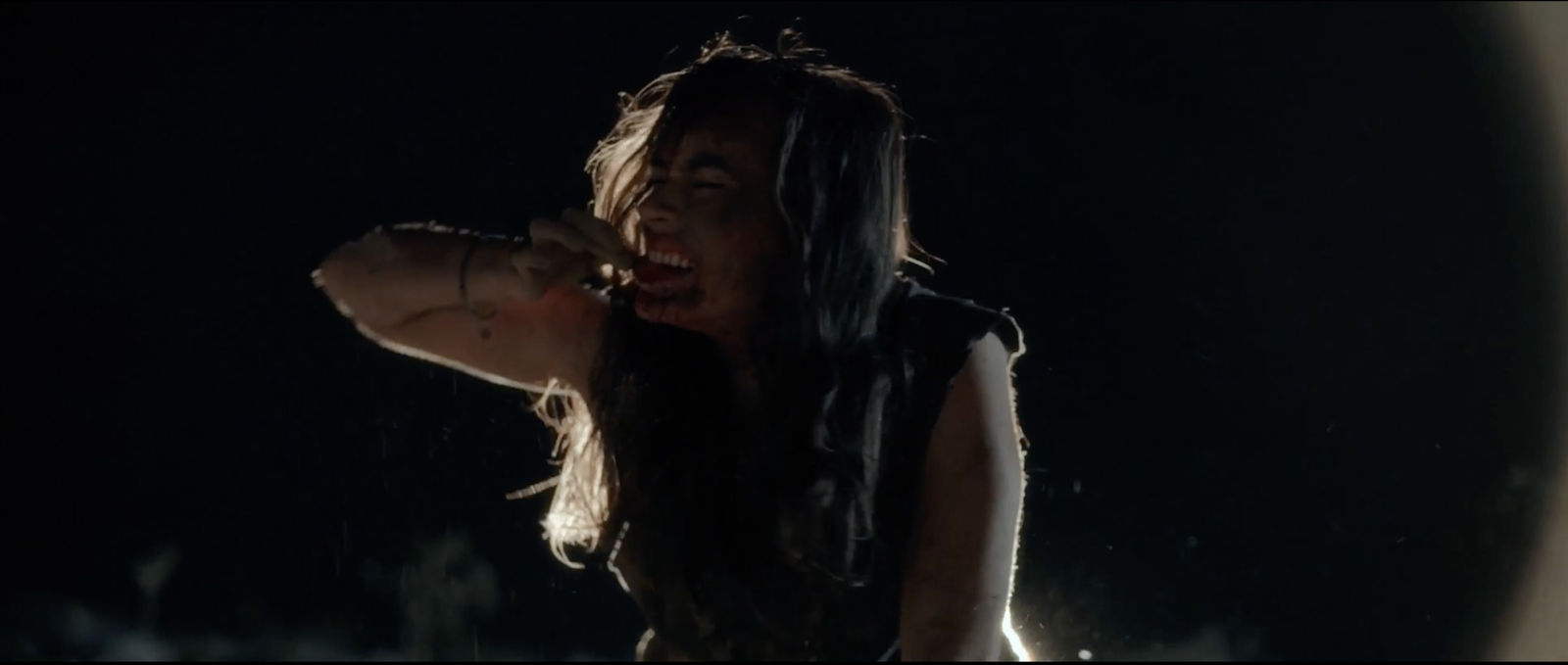
Close-up of a woman crying in the dark desert night, blood on her face
The film’s emotional wounds run as deep as the physical ones the ritual leaves behind.

Anna compares Rhett’s behaviour to their father, which initially angers Bobbi. She does not want to accept that she has become trapped in a familiar cycle of control and abuse.

During her encounter with Amy, Bobbi begins to understand more clearly how Anna attempted to protect her when they were younger. Amy’s experiences help Bobbi recognise aspects of her own life that she has resisted interpreting honestly.

That emotional realisation becomes part of the ending. Bilstein is the film’s most extreme embodiment of coercive power, but defeating him also gives Bobbi the clarity to reject Rhett.

Anna cannot make that decision for her. She can warn Bobbi and urge her to leave, but Bobbi must ultimately choose a different future herself.

The final rejection of Rhett’s call suggests that she has finally understood what her sister was trying to tell her.

Why Is the Ending So Violent?

The conclusion of Blood Star is deliberately brutal because the film has steadily removed Bobbi’s safer options.
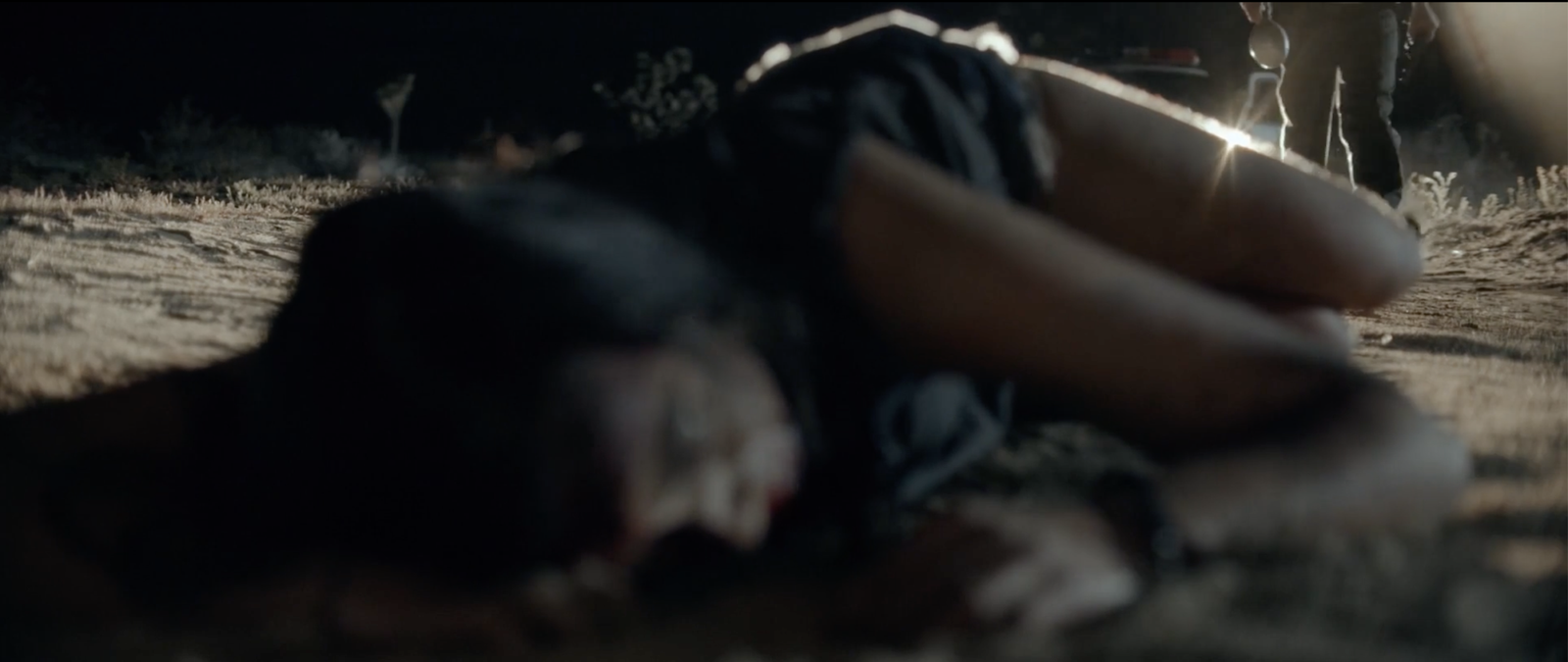
A bloodied woman lying in the dark desert as the sheriff approaches in the background
Each possible route to safety is blocked, corrupted or turned against her.

She attempts to leave the county. She seeks help at a petrol station and diner. She calls Rhett, her sister and the emergency services. She tries to explain what the sheriff is doing. Each possible route to safety is blocked, corrupted or turned against her.

Bilstein’s badge allows him to control the public version of events. He can present Bobbi as unstable, dishonest or criminal while using his authority to make his own behaviour appear legitimate.

By the time Bobbi fights back, violence is no longer her first choice. It is the final option left available to her.

Heads Up

The ending’s violence is graphic and deliberately uncomfortable to watch — the film treats Bobbi’s victory as costly and desperate, not clean or triumphant. Read on only if that’s the kind of ending you’re prepared for.

The ending therefore does not present revenge as easy empowerment. Bobbi survives at enormous physical cost. She is exhausted, injured and mutilated. Her victory is not clean, glamorous or painless.

This separates the climax from a conventional action-film transformation in which an ordinary character suddenly becomes an invulnerable fighter. Bobbi wins by observing Bilstein, improvising and exploiting his mistakes. She remains physically vulnerable throughout the confrontation.

Her violence feels desperate because it is.

What Does Sheriff Bilstein Represent?

Sheriff Bilstein represents more than an individual serial killer. His badge allows him to turn personal violence into institutional authority.

He does not initially appear as a masked attacker or an obvious criminal. He appears as the person who should provide protection on an isolated highway. He understands legal procedures, controls local information and knows that most travellers will instinctively obey him.

That makes his threat particularly effective.

Bobbi cannot simply report him to the nearest officer because he is the officer. He can confiscate her property, invent offences, manipulate witnesses and present his violence as legitimate police action.

Did You Know?

The film reportedly built on a “desert noir” tradition of isolated-highway thrillers, and its central irony — a lawman using his badge to make abuse look like law enforcement — is established from the film’s opening ritual, which the ending repeats and reverses beat for beat.

The ending removes these symbols from him one by one. Bobbi takes his knife, removes his ammunition, steals his cruiser and gathers the evidence he has hidden.

Bilstein’s authority gradually collapses until he is no longer a sheriff controlling the desert. He is simply a wounded man standing alone in the road with an empty gun.

That reduction is the essence of his defeat.

What Is the Meaning of the Blood Star Ending?

The ending of Blood Star is about reclaiming agency after systems of control have failed.

Bobbi begins the story moving between abusive forces. Rhett controls her emotionally. Bilstein controls her physically and institutionally. Both men assume that they can define her behaviour, credibility and destination.

The sheriff’s ritual reduces his victims to a small number of predictable choices. Bobbi survives because she stops behaving predictably.

She does not use the bullet in the way Bilstein expects. She does not remain where he leaves her. She does not permanently flee from the scrapyard. She does not return to her boyfriend, and she does not leave the previous victims anonymous.

Every action in the final section rejects a role that someone else has imposed upon her.

The ending is therefore not only about killing the villain. It is about Bobbi choosing who she will become after the immediate danger has passed.

How Bobbi turns the sheriff's own ritual against him

ObjectBilstein's Intended UseBobbi's Reversal
The single bulletForce a predictable, losing choiceBecomes part of a deception, not a real shot
The blood from her tongueEvidence of her mutilation and silencingCreates the illusion of her death
The jawbone knifeBilstein’s private symbol of inherited violenceBecomes the weapon used against him
The police cruiserInstrument of pursuit and institutional powerBecomes Bobbi’s means of escape and his killer
The victims’ licencesTrophies reducing women to souvenirsBecome evidence to identify the dead
The phoneA line Rhett uses to keep reaching herSomething Bobbi finally chooses to discard

Does Blood Star Have a Happy Ending?

The ending is hopeful, but it is not conventionally happy.

Bobbi survives and defeats both men. She retrieves potential evidence of their crimes and rejects Rhett. Those are clear victories.

However, she has suffered extreme physical and psychological trauma. Amy and the sheriff’s previous victims remain dead. Bobbi’s survival cannot undo what happened to them.

The conclusion recognises that escape and recovery are not the same thing.

Pro Tip for Rewatching

Watch the opening ritual scene again after finishing the film — it plays out the exact same beats (tongue, gun, single bullet, cruiser, road) that the ending repeats and reverses. The parallel is deliberate and easy to miss on a first viewing.

Driving towards the city lights is the beginning of what happens next, not the completion of Bobbi’s journey. She does not drive into the dawn restored to the person she was before Bilstein stopped her.

She drives towards it transformed, damaged and finally making her own decisions.

Blood Star’s Final Reversal

The ending of Blood Star works by repeating the sheriff’s ritual and changing its outcome.
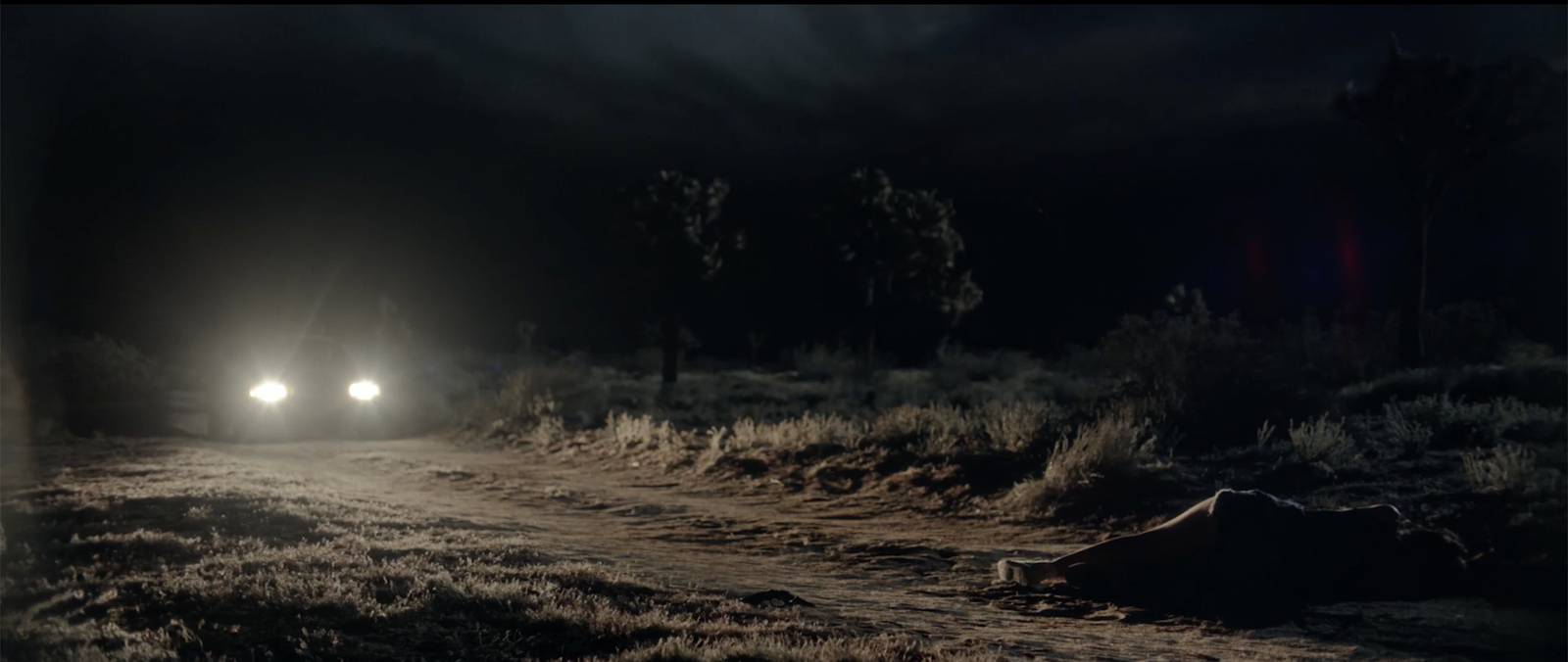
Wide shot of Bilstein's cruiser headlights approaching down a desert road with a body lying in the foreground
The same staging every time: a body in the road, headlights approaching through the dark.

A woman is placed alone in the road. She is given a gun and one bullet. A vehicle approaches through the darkness. The sheriff expects the same result he has created before.

Instead, Bobbi recognises the structure, rejects the apparent choice and turns every element of the ritual against him.

The bullet becomes part of a deception. The blood from her severed tongue creates the illusion of her death. The jawbone becomes her weapon. The police cruiser becomes her means of escape. The road becomes the place where Bilstein dies. The licences become evidence instead of trophies, and the phone becomes something Bobbi can finally discard.

Sheriff Bilstein believes that control means determining every option available to his victim.

Bobbi defeats him by creating an option he never imagined.

Frequently Asked Questions

No. Blood Star is a 2024 film directed by Lawrence Jacomelli in his feature debut, from a screenplay he co-wrote with Victoria Taylor and George Kelly, based on the short story “Don’t Look Back.”

John Schwab plays Sheriff Bilstein and Britni Camacho plays Roberta “Bobbi” Torres, alongside Travis Lincoln Cox, Sydney Brumfield and Wyomi Reed.

In the US, Blood Star is distributed by Quiver Distribution for streaming and on-demand viewing, following festival premieres including Neuchâtel International Fantastic Film Festival and Cinequest.

Yes — this is a full ending-explained article and reveals every major plot twist, including the fate of Sheriff Bilstein, Ed and Bobbi.

Learn More About Blood Star

If you’re interested in how independent filmmakers create ambitious thrillers on limited budgets, you can explore more about Blood Star, including its cast, production and behind-the-scenes story.

If you’d like to watch the film, visit the Blood Star Watch Page to see where it’s currently available to stream or purchase.
Obsession Review: A Horror Version of Big

Quick Answer

Obsession is a horror triumph because it treats its supernatural premise as an extension of teen relationship drama, not a replacement for it: Bear’s wish for Nikki to love him strips away her consent and turns devotion into something monstrous. Made for roughly $750,000 in a 20-day shoot, it draws clear lines to Big, Gremlins, American Pie and Scream, and works best when it trusts that central emotional idea over exhaustive mythology.

Spoiler Warning

This review contains discussion of the film’s premise, character relationships and selected scenes, but avoids revealing the complete ending.

Key Takeaways

  • Obsession works because it treats its horror concept as an extension of a teen relationship drama, not a replacement for one.
  • Bear’s wish removes Nikki’s consent and turns her devotion into something monstrous — the film’s real horror.
  • It draws clear lines to Big, Gremlins, Little Shop of Horrors, American Pie, Scream and The Vampire Diaries.
  • Made for roughly $750,000 in a 20-day shoot, the film had grossed more than $400 million worldwide by July 2026.
  • Curry Barker uses character blocking and physical positioning — especially in the chair scene — to tell the story visually.
Bear on the phone at night with Nikki visible in the background
Bear’s crush on Nikki is the ordinary desire the film’s horror magnifies.

Obsession Is Really a Teen Drama About Wanting to Be Loved

The most interesting thing about Obsession is that beneath its supernatural horror, grotesque violence and increasingly unhinged set pieces, it is fundamentally a story about a group of young people trying to understand love.

Bear wants to be loved by Nikki. Nikki wants to retain her own identity and emotional freedom. The other characters are navigating friendship, attraction, jealousy and the uncertainty of early adulthood. The horror does not replace those concerns. It magnifies them until an ordinary romantic desire becomes dangerous.

Writer-director Curry Barker understands that the concept only works if Bear’s wish initially feels emotionally recognisable. He does not begin as a conventional horror villain. He is lonely, insecure and afraid of rejection. Rather than risk expressing his feelings honestly, he chooses a supernatural shortcut and wishes for Nikki to love him more than anyone else in the world.

The wish is granted, but the wording removes everything that makes love meaningful.

Nikki’s affection is no longer freely chosen. It becomes total, compulsive and destructive. The innocent young woman Bear believed he wanted is transformed into an unwitting monster, not because she has independently become evil, but because his wish has overwritten her emotional autonomy.

That is the central horror of the film.

Bear does not simply create a dangerous version of Nikki. He removes the real Nikki from the relationship and replaces her with the fantasy of unconditional devotion he thought he desired.

The film’s supernatural premise therefore exposes something uncomfortable about romantic obsession. Wanting another person to love you may appear innocent, but wanting to control their feelings is something else entirely.

The Horror Version of Big

Structurally, Obsession has a surprising amount in common with Big.

In Penny Marshall’s film, a child encounters a strange fortune-telling machine, makes an impulsive wish and wakes to discover that the fantasy has become real. The wish initially appears exciting. Josh gets access to the adult world he imagined he wanted, but gradually learns that receiving the result without undergoing the necessary emotional development creates confusion, pain and responsibility.

Obsession follows a darker version of that framework.

Bear encounters a mysterious object, makes a wish rooted in an immature emotional desire and receives exactly what he asked for in the most destructive possible form. Like Josh in Big, he discovers that magical fulfilment does not eliminate consequences. It accelerates him into a situation for which he is emotionally unprepared.

The difference is that Josh wishes to change himself, while Bear wishes to change another person.

That distinction turns the coming-of-age fantasy into horror.

Josh must understand that adulthood is more complicated than it appears. Bear must understand that love obtained without consent is not love at all. His wish does not make him more mature, courageous or worthy of Nikki. It changes Nikki so that he no longer has to face rejection.

Seen from this perspective, Obsession is not simply a film about a cursed object. It is a corrupted coming-of-age story about a young man who tries to avoid emotional growth and instead unleashes a consequence he cannot control.

The supernatural element works because the emotional problem beneath it is so ordinary.

The Magic Shop Tradition

The early encounter with the One Wish Willow places Obsession within a long tradition of stories in which an apparently harmless shop, salesman or object offers access to forbidden fulfilment.

The magic shop is one of cinema’s most useful narrative devices because it allows the extraordinary to enter an otherwise recognisable world with very little explanation. A character crosses a threshold, encounters an eccentric proprietor or unusual artefact, and is offered something that appears small enough to dismiss.

The object is rarely dangerous because it malfunctions.

It is dangerous because it works too precisely.

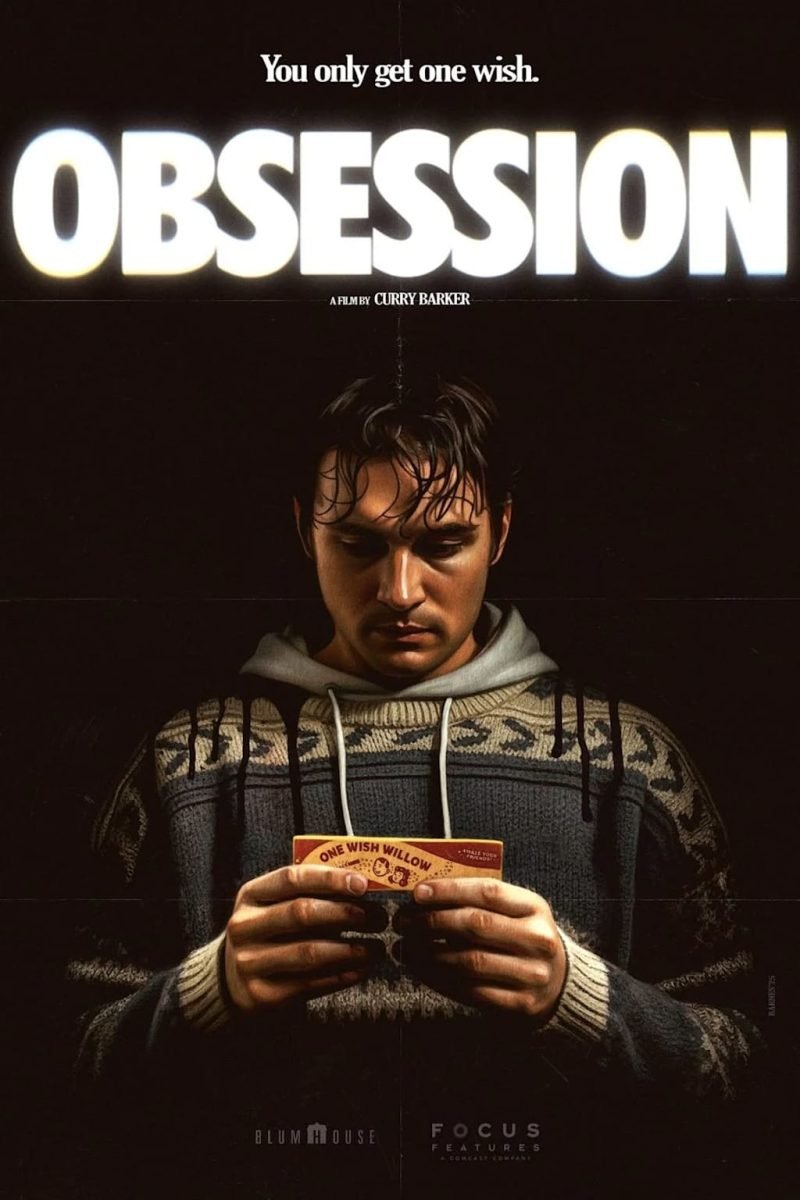
Bear holding the One Wish Willow box on the film's poster, with the tagline 'You only get one wish'
The One Wish Willow: a kitschy novelty object with the deceptive innocence the film’s horror depends on.

In Gremlins, the mysterious shop introduces Gizmo and the three rules that must be followed. The danger emerges not from a defective gift but from human carelessness and the failure to respect conditions that were clearly stated.

In Little Shop of Horrors, an apparently extraordinary plant offers Seymour a pathway out of obscurity. As Audrey II grows, the fulfilment of Seymour’s ambitions becomes inseparable from escalating violence.

Even Needful Things develops the idea of a shop that gives people exactly what they desire while using those desires to expose their weaknesses.

Obsession belongs to this tradition, but the One Wish Willow has the deceptive innocence of a novelty gift. It does not look like a grand occult object. Its name almost sounds like the kind of sentimental item someone might buy impulsively at a New Age shop.

That tonal lightness is important.

The object enters a youthful world of friendships, work and unspoken attraction. Its threat is not announced through elaborate Gothic design. The wish seems childish enough to make, which helps the consequences feel even more disturbing.

Gremlins and the Rules of a Dangerous Gift

The comparison with Gremlins is especially useful because both films begin with a magical gift whose initial appeal conceals the scale of the danger it contains.

Gizmo is charming and apparently manageable, but the rules surrounding him reveal that the gift carries consequences. When those rules are broken, one innocent creature gives rise to a group of destructive monsters.

In Obsession, the One Wish Willow similarly turns a simple desire into something uncontrollable. Bear’s wish produces a version of Nikki whose love multiplies beyond any healthy emotional limit.

The transformation is not as visibly creature-driven as Gremlins, but the underlying structure is related. An appealing supernatural possibility enters an everyday youthful world, the central character fails to understand the responsibility attached to it, and innocent behaviour mutates into chaos.

Both films also understand that horror and humour can coexist. The absurdity of a wish producing a catastrophically devoted girlfriend allows Obsession to move through moments of discomfort, comedy and violence without becoming tonally incoherent.

Barker does not treat the premise as a solemn metaphor from the first frame. He allows the awkwardness to be funny before it becomes threatening. That shift is one of the film’s strongest qualities.

The audience initially recognises a fantasy.

Then it watches that fantasy become unbearable.

The Emotional World of American Pie

Although Obsession is a supernatural horror film, much of its dramatic foundation belongs to the teen and young-adult relationship movie.

Its characters work together, socialise together and exist inside a small emotional ecosystem where friendships, romantic feelings and group loyalties overlap. Bear’s inability to tell Nikki how he feels would be completely at home in a film such as American Pie, where embarrassment, sexual insecurity and the fear of rejection drive much of the story.

The friend group playing giant Jenga and drinking together at a bar
The early group scenes establish a friendship circle with real history before the horror arrives.

The difference is what Obsession does with that insecurity.

In a conventional teen comedy, Bear might misunderstand Nikki, make a series of humiliating mistakes and eventually learn to speak honestly. The narrative would reward emotional maturity and direct communication.

Instead, Bear avoids that process entirely.

The wish allows him to skip the difficult scene in which Nikki might reject him. That avoidance is the original sin of the film. Everything that follows grows from his refusal to accept that another person’s feelings may not match his own.

This is why the teen-drama element is not incidental. Without it, the film would become a more generic cursed-object story. The horror has force because it emerges from the recognisable emotional fears of young adulthood: being unwanted, watching someone choose somebody else and believing that love will solve a damaged sense of self.

The early group scenes establish these relationships economically. The characters feel like people who already have a history rather than figures assembled solely to become victims.

That emotional familiarity gives the supernatural escalation something meaningful to destroy.

Scream, The Vampire Diaries and Horror Through Young Relationships

Obsession also sits within the tradition of horror stories in which the supernatural or violent plot grows directly out of the relationships between young characters.

The film's young cast in a playful photobooth-style group portrait
A tight-knit friend group is the engine Scream and The Vampire Diaries also run on — horror that grows out of relationships the audience already cares about.

Scream is not merely a slasher about identifying a masked killer. Its power comes from the fact that the murders invade a recognisable network of friendships, romances, rivalries and betrayals. The horror matters because the characters already matter to one another.

Similarly, The Vampire Diaries uses supernatural mythology to intensify familiar adolescent emotions. Love becomes eternal devotion. Jealousy becomes centuries-long conflict. Attraction can carry literal mortal danger.

Obsession uses a comparable form of escalation.

Bear’s crush does not remain a crush. It becomes a supernatural command. Nikki’s affection does not simply grow; it becomes an all-consuming force. Emotional dependence becomes physical threat.

This is one reason the film feels accessible despite the extremity of its horror. The characters’ emotional language is familiar, even when the consequences are not.

Barker recognises that the high concept should not float above the character drama. It should transform it.

The wish does not introduce an unrelated monster into the group. It turns one of the group’s most important relationships into the monster.

How Obsession compares to its clearest influences

FilmShared IdeaKey Difference
BigA wish grants an impossible fantasy overnightJosh wishes to change himself; Bear wishes to change someone else
GremlinsA charming magical gift conceals rules whose violation unleashes dangerGremlins multiplies a creature; Obsession multiplies one person’s devotion
American PieA youthful friend group defined by embarrassment, insecurity and the fear of rejectionAmerican Pie rewards honesty; Bear’s wish lets him avoid it entirely
Scream / The Vampire DiariesHorror or violence grows directly out of relationships between young charactersThose stories add an outside threat; Obsession turns the relationship itself into the threat

The Innocent Girl Becomes an Unwitting Monster

The smartest element of Obsession is the way it complicates Nikki’s position.

She becomes the immediate source of danger, but she is not the original author of that danger. Her obsession has been imposed upon her through Bear’s wish. The monstrous version of Nikki is therefore both antagonist and victim.

This creates a more interesting moral structure than a simple story about a possessive woman.

Bear wanted Nikki to love him. The wish creates a version of that love stripped of independence, judgement and restraint. She becomes the literal embodiment of his fantasy, and the horror lies in seeing how dehumanising that fantasy was from the beginning.

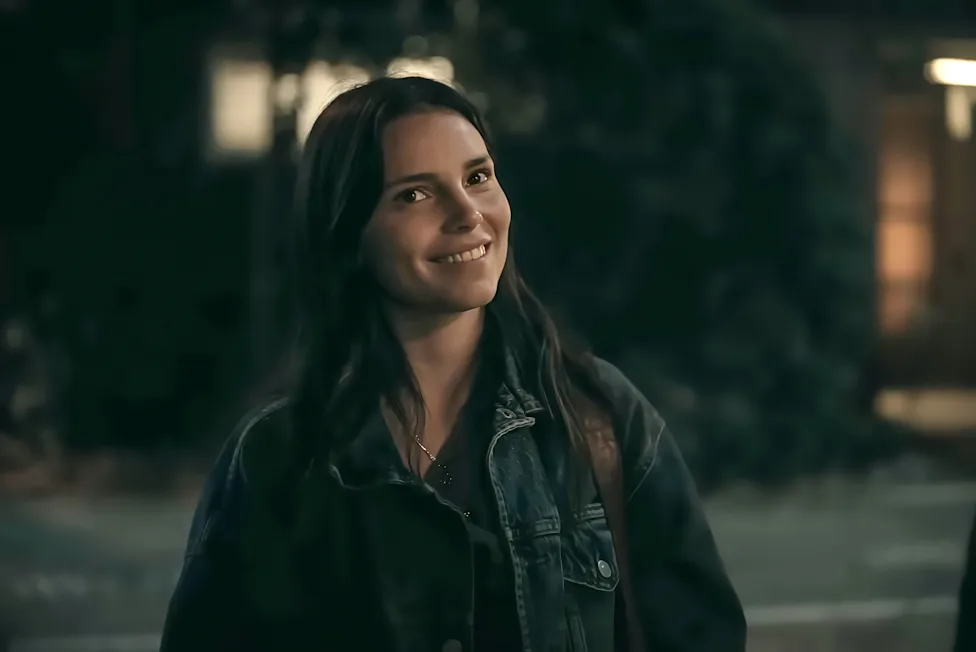
Nikki smiling warmly at night, before the wish transforms her
Inde Navarrette has to make Nikki’s devotion feel flattering, then uncomfortable, then terrifying — without losing the innocent woman underneath.

Inde Navarrette has to make the transformation work across several emotional registers. Her devotion must initially feel flattering enough for Bear to accept it, exaggerated enough to become uncomfortable and eventually powerful enough to become terrifying.

The performance avoids making Nikki feel like a completely unrelated demonic entity. Elements of the innocent young woman remain visible within the monster, which makes the situation more tragic.

She is not pursuing Bear because she independently decided that violence was justified.

She is fulfilling the emotional command he placed inside her.

Bear does not simply create a dangerous version of Nikki. He removes the real Nikki from the relationship and replaces her with the fantasy of unconditional devotion he thought he desired.

From the reviewOn Nikki's transformation

The film therefore reverses a familiar horror dynamic. The young woman may become the visible monster, but the young man’s desire created the conditions for her transformation.

The British Film Institute’s review similarly noted that the film reverses the roles of the obsessed person and the object of obsession, while allowing both the supernatural version of Nikki and the real Nikki to illuminate the consequences of Bear’s desire. (BFI)

A Strong Concept Designed for a Low Budget

From a filmmaking perspective, Obsession is an excellent example of a concept creating scale without requiring constant spectacle.

The film was reportedly made for approximately $750,000 and shot over 20 days, yet it became a major commercial success. (Forbes)

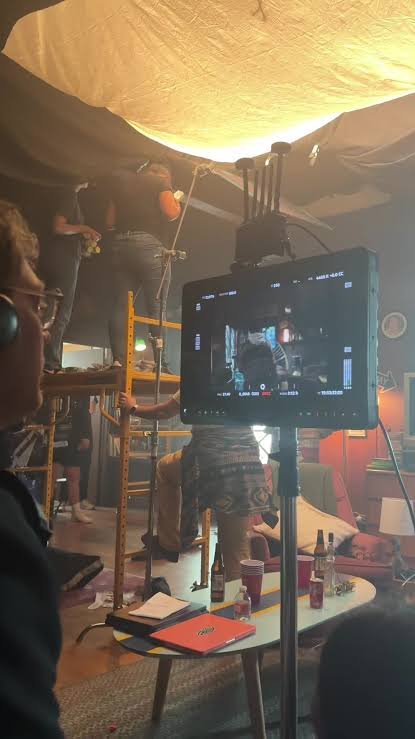
Behind-the-scenes crew rigging lighting on the Obsession set
Obsession was reportedly shot in 20 days for about $750,000 — a production model built around a strong concept rather than constant spectacle.

The production model works because the film concentrates its resources.

There is a contained group of principal characters, a limited number of central relationships and a small selection of significant horror set pieces. Much of the running time is carried by performance, blocking, dialogue and the gradual transformation of Nikki’s behaviour.

The film does not need a creature attack every five minutes. Its core concept generates suspense whenever Nikki enters a scene because the audience is watching for the moment when affection becomes possession.

This is the same principle that supports many successful low-budget genre films.

Paranormal Activity uses one house and one relationship. The original Saw is constructed around two men in a room and a small number of carefully selected reveals. The Blair Witch Project turns limited visibility and three performers into the entire source of dread.

Obsession is more visually polished and contains larger set pieces than those examples, but it shares their discipline. It understands that one memorable idea, performed well, can create more value than a large quantity of generic action.

The strength of the premise also allows the production to spend selectively. When violence or effects arrive, they feel significant because the film has not exhausted the audience with constant incident.

This is intelligent low-budget design.

Curry Barker’s Direction Is Built Around Character Geography

One of the most interesting aspects of Curry Barker’s direction is his use of physical placement to define the emotional relationships around Bear.

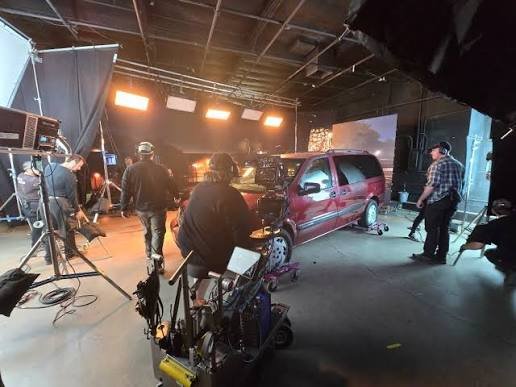
Behind-the-scenes view of a soundstage set built around a minivan
Barker’s blocking gives every relationship a visual geography before a single line explains it.

For much of the film, the two principal young women occupy distinct positions on either side of him. This is more than convenient blocking. It gives the relationships a visual geography.

Bear becomes the central point between two competing emotional realities. One woman represents the life and relationships that existed before the wish. Nikki represents the desire he has unnaturally brought into existence.

By repeatedly keeping the women on separate sides of Bear, Barker allows the composition to express a division that the dialogue does not always need to state.

The positions become meaningful through repetition.

Cinema teaches audiences how to read space. When characters consistently occupy particular sides of the frame or particular positions in relation to one another, those placements begin to feel stable. A director can then create unease simply by breaking the established arrangement.

Barker uses that principle effectively.

The blocking gives Bear the illusion of remaining at the centre of his own story. The women appear to exist in relation to him, arranged on either side of his emotional conflict.

But the apparent control is unstable.

The wish has created a force that will eventually rearrange the relationships according to Nikki’s obsessive logic rather than Bear’s desire.

The Chair Scene Breaks the Established Order

The chair scene is especially effective because it disrupts the visual pattern Barker has established.

Until this point, each of the central women has largely retained her own side of Bear. The geography keeps their identities and relationships visually separate.

During the chair sequence, Nikki pulls the other woman backwards and physically takes her place.

The action is disturbing on a literal level, but its visual meaning is even stronger.

Nikki does not merely attack a rival. She occupies her position.

The blocking shows the supernatural obsession eliminating an existing relationship and replacing it with itself. The woman who previously belonged in that part of Bear’s world is removed, while Nikki assumes the space beside him.

This is a simple directorial decision, but it demonstrates careful visual thinking.

The meaning does not depend on a character explaining that Nikki is taking over Bear’s emotional life. The composition has already taught the audience what the positions mean. When Nikki drags the other woman away and moves into her place, the film completes the idea through movement.

It is an example of blocking functioning as storytelling rather than simply organising actors for camera coverage.

The most effective directing choices often operate this way. They are understandable without drawing attention to themselves, but become richer when reconsidered after the scene.

Bear Is Not a Traditional Hero

The film’s structure encourages the audience to identify with Bear, but it never completely absolves him.

He is sympathetic because his loneliness is recognisable and because the results of the wish quickly exceed anything he consciously intended. Yet the story repeatedly returns to the fact that he made a choice concerning Nikki’s mind and emotions without her consent.

This makes him a more complicated protagonist than the innocent recipient of a curse.

Bear is both victim and instigator.

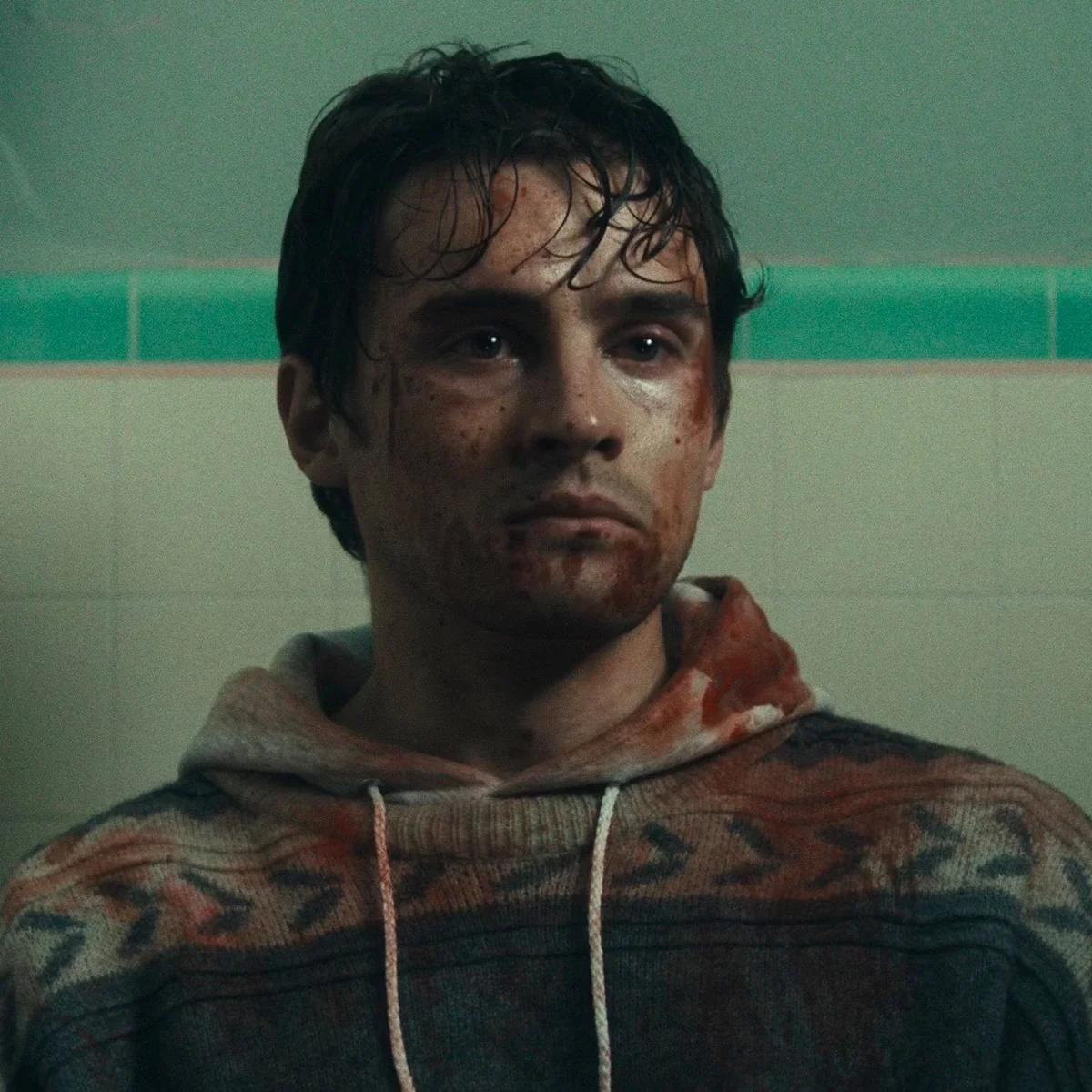
Bear, shaken and covered in blood, in the film's aftermath
The film never lets Bear fully off the hook for the choice that started everything.

The wish exposes a form of entitlement hiding inside apparent romantic vulnerability. He believes his love for Nikki is sincere, but sincerity does not give him the right to determine how she feels.

The film does not need Bear to be consciously malicious for the decision to be wrong. In fact, the premise becomes more effective because he considers himself harmless.

His self-image allows the audience to recognise how controlling ideas can hide within familiar romantic language. “I only want her to love me” sounds tender until the other person’s freedom is removed from the sentence.

Michael Johnston plays Bear with enough vulnerability to prevent the character from becoming easily dismissible. The audience can understand why he makes the wish while still recognising the moral failure inside it.

That tension keeps the film emotionally alive after the supernatural rules have been established.

The Film Understands the Difference Between Love and Possession

At its centre, Obsession asks a simple question: what is love worth when it is not freely chosen?

Bear initially believes that Nikki’s devotion will solve his unhappiness. Instead, her transformed behaviour reveals the emptiness of what he has received.

She may focus entirely on him, but that focus no longer reflects knowledge, trust or genuine emotional choice. It is simply supernatural compulsion.

The horror version of Nikki expresses the difference between being loved and being possessed.

Her devotion leaves no room for Bear to remain independent either. The wish that was intended to give him emotional security begins controlling his life. Every other relationship becomes a threat, and every attempt to move away from Nikki becomes an act she must prevent.

Possession therefore works in both directions.

Bear has attempted to possess Nikki’s feelings, but the transformed Nikki begins to possess Bear’s entire existence.

The film’s concept becomes a closed emotional trap in which neither character can experience genuine love because the wish has destroyed the freedom on which love depends.

Where Obsession Is Most Effective

The film is strongest when it remains close to its emotional premise.

The early awkwardness, the gradual intensification of Nikki’s behaviour and the shifting dynamics within the friendship group are more compelling than any attempt to explain the supernatural mythology in exhaustive detail.

Barker trusts the central idea.

He understands that an affectionate gesture can become frightening if it lasts too long, arrives with too much intensity or ignores another person’s discomfort. Inde Navarrette’s performance gives him the ability to move from innocence to threat without requiring an obvious visual transformation in every scene.

Pro Tip for First-Time Viewers

Watch how Curry Barker positions the two women on either side of Bear throughout the film — the blocking is quietly telling you exactly where the story is headed long before the chair scene makes it explicit.

The sound design and visual control amplify this discomfort. The film often creates dread before anything explicitly violent occurs because Nikki’s presence changes the emotional temperature of the room.

The direction also maintains a useful tension between dark humour and genuine horror. The premise is inherently absurd, but the emotional consequences are treated seriously.

That balance prevents the film from becoming either a one-joke horror comedy or an oppressively self-important metaphor.

Where the Film Is Less Convincing

The film is less secure when its supernatural mechanics become more important than its emotional logic.

Like many high-concept horror films, Obsession must eventually explain enough of its rules to move towards a conclusion. Those explanations are necessary, but they are rarely as interesting as the original transformation.

The most powerful idea is easy to understand: Bear wished for Nikki to love him more than anyone, and the wish turned that love into something monstrous.

Everything added around that premise risks diluting its simplicity.

Heads Up

If you’re the type of viewer who fixates on plot logic, temper your expectations around the film’s third act — recent discussion of the film’s streaming release has focused on the questionable logic surrounding the death of Bear’s cat. (CinemaBlend)

There are also individual plot details that may invite questions. Recent discussion of the film’s streaming release, for example, has focused on the questionable logic surrounding the death of Bear’s cat. (CinemaBlend)

However, these weaknesses do not damage the film’s central achievement. The concept, performances and controlled escalation remain strong enough to carry the narrative over occasional gaps in logic.

Why Obsession Became Such a Breakout

The film’s extraordinary commercial performance is not difficult to understand from a creative perspective.

It has an immediately communicable concept: a lonely young man wishes that his female friend will love him, and the wish turns her into a monster.

That sentence contains romance, horror, irony and consequence.

It also provides a strong trailer structure. The audience can see the innocent world, the wish, the initial fulfilment and the first signs that something is wrong without being shown the entire narrative.

The film is recognisably contemporary but built from durable storytelling elements: a magic object, an impulsive wish, a youthful friendship group and a desire that carries an unexpected price.

Did You Know?

Obsession’s reported $750,000 production budget and 20-day shoot make its eventual box-office performance particularly remarkable. By July 2026, reports placed its worldwide gross above $400 million — making it, by some measures, the highest-grossing film ever made relative to its budget.

Its reported $750,000 production budget and 20-day shoot make its eventual box-office performance particularly remarkable. By July 2026, reports placed its worldwide gross above $400 million. (Forbes)

The success demonstrates something independent filmmakers repeatedly need to remember: production value is not only visible expenditure.

A strong concept is production value.

A memorable performance is production value.

Clear character relationships are production value.

A scene whose blocking communicates the entire dramatic idea is production value.

Final Verdict

Obsession works because Curry Barker does not treat the horror concept as a replacement for the teen drama beneath it.

The film is about wanting to be loved, fearing rejection and attempting to avoid the vulnerability required to form a real relationship. The One Wish Willow takes those recognisable emotions and transforms them into supernatural consequences.

The magic-shop setup recalls Gremlins and Little Shop of Horrors, where an apparently appealing gift or opportunity contains the mechanism of destruction. Its wish-fulfilment structure makes it feel like a horror version of Big, except Bear attempts to change somebody else rather than himself. Its youthful social world connects it to American Pie, Scream and The Vampire Diaries, stories in which friendship, attraction and jealousy become the foundations for comedy, violence or supernatural drama.

But Obsession has an identity of its own.

Its best idea is the transformation of an innocent young woman into an unwitting monster created by someone else’s romantic desire. Nikki becomes terrifying, but she is also the person most completely violated by Bear’s wish.

From a directorial perspective, Barker reinforces that idea through careful character placement. The women occupy separate positions around Bear until the chair scene, when Nikki physically removes the other woman and assumes her place. It is a precise visual expression of the entire story: obsession does not simply want to be included in Bear’s world. It wants to replace everything else inside it.

For a film made on a remarkably small budget and short schedule, Obsession feels focused rather than restricted. It relies on concept, character, performance and a small number of memorable set pieces instead of trying to imitate the scale of a studio blockbuster.

The film proves that a horror movie does not need an enormous mythology or endless kills to feel substantial.

Sometimes it needs only one wish, one unspoken desire and one person who never had the chance to say no.

Frequently Asked Questions

No. Obsession is an original screenplay written and directed by Curry Barker, drawing on the long “magic shop” horror tradition of films like Gremlins and Needful Things rather than any real-life event.

Curry Barker directed the film, his feature debut following the viral short “The Chair” and his earlier film “Milk & Serial.” Michael Johnston plays Bear and Inde Navarrette plays Nikki. It was produced by Blumhouse Productions and released by Focus Features.

The film was reportedly made for approximately $750,000 and shot over 20 days. By July 2026 it had grossed more than $400 million worldwide, making it one of the highest-grossing films ever relative to its production budget.

It discusses the film’s premise, character relationships and selected scenes, but avoids revealing the complete ending.

Learn More About Blood Star

If you’re interested in how independent filmmakers create ambitious thrillers on limited budgets, you can explore more about Blood Star, including its cast, production and behind-the-scenes story.

If you’d like to watch the film, visit the Blood Star Watch Page to see where it’s currently available to stream or purchase.
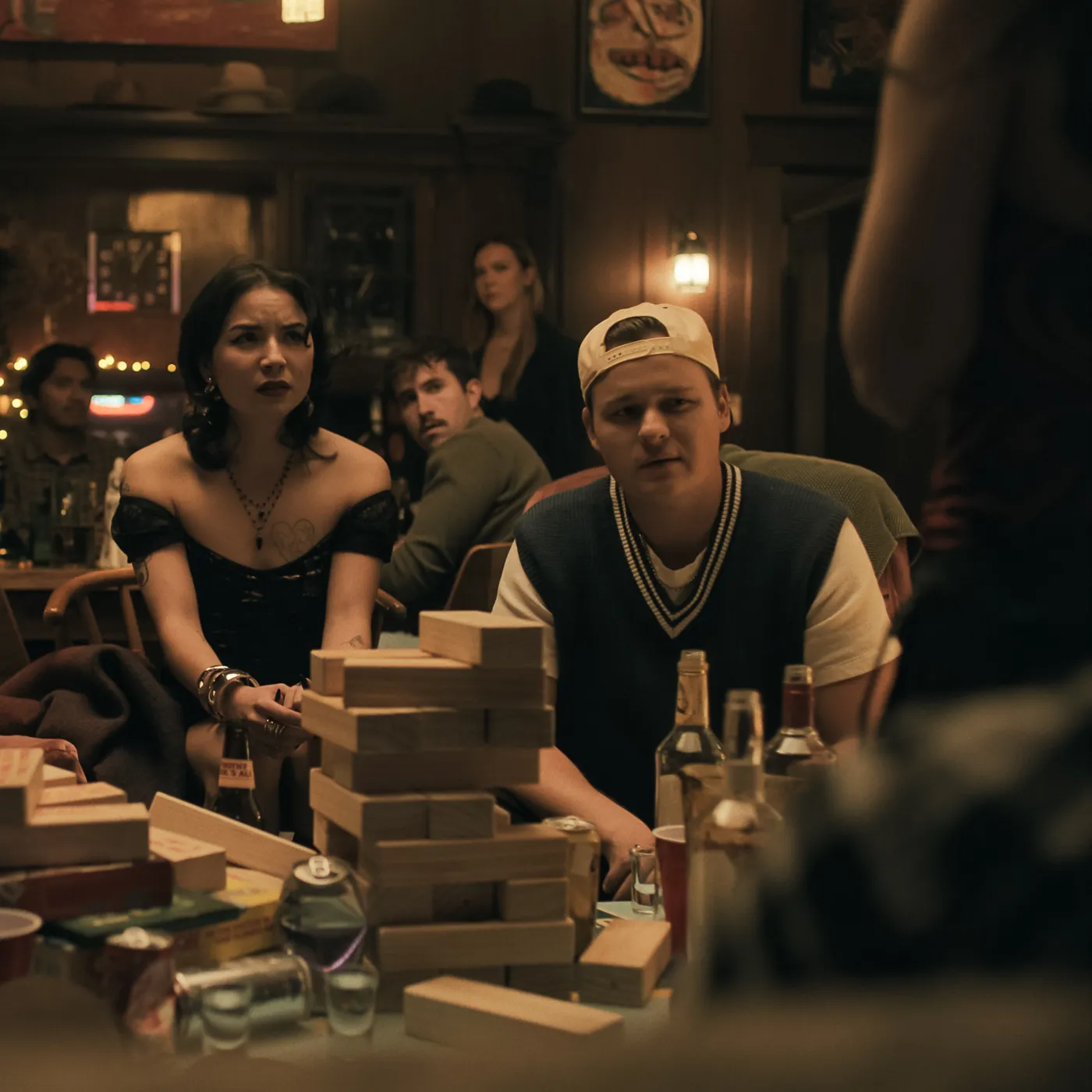
Backrooms Review: When Production Design Becomes the Monster

Quick Answer

Backrooms is a horror triumph because it treats production design itself as the antagonist: 30,000+ sq ft of physical sets turn endless fluorescent-lit corridors into a monster more disturbing than anything with teeth. It draws clear lines to The Shining, The Blair Witch Project, Stranger Things and Poltergeist, and works best when it trusts empty rooms over exposition.

Spoiler Warning

This review contains limited discussion of the film’s premise and visual ideas but avoids revealing its major final twists.

Key Takeaways

  • Backrooms turns production design into the film’s true antagonist, not just its backdrop.
  • More than 30,000 square feet of physical sets were built so the camera could travel through real, contiguous space.
  • The film’s clearest ancestors are The Shining, The Blair Witch Project, Stranger Things and Poltergeist.
  • Osgood Perkins produced (alongside James Wan and Shawn Levy); director Kane Parsons is the clear authorial voice.
  • The film is strongest exploring empty rooms and weakest when it becomes a conventional chase.

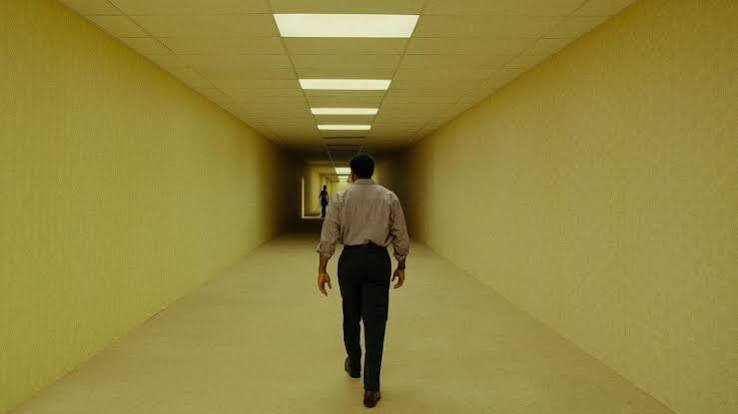
A lone figure walking down an endless yellow fluorescent-lit corridor in Backrooms
The Backrooms’ endless corridors are designed to feel familiar but never correct.

Backrooms Is a Triumph of Production Design

The most striking thing about Backrooms is not its creature, mythology or internet origins. It is the extraordinary confidence with which the film turns production design into the principal source of horror.

The film’s endless corridors, stained carpets, ceiling grids, fluorescent tubes and sickly yellow walls are immediately recognisable. They resemble offices, hotels, storage facilities, waiting rooms, furniture showrooms and institutional spaces, yet they never settle into one identifiable location. Everything feels familiar, but nothing feels correct.

That contradiction is the film’s greatest hook.

Backrooms understands that production design is not merely a way of creating an attractive environment around the actors. The environment is the antagonist. It controls movement, denies orientation and gradually weakens the characters’ certainty about where they are and whether the physical world still follows dependable rules.

Director Kane Parsons and production designer Danny Vermette do not decorate the Backrooms with conventional Gothic detail. There are no cobwebbed staircases, ancient portraits or obvious symbols of death. Instead, they find terror in suspended ceiling tiles, corporate carpet patterns, plastic wall panels and anonymous architectural repetition.

The film reportedly constructed more than 30,000 square feet of physical Backrooms sets for the production. That decision is visible on screen. The actors are not simply performing against abstract digital backgrounds; they appear physically contained by the spaces around them. The scale of the build allows the camera to travel, turn corners and reveal new architectural contradictions without the environment feeling weightless. (Wikipedia)

Did You Know?

The production reportedly built more than 30,000 square feet of physical Backrooms sets, allowing the camera to travel and turn corners through real, contiguous space instead of compositing digital backgrounds.

It is a brilliant example of how strong art direction can become a film’s primary piece of intellectual property.

A Familiar Place That Has Forgotten Its Purpose

The central horror of the Backrooms is that the space appears to have been designed for people, but it no longer has a clear human purpose.

A room normally communicates its intended function. A bedroom contains a bed. A kitchen provides somewhere to prepare food. A cinema points its seats towards a screen. Even an office corridor is expected to connect recognisable working areas.

The Backrooms remove those signals.

A corridor may lead to another identical corridor. A room may contain several openings but no indication of which direction represents progress. The architecture continually suggests that somewhere useful must exist just out of sight, yet the search for that destination only produces more space.

This is where the film moves beyond the novelty of recreating the viral internet aesthetic. The Backrooms are frightening because they resemble a memory of architecture rather than architecture itself: an imperfect reconstruction created by something that understands the visual ingredients of human environments but not why humans built them.

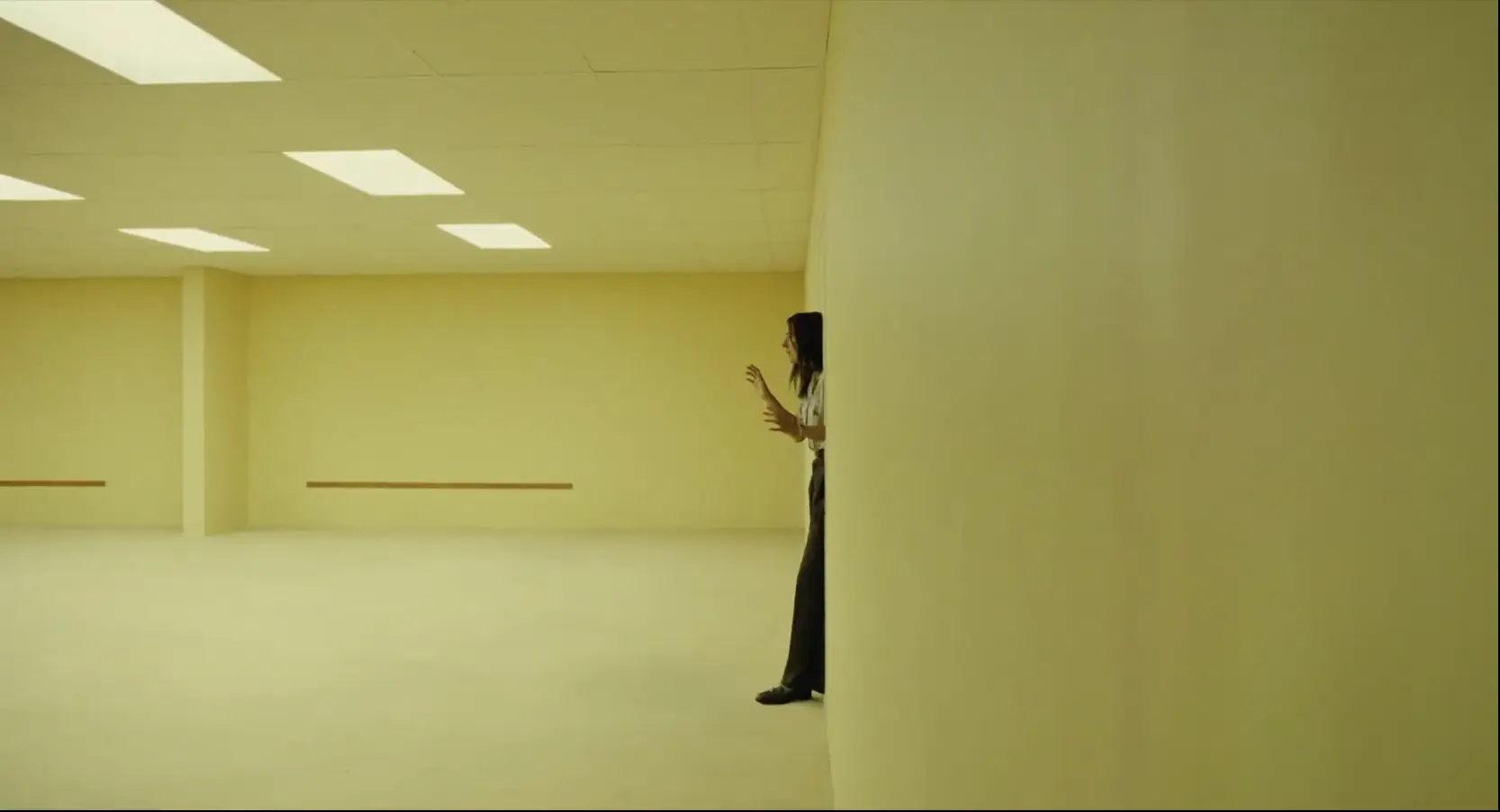
A woman searching an endless, featureless yellow wall in an empty Backrooms room
Scale shifts unexpectedly — the environment seems to observe reality and copy it incorrectly.

A wall turns where it should continue. A staircase promises vertical progress but leads into another variation of the same visual system. A domestic space appears inside an institutional one. Scale shifts unexpectedly. The environment seems to be observing reality and copying it incorrectly.

That is far more disturbing than simply placing a monster inside a maze.

The production design creates the sense that the world itself is malfunctioning.

The Shining and the Impossible Architecture of Fear

The clearest cinematic comparison is Stanley Kubrick’s The Shining.

The Overlook Hotel is frightening before Jack Torrance becomes fully dangerous because its architecture cannot be trusted. Corridors appear to extend beyond the physical boundaries of the building. Rooms and windows occupy positions that do not make logical sense. The hotel feels coherent when viewed one shot at a time, but impossible when mentally assembled.

Kubrick used that geographical uncertainty to destabilise the audience. We believe we understand what a hotel is, but the Overlook quietly rejects our attempts to map it.

Backrooms develops the same idea on a far greater scale.

The Overlook still performs the role of a hotel. It has bedrooms, kitchens, a ballroom and service corridors. The Backrooms have been stripped of even that functional reassurance. Their spaces repeat the visual language of commercial architecture without providing a destination.

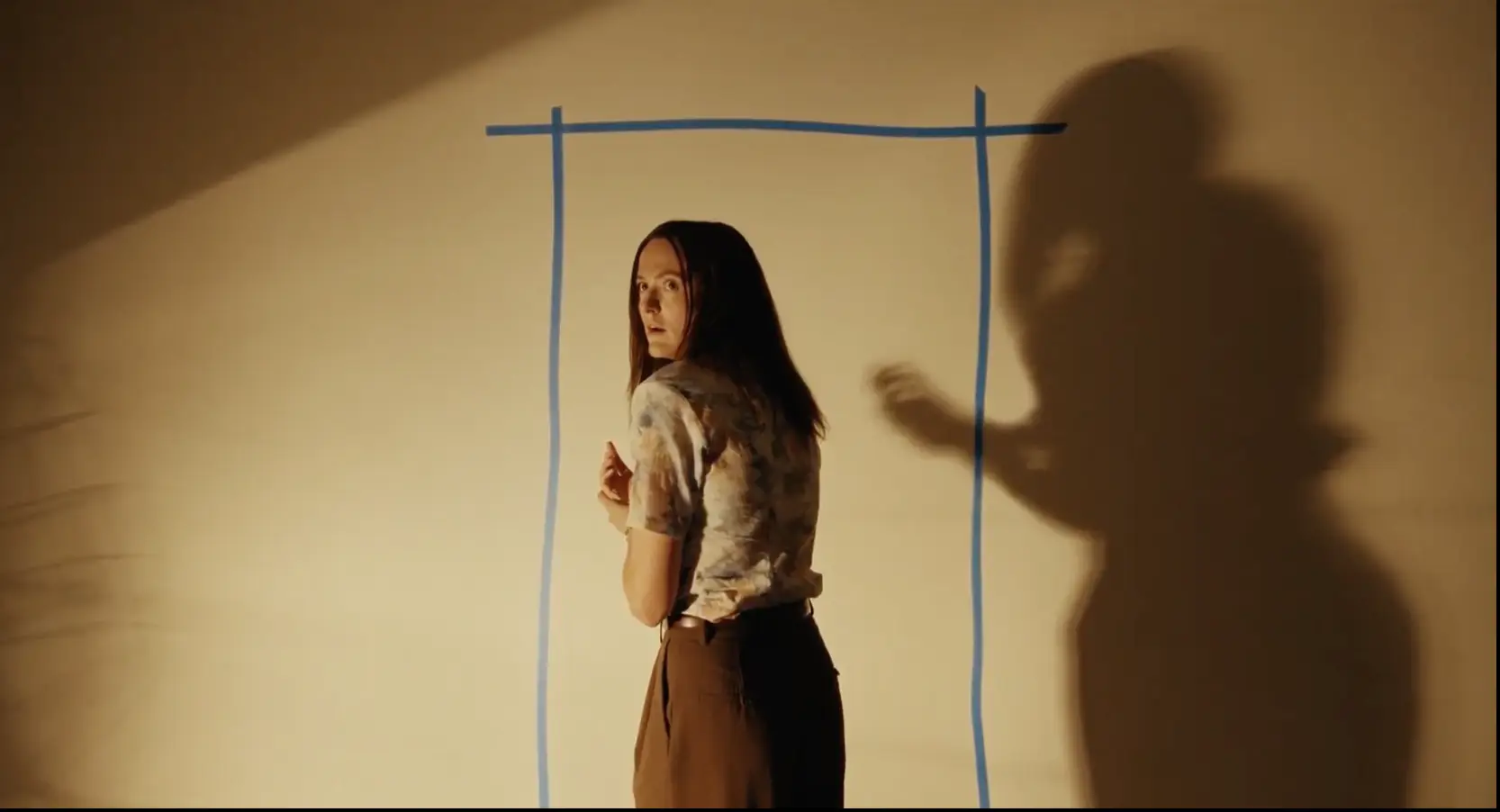
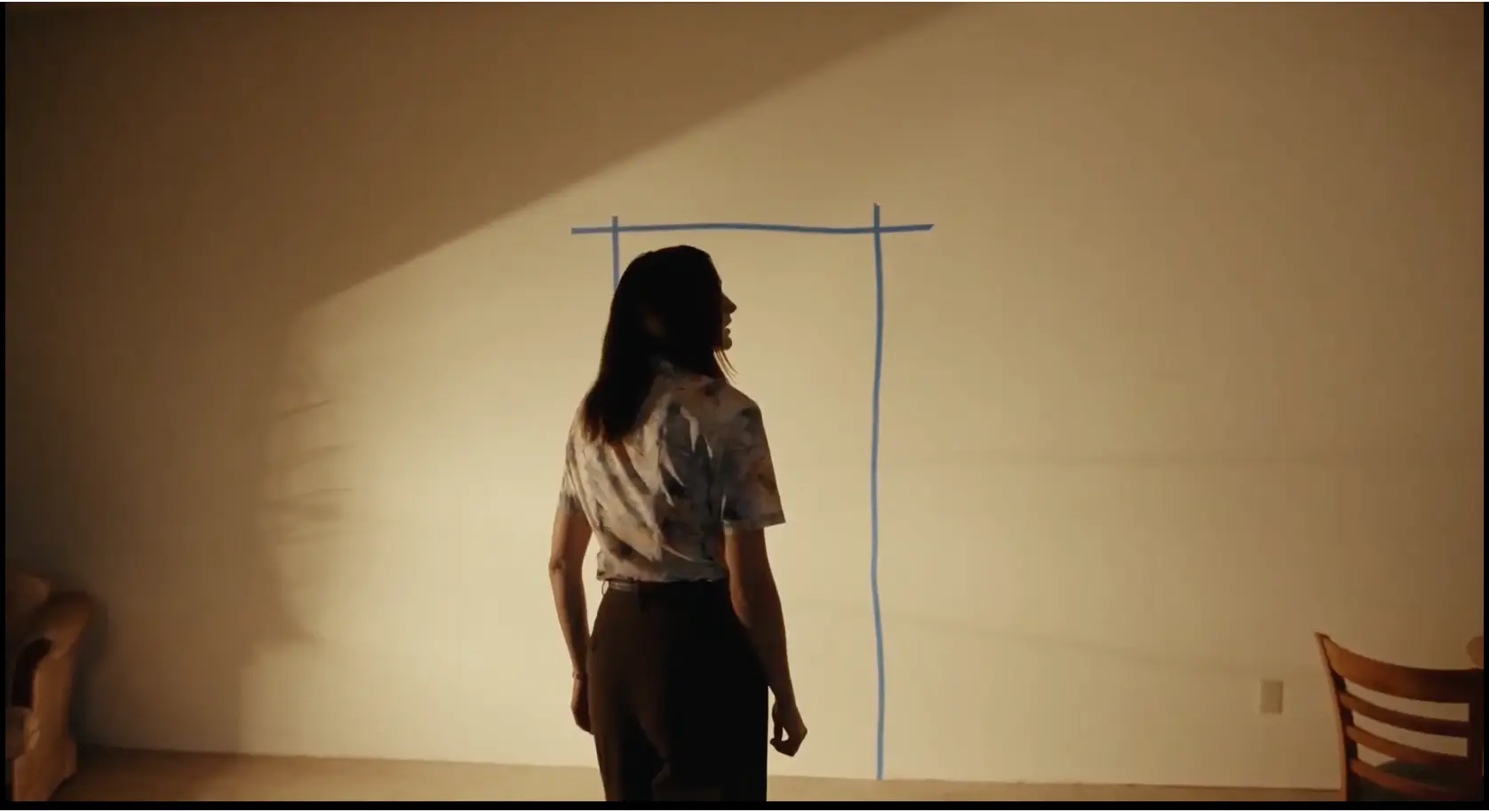
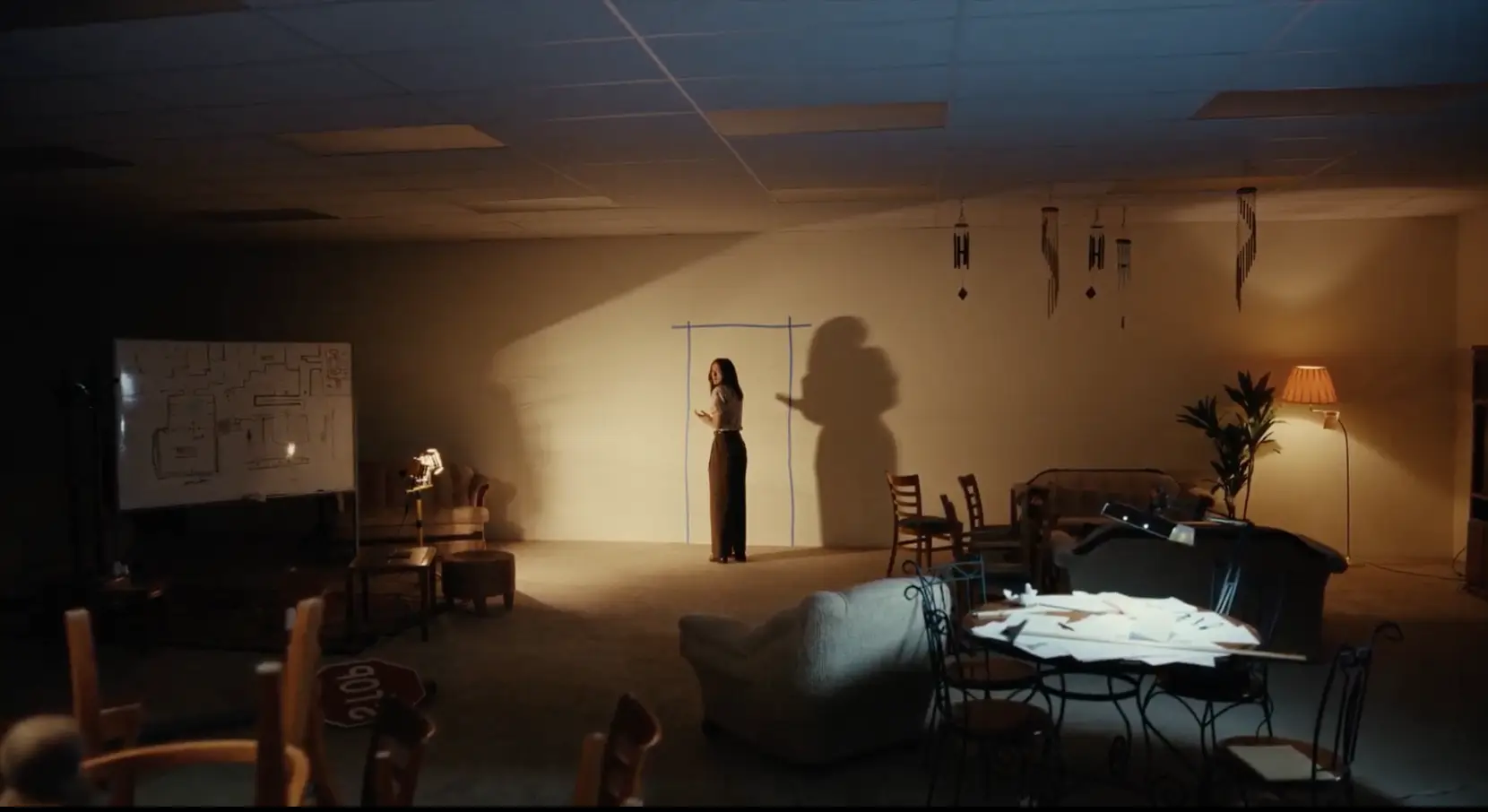
A character stands inside a doorway outline drawn in tape on a blank wall, with a huge shadow looming beside her
A “doorway” that is only a line of tape on a blank wall — the film’s clearest image of impossible architecture.

Both films also use symmetrical compositions and slow camera movement to suggest that the environment is controlling the frame. The characters appear temporarily permitted to occupy these spaces rather than truly inhabiting them.

In The Shining, Danny’s tricycle journeys teach the audience the visual rhythm of the Overlook. The alternating sound of wheels moving across hard flooring and carpet makes us conscious of every threshold. Each corner might reveal nothing, the twins or an image that breaks the logic of the hotel.

Backrooms creates a similar anticipation. Corners become editing points inside the physical environment. Every turn promises a revelation, but the most disturbing possibility is often another empty room.

The fear comes not only from what may appear, but from the possibility that the architecture will continue forever.

The Backrooms do not simply contain the horror. They are the horror.

From the reviewOn the film's core idea

The Blair Witch Project and the Horror of Failed Navigation

The film also owes a clear debt to The Blair Witch Project, particularly in its treatment of navigation.

In The Blair Witch Project, the forest does not need to transform visibly. The characters walk, consult their map and attempt to maintain a direction, yet continually find themselves returning to familiar spaces. The landscape destroys their confidence through repetition.

The terror is not simply that they are lost. It is that the normal methods of becoming unlost no longer work.

The Backrooms operate according to the same principle. Characters attempt to remember routes, identify landmarks and impose patterns upon the environment, but the space resists being reduced to a map.

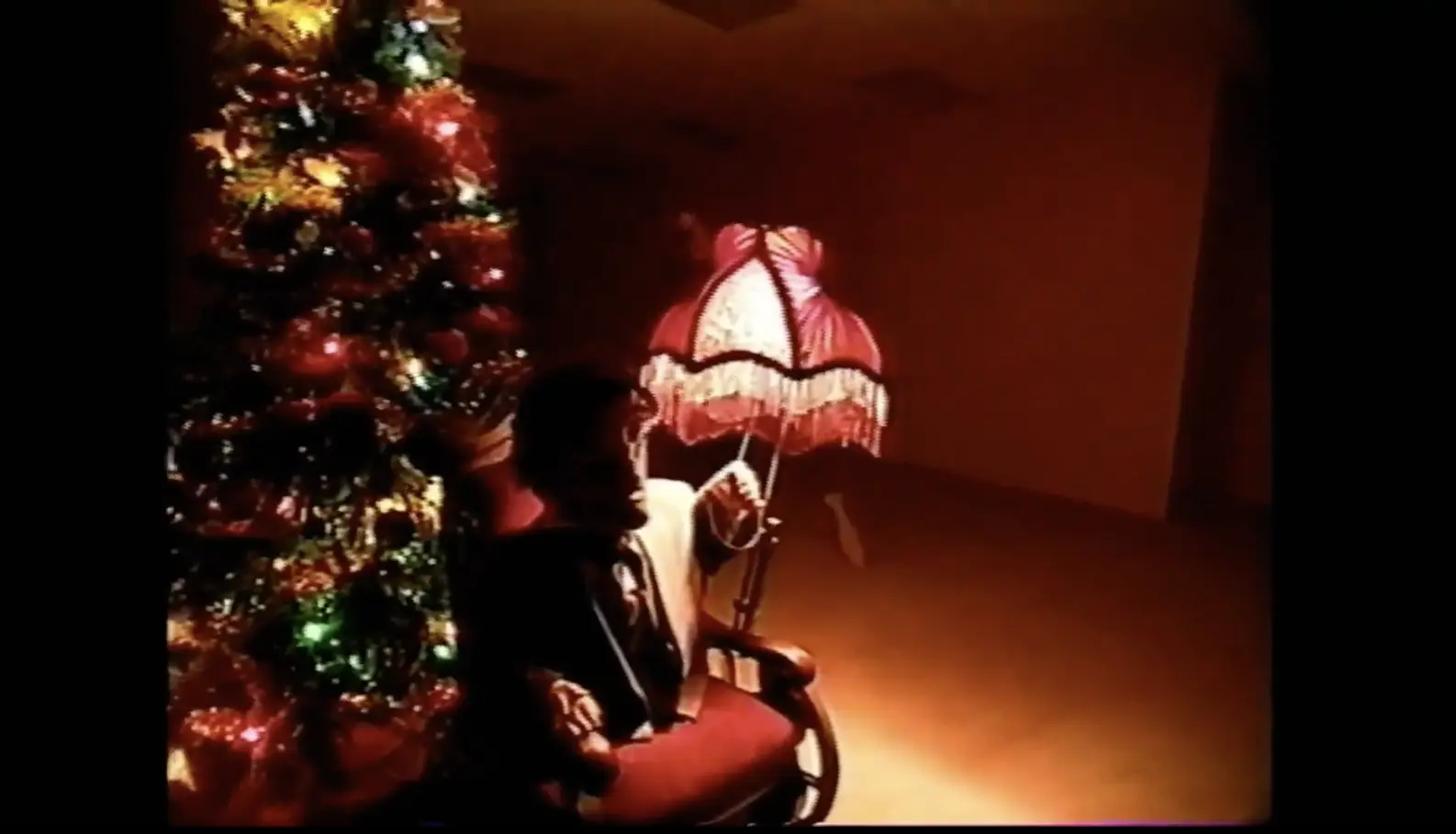
Warm, grainy VHS-style home-video footage used in the film's analog-horror sequences
The film’s grainy, VHS-style inserts preserve the analog, found-footage texture of Parsons’ original web series.

Parsons’ original YouTube work also helped popularise a form of analog and found-footage horror in which the recording itself becomes evidence of an impossible event. That influence remains present in the feature, even as the film expands beyond the visual limitations of a single recovered tape. The result preserves the feeling that we are witnessing material never intended for public viewing, but combines it with the scale and control of a fully designed feature production. The feature grew from Parsons’ viral online series, which he began creating as a teenager using Blender and Adobe After Effects. (Wikipedia)

The comparison with Blair Witch is also important because both films understand that withholding information can generate more fear than explanation.

A weaker adaptation of the Backrooms concept might have spent much of its running time cataloguing levels, monsters and rules. Parsons is more interested in the experience of being inside the environment. The film offers mythology, but its strongest passages retain the primitive anxiety of not knowing where the next corridor leads.

Stranger Things and the Corrupted Reflection of Reality

The relationship to Stranger Things is most apparent in the idea of a parallel environment that reflects familiar reality while corrupting it.

The Upside Down reproduces recognisable places, but transforms them through decay, darkness and organic contamination. A family home, school or public building remains geographically familiar while becoming physically hostile.

The Backrooms are less obviously organic, but they create a related sensation. The environments appear to have been derived from human memory and commercial design, then emptied of social purpose. Instead of covering our world with vines and spores, they reconstruct it as a sequence of architectural approximations.

Both works also create horror from crossing an apparently ordinary threshold. A wall, doorway or damaged surface can become an entrance into another system of reality. Once that boundary is crossed, returning is not simply a matter of walking backwards through the same door.

A domestic kitchen inside the Backrooms with a still, silent figure standing in the background
A recognisable domestic space — a kitchen — reproduced without the life that would normally give it meaning.

Yet Backrooms is colder than Stranger Things. The Upside Down often feels predatory and alive. The Backrooms can feel indifferent. They do not always appear to be attacking the characters; they may simply be continuing, endlessly and without concern for the human beings trapped inside them.

That indifference gives the film its existential quality.

The characters are not necessarily important to the space. They may be temporary errors moving through a structure too large to notice them.

Poltergeist and the Terror Beneath Commercial Suburbia

The connection to Poltergeist comes through the corruption of commercial and domestic security.

Poltergeist begins in a planned suburban community whose homes, televisions and consumer comforts suggest order. The horror emerges from the discovery that the environment has been built over something unresolved and that the apparently safe home contains entrances into another dimension.

Backrooms similarly locates the impossible beneath a furniture showroom — a place devoted to selling idealised versions of domestic comfort. Sofas, beds, tables and room displays are supposed to help customers imagine secure and attractive homes. Beneath that commercial surface lies an endless environment in which the concept of home has been copied but emptied of warmth.

This is one of the film’s smartest visual ideas.

A furniture showroom already contains artificial rooms. It presents living spaces without the lives that would normally give them meaning. Walls may not connect to ceilings, windows may look onto nowhere and bedrooms may sit a few metres from dining rooms belonging to completely different imagined houses.

The showroom is therefore already a controlled simulation of domestic reality.

The Backrooms feel like that logic extended infinitely.

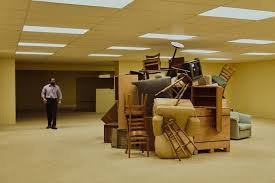
A huge chaotic pile of stacked furniture in the middle of an empty Backrooms room
Furniture stripped of its showroom staging and piled with no purpose — commercial comfort turned meaningless.

This creates a powerful thematic bridge between consumer architecture and supernatural space. The characters enter a world made from the visual remains of human environments, just as Poltergeist turned the ordinary family home into a place where walls, cupboards and television screens could no longer be trusted.

How Backrooms compares to its clearest influences

FilmShared IdeaKey Difference
The ShiningUntrustworthy, maze-like architectureThe Overlook still functions as a real hotel; the Backrooms don’t function as anything
The Blair Witch ProjectNavigation itself becomes the horrorBlair Witch uses a real forest; Backrooms uses built, repeating interiors
Stranger ThingsA parallel world that mirrors and corrupts oursThe Upside Down feels alive and predatory; the Backrooms feel indifferent
PoltergeistDanger hidden beneath ordinary commercial/domestic spacePoltergeist corrupts a home; Backrooms corrupts a furniture showroom

Osgood Perkins and the Value of Restraint

Osgood Perkins‘ involvement as one of the film’s producers is significant, even though Backrooms remains clearly Kane Parsons’ film. Perkins has built his directorial identity around atmosphere, negative space, carefully controlled compositions and the fear produced by information that remains just beyond the audience’s understanding. He was among the film’s credited producers alongside figures including James Wan and Shawn Levy. (Wikipedia)

Films such as The Blackcoat’s Daughter and Longlegs demonstrate Perkins’ interest in environments that feel spiritually contaminated before the narrative fully explains why. His frames often invite the viewer to examine doorways, dark areas and empty portions of the image, waiting for something that may already be present.

That sensibility is compatible with the Backrooms concept.

The film is strongest when it resists the temptation to overpopulate its spaces. An empty corridor becomes frightening because the composition encourages us to search it. A distant shape may be an architectural feature, a person or something that has learned to resemble one.

Parsons shares Perkins’ understanding that horror can be generated through duration. A frame becomes uncomfortable when it remains on screen long enough for the viewer to move beyond simple recognition and begin imagining possibilities.

A frightened character in close-up with a motionless, ominous figure visible in the background
The film’s most restrained scares come from something merely present in the frame, never explained.

Perkins’ producing presence should not be overstated as evidence that he directed the film from behind the scenes. Parsons’ authorship is clear, particularly in the relationship between analog imagery, digital culture and liminal architecture. But the partnership makes creative sense. Both filmmakers recognise that dread often begins before the audience can explain what it is seeing.

Pro Tip for First-Time Viewers

Watch this one with the lights off and the volume up. The film’s best moments are long, quiet held shots of empty rooms — the kind of horror that rewards patience rather than jump-scare reflexes.

The Production Design Is More Important Than the Monster

Many horror films are marketed around the reveal of their creature. Backrooms is more interesting because its most memorable creation is the environment itself.

The film does contain physical threats, but the Backrooms would remain frightening without them. In fact, some of the most effective sequences involve little more than a character entering a space and attempting to understand its dimensions.

This is where Danny Vermette’s production design becomes so important. The walls are not merely yellow; they exist within a carefully controlled range of sickly institutional tones. The carpets are patterned enough to feel designed but never distinctive enough to become useful landmarks. The fluorescent lighting appears functional while creating no sense of comfort or natural time.

Every design decision supports disorientation.

The Backrooms must be monotonous without becoming visually monotonous for the audience. That is a difficult balance. If every room were genuinely identical, the film would quickly become dramatically flat. If every room were wildly different, the central concept of repetition would disappear.

A vast empty room seen through a doorway, with a single purple chair and scattered belongings on the floor
Every design decision supports disorientation — the world evolves while feeling generated by the same flawed intelligence.

The designers solve this by creating variations within a coherent visual language. Ceiling heights change. Corridors narrow or widen. Domestic, industrial and commercial forms begin to bleed into one another. The world evolves while retaining the sense that it was generated by the same flawed architectural intelligence.

One review described the film’s production design as “controlled ugliness,” which captures the achievement well: the spaces are intentionally banal, but the filmmaking is never visually careless. (The Jam Report)

The ugliness is authored.

Kane Parsons Understands the Original Hook

The risk in adapting an internet phenomenon is that the feature film will explain away the quality that made the original compelling.

The early Backrooms image worked because almost nothing was known about it. The viewer was given an empty yellow space and the suggestion that someone had accidentally fallen outside the normal boundaries of reality.

That is enough to activate the imagination.

Parsons understands that the concept is not simply “a maze with creatures.” Its deeper appeal lies in the fear of entering a place that seems to remember humanity without containing human life.

A screenshot from Kane Parsons' original low-budget viral Backrooms short film, showing an impossible slanted room angle
The 2022 viral short that started it all — the same impossible-geometry idea, built on a fraction of the budget.

The film expands the idea through characters, a wider narrative and major physical production, but it repeatedly returns to that original sensation. A person stands inside a room that should make sense and realises that it does not.

For a filmmaker making his feature debut at such a young age, Parsons demonstrates remarkable visual assurance. The film is not flawless, and its mythology occasionally competes with the purity of its premise. The more information a horror film provides, the harder it becomes to preserve the terror of the unknown.

Behind-the-scenes photo of director Kane Parsons discussing a scene with Chiwetel Ejiofor on the yellow-walled Backrooms set
Kane Parsons on set with Chiwetel Ejiofor — from a teenager’s Blender experiments to a fully-built physical production.

However, the strength of the visual world carries the film through its more complicated narrative passages. Parsons knows how to compose emptiness, how to delay a reveal and how to make a static architectural feature feel threatening.

That is not simply internet fluency. It is direction.

Where Backrooms Is Less Effective

The film is at its strongest when the characters are exploring, listening and attempting to understand the environment. It becomes more conventional whenever the Backrooms are reduced to a location through which people must run while being pursued.

This is a familiar tension in modern horror. Atmosphere attracts the audience, but narrative escalation often demands increasingly visible danger. Once a threat has been clearly identified, framed and explained, part of its power inevitably disappears.

The human story is necessary because a feature cannot survive entirely as an architectural demonstration. Chiwetel Ejiofor and Renate Reinsve give the film emotional seriousness, preventing the characters from feeling like anonymous figures moving through an elaborate installation. Parsons also uses the central relationship to connect the impossible environment to guilt, memory and psychological fracture.

A close-up of a man's uneasy face with a still, unsettling figure visible near an archway in the background
Chiwetel Ejiofor and Renate Reinsve give the film emotional seriousness the architecture alone couldn’t carry.

Even so, there are moments when the film’s desire to provide narrative machinery is less compelling than the simple act of opening another door.

That is not a fatal weakness. It is evidence of how powerful the central environment is. The art direction creates such a compelling form of fear that conventional plot mechanics can feel less interesting by comparison.

Heads Up

If you’re going in expecting a monster-first creature feature, temper your expectations — the chase sequences are the film’s least distinctive passages. The atmosphere is the main event.

A New Generation’s Shining?

Calling Backrooms a new generation’s The Shining would be too simplistic, but the comparison points towards what makes the film culturally significant.

Both films understand that architecture can hold psychological power. Both create spaces that cannot be reliably mapped. Both make empty corridors feel observant. Both use production design not merely to illustrate the story, but to determine how the story is experienced.

The difference is generational.

The Overlook Hotel comes from the architecture of institutional luxury: grand corridors, formal carpets, ballrooms and an accumulated historical past. The Backrooms come from late twentieth-century commercial anonymity: offices, showrooms, suspended ceilings, fluorescent lighting and spaces designed to be used without being remembered.

One is haunted by history.

The other feels haunted by the absence of history.

For audiences raised around shopping centres, office parks, multiplayer game environments, abandoned retail units and digitally generated spaces, the Backrooms offer a recognisable modern nightmare. They represent the fear that behind the designed surfaces of everyday life lies an infinite system with no human purpose.

A character seen from behind, standing before a doorway outline drawn in tape on a blank wall
No history, no ornament — just a shape on a wall where a door should be.

Final Verdict

Backrooms is a reminder that great horror does not always begin with a monster. Sometimes it begins with wallpaper, carpeting, fluorescent lighting and a doorway positioned where no doorway should exist.

As a piece of production design, the film is exceptional. Its sets create scale, atmosphere and a visual identity powerful enough to exist beyond the plot. The influence of The Shining can be felt in its impossible architecture, while The Blair Witch Project echoes through its failed navigation and analog-horror language. Stranger Things and Poltergeist provide useful parallels in their corrupted reflections of familiar spaces, while Osgood Perkins’ producing involvement feels appropriate for a film so committed to composition, restraint and sustained dread.

Most importantly, Kane Parsons has not treated art direction as decoration.

He has treated it as story, character, mythology and threat.

The Backrooms do not simply contain the horror.

The Backrooms are the horror.

A cluttered basecamp room full of mismatched furniture, a whiteboard covered in a hand-drawn map, and wind chimes hanging from the ceiling
Trying to map the unmappable: a whiteboard covered in guesses, in a room that refuses to hold still.

Frequently Asked Questions

No. It originated as an internet “creepypasta” / liminal-space image macro before Kane Parsons expanded it into a viral analog-horror web series and, eventually, this feature film.

Kane Parsons directed the film, expanding on the YouTube series he began creating as a teenager using Blender and Adobe After Effects. Osgood Perkins produced alongside James Wan and Shawn Levy.

The film’s official marketing lists a theatrical release date of May 29, via A24.

It discusses the film’s premise, tone and visual ideas in detail but avoids revealing the movie’s major final twists.

Learn More About Blood Star

If you’re interested in how independent filmmakers create ambitious thrillers on limited budgets, you can explore more about Blood Star, including its cast, production and behind-the-scenes story.

If you’d like to watch the film, visit the Blood Star Watch Page to see where it’s currently available to stream or purchase.
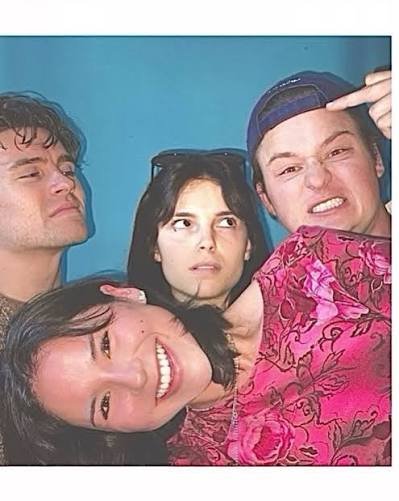
Serial Killer Movies: How Our Indie Serial Killer Movie Became One of the Top Serial Killer Movies of the Year

serial killer movies

Serial Killer Movies: How Our Indie Serial Killer Movie Became One of the Top Serial Killer Movies of the Year

When we chose to make a serial killer movie, we weren’t chasing controversy — we were leaning into one of the most durable and commercially powerful genres in cinema. Serial killer movies have endured for decades because they combine psychological intensity, crime structure and moral tension in a way that few other genres can.

At the centre of Blood Star is a premise that immediately reframes the serial killer movie format: the killer is a cop. We reveal this early. It isn’t a late twist. It’s the foundation of the film.

That decision was what made the project feel urgent and distinct within the world of modern serial killer movies. A serial killer who operates inside law enforcement doesn’t just hunt victims — he controls narrative, access and perception. He understands procedure. He manipulates trust. He weaponises institutional authority. Serial killer thriller movies often explore obsession and compulsion. This serial killer movie explores power and control pushed to the extreme. That narrative hook was the reason we committed to the genre.

Survival Horror Movies

What Makes Serial Killer Movies So Commercially Powerful?

Why Serial Killer Thriller Movies Continue to Sell

Serial killer movies consistently rank among the most watched and most discussed crime-driven films because they are built around recognisable structure. A serial killer movie offers escalating tension, psychological cat-and-mouse dynamics and clear stakes.

When distributors curate collections of the best serial killer movies or assemble lists of top serial killer movies for streaming platforms, they are looking for clarity. The genre promises:
• A central predator
• A psychological battle
• Escalating threat
• Moral imbalance

Modern serial killer movies also sit at the intersection of crime thriller and horror, expanding their audience reach. Psychological serial killer movies in particular attract viewers who may not engage with supernatural horror but are drawn to character-driven tension. That commercial flexibility is why serial killer movies remain globally viable.

Checkout Our Production

A Serial Killer Movie About Authority and Abuse of Power

Many serial killer movies focus on anonymity — a predator hiding in plain sight. In our case, the serial killer is visible, respected and empowered by the system. The idea of a police officer abusing institutional authority to commit extreme violence created a deeper layer than a conventional serial killer movie. It allowed the film to explore how power protects the predator rather than exposing him.

Psychological serial killer movies become more unsettling when the antagonist holds structural control. It shifts the fear from random violence to systemic manipulation. That thematic angle gave the film weight and separated it from generic serial killer thriller movies.

An Indie Serial Killer Movie Shot in Ten Days

Blood Star was a self-financed indie serial killer movie shot in ten days. There were no safety nets, no large marketing machine and no extended production schedule. We risked everything to make it. Working within the serial killer movies genre under those constraints forced discipline. The tension had to come from structure and performance, not spectacle. The pacing had to hold. The psychological pressure had to escalate naturally.

The best serial killer movies are rarely defined by scale. They are defined by control. We understood that if we respected the mechanics of serial killer thriller movies — escalation, proximity and psychological imbalance — the film could punch above its budget.

Check Our Instagram

Packed Theatres, Festival Selection and Rapid International Sales

The first festival screenings were intense. Packed theatres responded physically to the tension. Silence in key moments stretched longer than expected. Audiences leaned forward. Serial killer movies often find their life on streaming platforms, but this serial killer movie proved that the genre still works theatrically when executed with precision.
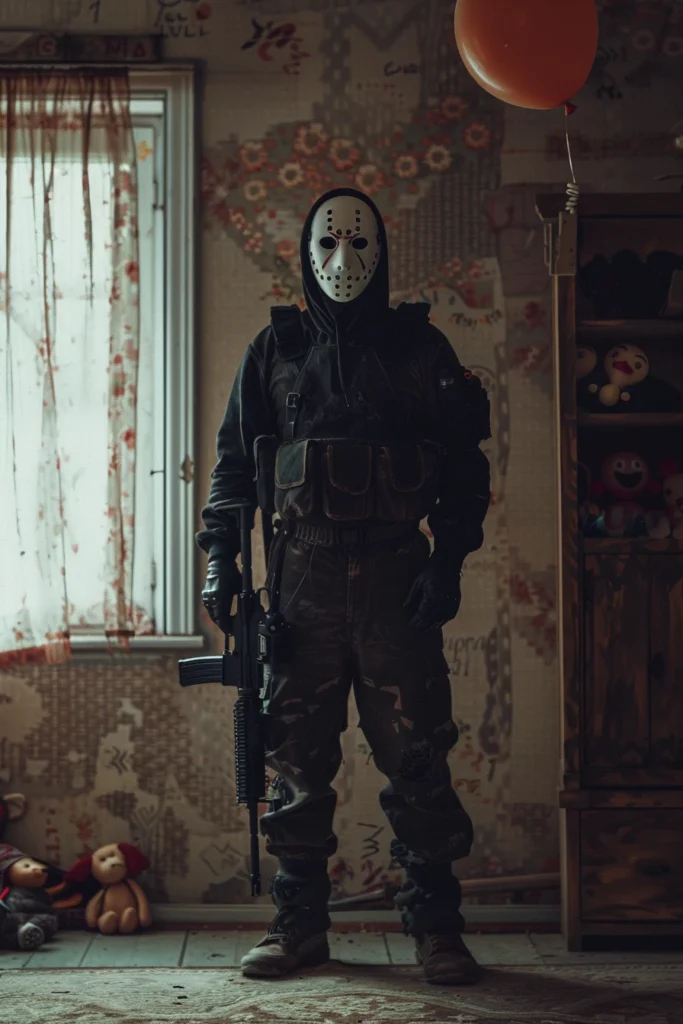
Festival selections amplified visibility. Buyers immediately understood how to position the film within collections of modern serial killer movies. Conversations accelerated. Within a short window, the film sold into major international markets.

That speed wasn’t luck. It was genre clarity. When you commit to a serial killer movie that understands commercial structure, it becomes easier for distributors to slot it into conversations about the best serial killer movies and top serial killer movies of the year.

John Schwab — Blood Star
Cinematographer Pascal Combes Knocke movies — Blood Star

What Separates the Best Serial Killer Movies From the Rest?

The best serial killer movies are not simply violent. They are controlled. They escalate psychologically before escalating physically. They understand pacing. Psychological serial killer movies that endure focus on power imbalance. In our case, the dynamic between predator and victim is intensified by institutional authority. The serial killer does not just stalk; he commands.
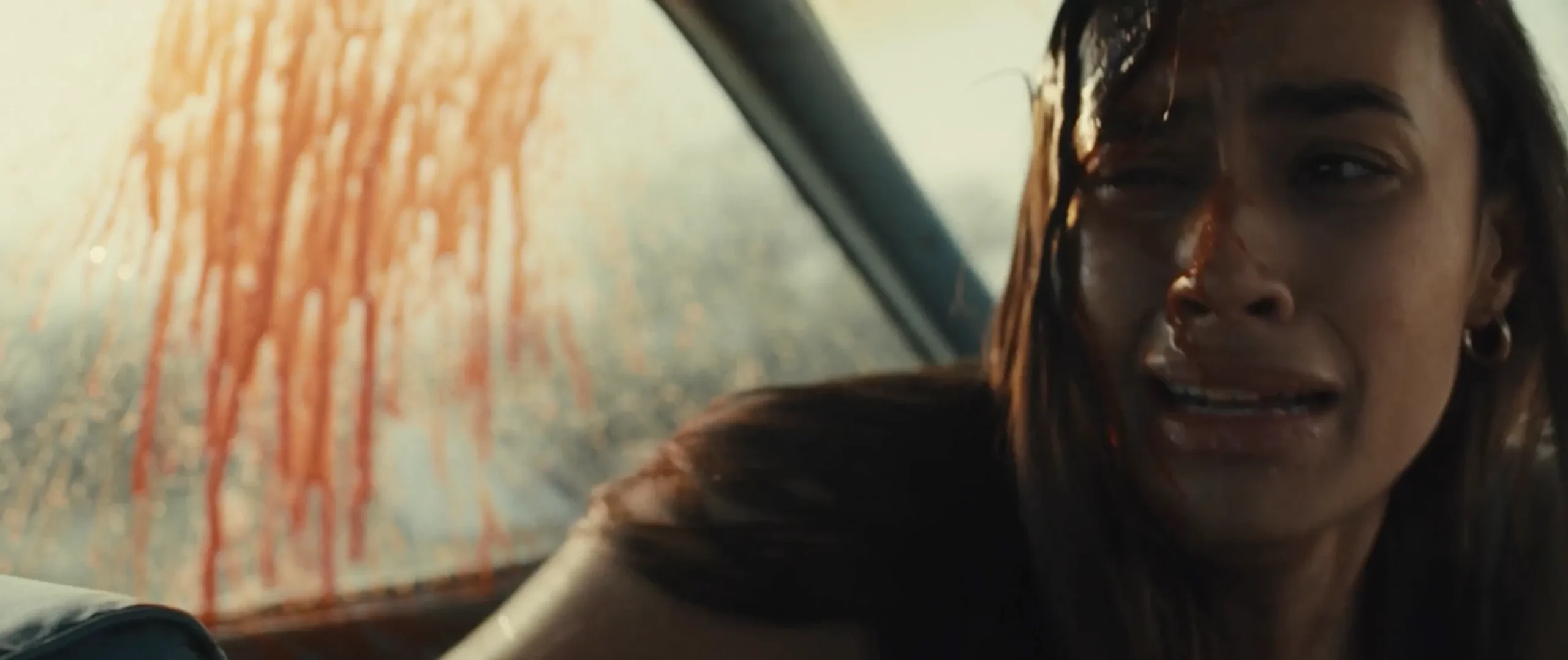
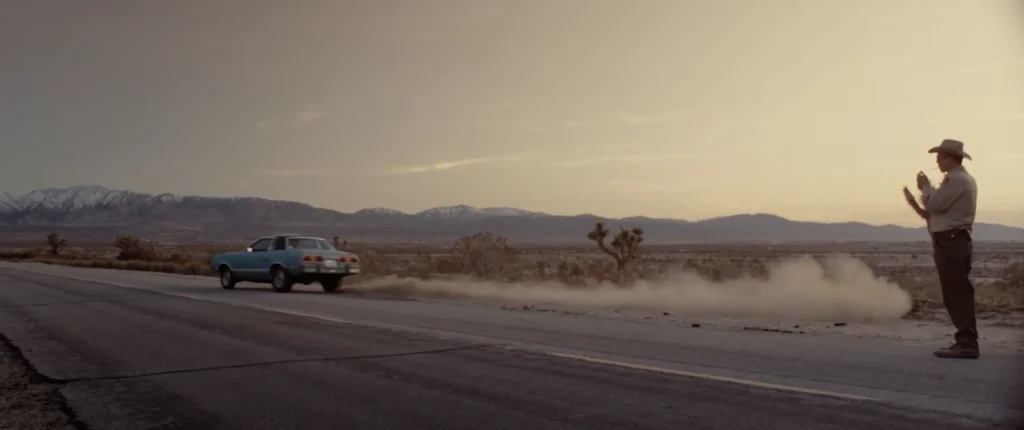
Serial killer thriller movies resonate when the antagonist feels disturbingly plausible. When the power dynamic feels real. When the abuse of control is methodical rather than chaotic. That realism anchors modern serial killer movies in something more unsettling than spectacle.

Why Serial Killer Movies Remain One of the Top Genre Pillars

Serial killer movies have outlasted trends because they are built on universal fear: being chosen, hunted or controlled by someone who sees you as expendable. When platforms curate lists of the best serial killer movies or assemble rankings of top serial killer movies, they are reinforcing the genre’s durability. Audiences continue to seek out serial killer thriller movies because they offer psychological intensity grounded in reality.

The lesson for us was clear. The risk was not making a serial killer movie. The risk would have been making something undefined. By committing fully to the serial killer movies category — and by building the narrative around authority abused to the extreme — we created clarity. That clarity translated into packed theatres, festival momentum and international sales. Genre strategy paid off.

Check Our Wikipedia

Frequently Asked Questions About Serial Killer Movies

What defines a serial killer movie?

A serial killer movie focuses on a recurring predator whose crimes follow a pattern. Serial killer movies emphasise psychology, escalation and pursuit rather than one-off criminal acts.

What are the best serial killer movies?

The best serial killer movies combine psychological depth with sustained tension. They prioritise character dynamics, power imbalance and credible threat over spectacle.

Why are serial killer movies so popular?

Serial killer movies remain popular because they blend crime, horror and psychological thriller elements. Audiences are drawn to the exploration of control and obsession that defines serial killer thriller movies.

What makes modern serial killer movies different?

Modern serial killer movies often focus more on realism and institutional themes. Psychological serial killer movies increasingly examine power structures and moral corruption rather than mythic villain archetypes.

What are the top serial killer movies this year?

The top serial killer movies each year tend to be those that commit fully to genre mechanics and deliver disciplined escalation. Indie serial killer movies that respect structure can compete strongly alongside larger studio productions.

Ljaco74 A man standing in a vast dimly lit room facing a sing 63c7d53e 757e 43b4 9e71 3d9a6e9a6247 1 — Blood Star

You Want to Make a Feature Film. But Is This Script Worth Your Life?

You Want to Make a Feature Film But Is This Script Worth Your Life — Blood Star

At some point, every first-time filmmaker reaches the same uncomfortable moment.

You’ve written a script. You’ve lived with it for months, maybe years. You know its rhythms. You know its flaws. You’ve defended it in late-night conversations and quietly rewritten scenes you swore you’d never touch again. And then a more dangerous thought creeps in:

What if I actually make this film?

This is the moment where filmmaking stops being purely creative and starts becoming existential. Because a first feature film doesn’t just cost money. It costs time, relationships, emotional bandwidth, reputation, and often years you don’t get back. If you’re planning to make a film independently or speculatively — without studio backing, without guarantees — you’re effectively betting a chunk of your life on a single script.

So the real question isn’t whether your screenplay is “good.”

The question is whether it’s worth making as your first feature film.

And there are ways to evaluate that — not with certainty, but with honesty — if you’re brave enough to ask the right questions.


Can You Pitch Your Feature Film Without Apologising?

The first real test of a feature film script isn’t coverage, feedback, or notes.

It’s conversation.

Imagine you’re sitting next to someone on a plane. They ask what you’re working on. You have thirty seconds before they lose interest. What do you say?

If you find yourself qualifying the idea, explaining tone shifts, or saying things like “it’s not really about the plot”, you may have a problem. Not because complexity is bad, but because confusion is expensive — especially for first-time filmmakers.

A strong feature film concept has gravity. It pulls people in. It doesn’t require footnotes. When an idea is clear, people lean forward. When it isn’t, they politely lean back and change the subject.

This matters because the entire film industry runs on shorthand. Festival programmers, producers, sales agents, distributors, and journalists all encounter films first as ideas, not finished movies. If your concept doesn’t travel cleanly, your film won’t either.

If you can’t explain your feature film simply without feeling like you’re betraying it, you may not yet understand what it truly is.


If Your Film Were a Single Image, What Would It Be?

Before there’s a feature film, there’s a promise.

That promise is visual.

Long before anyone watches your movie, they’ll see a rectangle on a screen: a poster, a thumbnail, a still image competing with thousands of others. That image needs to communicate something instantly — this film is for you.

If you close your eyes and genuinely can’t picture that image — not a mood board or a collage, but one arresting idea — that’s important information. It doesn’t mean your script is bad. It means it might not yet know what it wants to be.

Strong feature film ideas tend to crystallise visually early. Weak ones often hide behind atmosphere. And atmosphere is hard to sell.

This isn’t about marketing polish. It’s about clarity of intent. A poster forces you to confront what your film is actually offering emotionally: fear, tension, catharsis, intimacy, dread. If you can’t see it, neither will your audience.


Be Honest About the Genre of Your First Feature

One of the most damaging mistakes first-time filmmakers make is lying to themselves about genre.

Genre isn’t a dirty word. It’s an emotional contract. When someone presses play on a film, they’re agreeing to feel a certain way for ninety minutes. If you don’t know what emotional experience you’re offering, the audience won’t either.

This is especially important when making an independent feature film without a safety net. Some genres are simply more forgiving at the low-budget and debut level. Horror, thrillers, contained genre films — these have built-in audiences actively searching for new titles. They travel well, sell internationally, and forgive unknown casts.

Other genres demand more trust. Slow dramas, subtle character studies, experimental hybrids — these can be artistically powerful, but they are harder to place and easier to ignore unless something cuts through immediately.

There’s no shame in any genre choice. But there is danger in pretending the market doesn’t exist. When writing your first feature film, the most practical question isn’t “what do I want to say?” but “how will this be received by someone who doesn’t know me?”


Film Festivals Aren’t Validation — They’re Strategy

Film festivals are often treated as a single mythical gatekeeper. They aren’t.

They are ecosystems with different appetites, politics, audiences, and risk tolerances. Before submitting your first feature film, you should know where it realistically belongs — not aspirationally, but strategically.

Some festivals want urgency. Some want craft. Some want bold voices. Some want discovery. Very few want ambiguity.

A debut feature lives or dies on momentum. Festivals can create that momentum — but only if the film gives programmers a reason to care. That reason might be topical relevance, emotional punch, formal confidence, or sheer audacity. But it has to be legible.

If your festival strategy is “we’ll submit everywhere and see what happens”, you don’t have a strategy. You have hope. And hope is not a plan.


Distribution Is Where First-Time Filmmakers Get Hurt

At some point, someone has to pay for your film to exist in the world.

Distributors aren’t villains. They aren’t saviours either. They are businesses whose job is to extract value from content. They care about audience, positioning, and risk. They do not care how hard your shoot was.

This is where many first-time filmmakers stumble — not because their film is bad, but because they don’t understand leverage. Festivals, reviews, press, and awards are currencies. Without them, you are negotiating from weakness.

And contracts matter. Bad distribution deals don’t feel bad at first. They feel like relief. Then they quietly own your film for years.

If you’re making a feature film speculatively, legal advice isn’t optional. It’s part of the cost of making a first feature.


Marketing Isn’t the Enemy of Art — It’s the Language of Survival

Here’s the uncomfortable truth: a film no one can talk about doesn’t exist.

Marketing isn’t about lying. It’s about framing. It gives people language. Journalists don’t just review films — they contextualise them. Publicists don’t invent stories — they amplify what’s already there.

Ask yourself honestly: what would someone write about this film besides the plot?

Why now?

Why this story?

Why this perspective?

Why you?

If the only answer is “because it’s good”, you’re in trouble. Many films are good. Very few are necessary.

Uniqueness doesn’t mean novelty. It means specificity. It means the film could not have been made by anyone else in quite the same way.


The One Question That Determines Whether Your Script Is Worth Making

Strip everything away and there’s one question no first-time filmmaker can avoid:

If this feature film didn’t exist, would anyone notice?

Not your friends.

Not your collaborators.

The world.

That question isn’t cruel. It’s clarifying.

If the answer is yes — if the idea feels urgent, clear, visual, positioned, and alive — then the fear you feel is probably the right kind. The kind that means you’re about to make something that matters.

If the answer is no, that’s not failure. That’s wisdom. It means the script isn’t finished becoming what it needs to be.

The hardest part of filmmaking isn’t making a feature film.

It’s knowing when a script is worth turning into one.

Blood Star: A Grindhouse Road Horror Movie for a New Generation

Bobbi1 — Blood Star

Set against vast desert roads and isolated towns, the film reimagines familiar road-movie iconography as hostile terrain. Gas stations, motels, and endless stretches of asphalt feel less like pit stops and more like pressure points. The landscape itself becomes complicit, watching silently as danger tightens. This is a world where distance doesn’t equal safety — it amplifies vulnerability.

Horror Road Movies Like Duel — Revisited and Reframed

Fans of horror road movies like Duel will recognise the DNA immediately. Like Spielberg’s classic, Blood Star understands that fear is most effective when it is procedural, inevitable, and tied to authority rather than chaos. The antagonist doesn’t rely on theatrics. Control is exerted calmly, methodically, and without mercy.

Movement offers no advantage. Each mile travelled increases the stakes, and every decision carries consequences. The road is not a means of escape but a narrowing corridor — one that allows no detours, no relief, and no clear end.

A Psychological Desert Road Thriller Built on Pressure

At its core, Blood Star is a psychological desert road thriller. The film’s tension comes not from sudden shocks but from sustained pressure. Silence, distance, and repetition become tools of dread. The desert’s emptiness magnifies every choice, every interaction, and every mistake.

The violence, when it arrives, is direct and unsentimental. There is no stylisation, no indulgence. The film refuses catharsis, choosing instead to maintain momentum. Control is tested not once, but repeatedly, as the protagonist is forced to adapt, resist, and calculate in an environment that offers no mercy.

The Desert as Antagonist

As a desert road horror thriller, Blood Star treats geography as more than backdrop. The desert is a character — vast, indifferent, and inescapable. Its scale dwarfs human presence, reinforcing a sense of insignificance and exposure. Wide horizons offer no comfort; instead, they confirm that help is nowhere nearby.

This approach places the film in stark contrast to more stylised genre entries. The beauty of the desert is acknowledged, but never romanticised. It is stark, desolate, and unforgiving — a perfect setting for a story about power, endurance, and survival.

A Standout Among Indie American Road Movies 2025

Within the landscape of indie American road movies of 2025, Blood Star stands apart for its discipline and confidence. It doesn’t chase trends or lean on irony. Instead, it embraces a stripped-back, almost brutal clarity of purpose. The film knows exactly what it wants to do — and commits fully.

By blending the grit of grindhouse cinema with the precision of modern indie filmmaking, Blood Star delivers a road movie that feels both timeless and confrontational. It challenges the mythology of the open road and replaces it with something far more unsettling: the idea that once you’re moving, there may be no way out.

In Blood Star, the road doesn’t promise freedom. It promises endurance. And survival, here, is never guaranteed.