There was something particularly uncompromising about American cinema in the 1970s. It was a period when filmmakers seemed less concerned with making audiences comfortable and more interested in confronting them with the things they feared. The films were often rough around the edges, sometimes deeply unpleasant, but they possessed an energy and unpredictability that I find increasingly difficult to discover in contemporary mainstream cinema.
I’ve always been attracted to that kind of filmmaking. Stories that place ordinary people in extraordinary circumstances, strip away their security and force them to confront something they cannot understand or control. I’m particularly interested in the moments before violence occurs, when a character begins to realise that something is wrong but hasn’t yet worked out how much danger they’re in. For me, those moments of uncertainty are often more frightening than the violence itself.
When I set out to make Blood Star, I wanted to capture something of that spirit. Not to recreate a 1970s exploitation movie or imitate the visual characteristics of old grindhouse films, but to make a contemporary psychological road thriller that shared their directness, tension and willingness to make an audience uncomfortable.
The American highway seemed the perfect place to explore those ideas. In cinema, the open road has traditionally represented freedom, escape and the possibility of starting again. But in horror movies, that same road can become a place of extraordinary vulnerability. The further you travel from civilisation, the fewer options you have when something goes wrong.
That contradiction became one of the central ideas behind Blood Star.
The Origins of Grindhouse Cinema and American Road Horror
To understand the appeal of grindhouse horror, it’s worth remembering what the term originally meant. Grindhouses were cinemas, particularly associated with American cities such as New York, that screened exploitation films, low-budget thrillers, horror movies and other commercially provocative pictures, often in continuous programmes. These weren’t necessarily films designed for critical approval. They were made to attract audiences with sensational stories, disturbing imagery and experiences that mainstream Hollywood was often reluctant to provide.
The term has since become shorthand for a particular style of filmmaking, but I think it’s important to distinguish the original exhibition culture from the films themselves. Not every exploitation film was shown in a grindhouse, and not every great American road thriller belongs neatly within that category. What interests me is the creative attitude that connects many of them: an economy of storytelling, a willingness to explore uncomfortable subjects and a refusal to reassure the audience that everything will turn out well.
The development of American road horror is particularly fascinating because it draws on several traditions. There are elements of film noir, with its fatalism and morally compromised characters; the western, with its isolated landscapes and struggles for survival; and the psychological thriller, where fear comes from manipulation and the gradual loss of control. By the 1970s, these influences were converging in a series of films that turned highways, small towns and remote landscapes into places of danger.
These movies often begin with the most ordinary of situations. Someone takes a journey, stops for fuel, accepts a lift or encounters a stranger. Nothing about the circumstances initially seems extraordinary. But a single decision changes everything, and the character discovers that the normal protections of everyday life no longer apply.
That simplicity is something I’ve always admired. You don’t necessarily need an elaborate premise to make an effective thriller. Sometimes the most frightening idea is simply being in the wrong place, at the wrong time, with the wrong person.
The Hitch-Hiker (1953): The Foundations of Psychological Road Terror
One of the earliest and most influential examples of the American road thriller is Ida Lupino’s The Hitch-Hiker (1953). Inspired by the crimes of real-life murderer Billy Cook, the film follows two men whose fishing trip becomes a nightmare after they pick up a hitchhiker who turns out to be a killer.
What makes the film so effective is the imbalance of power. The antagonist doesn’t need an elaborate plan or a complicated motivation. He has a gun, he understands how frightened his victims are, and he uses that fear to control their behaviour. Much of the tension comes from the victims’ inability to predict what he will do next.
Lupino also makes remarkable use of the landscape. The remote roads and desert locations create a sense of isolation that feels almost existential. The characters are surrounded by open space, yet they have nowhere to escape. It’s an early example of something that would become central to the desert horror movie: the transformation of geographical freedom into psychological imprisonment.
I find that contradiction particularly compelling. The idea that a landscape can appear limitless while offering almost no possibility of escape is one of the reasons I was drawn to setting Blood Star in the American Southwest.
Duel (1971): When the Road Becomes the Enemy
Steven Spielberg’s Duel (1971) remains one of the most extraordinary examples of economical thriller filmmaking. Originally produced as a television film, it takes a remarkably simple premise and sustains it through visual storytelling, escalating tension and an almost unbearable sense of inevitability.
A travelling salesman is pursued by a truck whose driver remains largely unseen. We never receive a satisfying explanation for the attack, and that absence of motivation becomes part of the terror. The protagonist is forced to respond to a threat he cannot reason with, negotiate with or fully understand.
What interests me about Duel is how Spielberg turns the geography of the road into a mechanism of suspense. Every bend, junction and hill creates a new possibility for danger. The landscape becomes an essential part of the storytelling.
Interestingly, Duel was filmed around the Santa Clarita Valley in California, which is where we initially began scouting locations for Blood Star. It’s a fantastic landscape for a chase thriller. The winding roads and mountainous terrain offer endless opportunities for vehicles to disappear around corners, conceal themselves or suddenly reappear.
But for Blood Star, we were looking for almost the opposite.
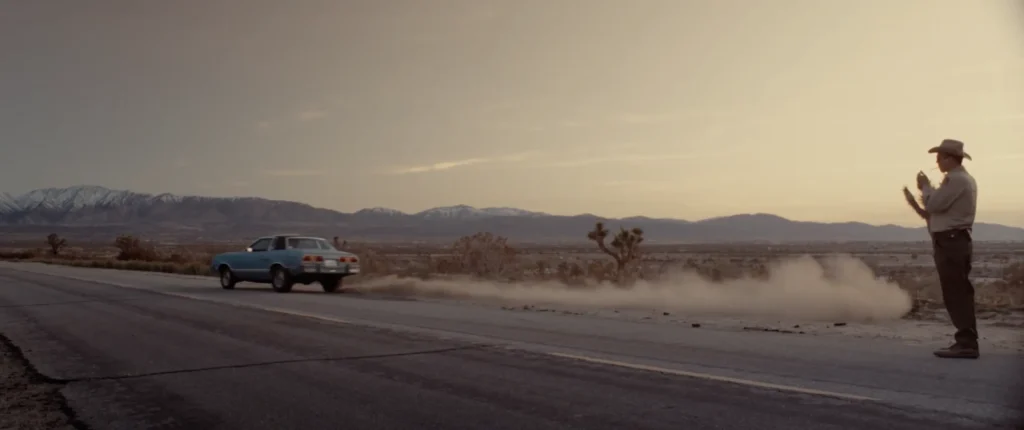
I wanted long, straight roads and vast, open landscapes where there was nowhere to hide. The idea was to create a sense of complete exposure. You could see for miles in every direction, yet that visibility offered no protection. At the same time, we needed mountainous sections where the sheriff could observe his prey from above. The topography was very specific to the psychological relationship between our characters.
We eventually found what we were looking for further out in the desert, around Palmdale.
That decision, however, created a significant production challenge. We were now outside the Los Angeles studio zone, making it impractical to transport the crew back and forth each day. Instead, we had to accommodate everyone locally, adding a substantial expense to an already tight independent film budget.
But there was another side to the equation. Locations within the zone were sometimes five times more expensive than comparable locations further out. What we spent on accommodation could potentially be offset by what we saved on location fees.
That’s the reality of independent filmmaking. Almost every creative decision has a financial consequence, and sometimes what initially appears to be an expensive choice turns out to be the more economical one.
Ultimately, the decision was driven by the story. Spielberg used the bends and blind corners of Santa Clarita to create suspense through what his protagonist couldn’t see. With Blood Star, I wanted to explore the opposite: the terror of being able to see everything around you and realising that there’s still nowhere to escape.
The Texas Chain Saw Massacre (1974): The Power of Independent Horror
Tobe Hooper’s The Texas Chain Saw Massacre (1974) is often remembered for its brutality, but I think one of its greatest achievements is the atmosphere of dread it creates long before the violence begins.
The film feels hot, oppressive and almost physically uncomfortable. Its locations appear lived-in and authentic, and the sound design creates a sense of disorder and unease. The audience is never allowed to settle into a comfortable rhythm.
What is particularly remarkable is how much Hooper achieved with limited resources. The film demonstrates that the impact of independent horror cinema is not necessarily proportional to its budget. In fact, the roughness and immediacy of the filmmaking can become part of its identity.
That was an important consideration when making Blood Star. We shot the film in the desert over ten days with a crew of fewer than twenty people. Working on that scale requires a different mentality from a conventional feature production. You have to understand exactly what the story needs, where the tension comes from and which elements are essential.
I don’t believe a limited budget should automatically mean a limited cinematic ambition. It means making deliberate choices about where to place your resources and how to use the locations, performances and sound to their greatest effect.
One of the lessons I take from films such as The Texas Chain Saw Massacre is that atmosphere is not something you can simply purchase. It comes from the relationship between the camera, the environment, the performances and the audience’s expectations.
Race with the Devil (1975): Paranoia on the American Highway
Another fascinating entry in the history of road horror is Jack Starrett’s Race with the Devil (1975), starring Peter Fonda and Warren Oates. The film follows two couples travelling through Texas in a recreational vehicle who witness what appears to be a ritual murder and subsequently find themselves pursued.
What makes the film particularly effective is the gradual destruction of trust. As the characters attempt to seek help, they become increasingly uncertain about who is involved and whom they can believe.
The familiar institutions of everyday life begin to seem unreliable. The characters cannot be sure whether the people they encounter are offering assistance or leading them into greater danger.
This is an important element of psychological road horror. Isolation is not simply about physical distance. It’s also about the inability to establish whom you can trust.
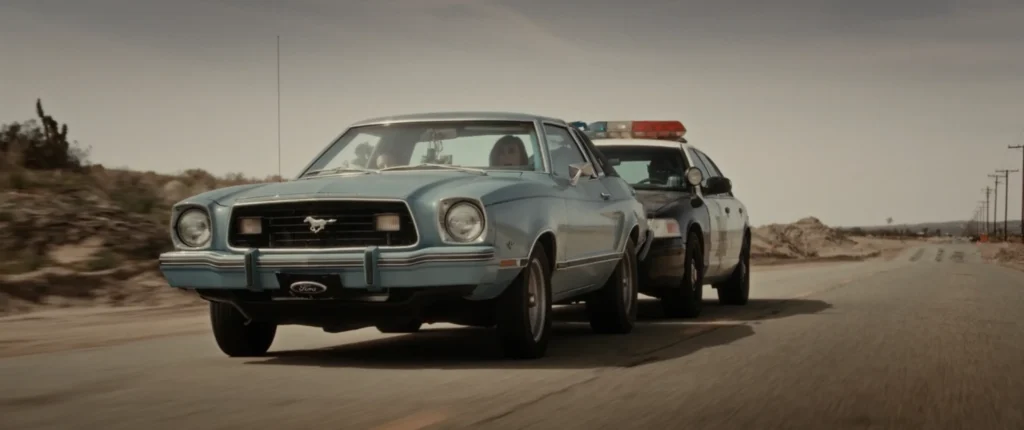
In Blood Star, the threat is complicated by the fact that Sheriff Bilstein represents the law. His badge gives him credibility, authority and the ability to control situations that would otherwise be more difficult for an ordinary criminal to manipulate.
That inversion of authority is central to the film’s psychological tension. The person Bobbi should be able to approach for protection is the person she most needs to escape.
The Hills Have Eyes (1977): The Desert as a Place of Survival
Wes Craven’s The Hills Have Eyes (1977) takes the American desert and transforms it into a landscape where the boundaries of civilisation seem to disappear.
A family travelling through the desert becomes stranded and is forced into a violent struggle for survival. The film draws much of its power from the environment. The rocky hills, remote roads and absence of help create a sense of exposure that is difficult to replicate in an urban setting.
The desert has always interested me as a cinematic landscape because of its contradictions. It can be extraordinarily beautiful, particularly in the early morning or late afternoon, but that beauty conceals an environment that is indifferent to human vulnerability.
There’s also something unsettling about the scale. A person can appear almost insignificant against the mountains and empty horizons. The audience can see the vastness of the landscape, yet understand that the character has very few practical options.
When we filmed Blood Star in the desert, I wanted the environment to become an active part of the storytelling. The long stretches of road, the isolated buildings and the distances between locations all contribute to Bobbi’s predicament.
The desert doesn’t need to be exaggerated or stylised to become frightening. Its emptiness is enough.
The Hitcher (1986): The Psychology of the Predator
Robert Harmon’s The Hitcher (1986) is perhaps one of the clearest examples of the psychological road thriller developing beyond the conventions of traditional exploitation cinema.
Rutger Hauer’s performance as John Ryder gives the film an antagonist who is both physically threatening and psychologically elusive. His behaviour is unpredictable, his motivations remain ambiguous, and his relationship with the protagonist becomes increasingly disturbing.
What I find particularly interesting is that the film is not simply about pursuit. It’s about the psychological relationship that develops between predator and victim.
The antagonist attempts to dictate the terms of the encounter, while the protagonist struggles to regain control over his own decisions.
That dynamic is something I wanted to explore in Blood Star. Sheriff Bilstein is not merely a physical threat. He understands how to manipulate people, how to exploit uncertainty and how to use his position to create situations in which resistance becomes increasingly difficult.
Bobbi’s survival depends not simply on escaping him, but on understanding the nature of the threat and finding ways to challenge his control.
For me, that psychological dimension is what separates a compelling survival thriller from a straightforward chase movie.
Why I Wanted to Make Blood Star
Looking at these films together, what interests me most is how they create tension from relatively simple circumstances. Their protagonists are not superheroes or professional fighters. They’re ordinary people who find themselves confronted by situations they could never have anticipated.
That was fundamental to my approach to Blood Star.
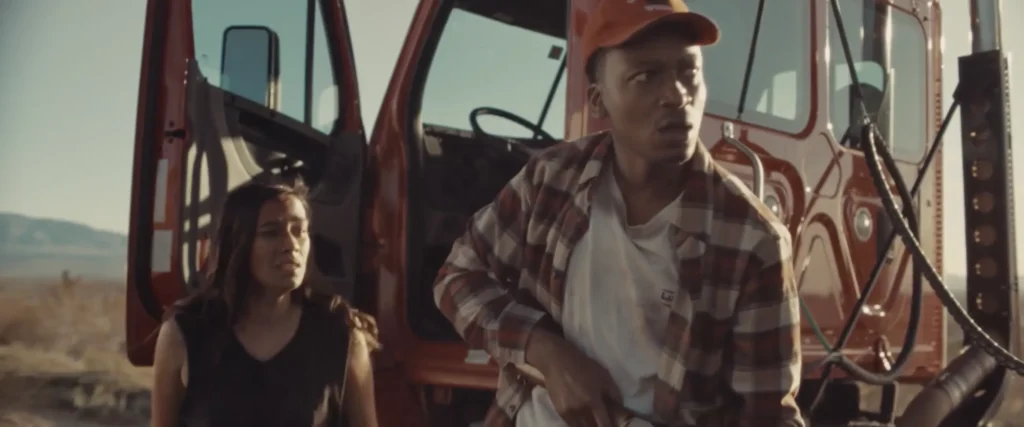
I wanted Bobbi to feel like a recognisable person rather than a conventional action heroine. Someone who makes mistakes, becomes frightened, occasionally misjudges a situation and has to work out how to survive as events unfold.
I was also interested in the abuse of authority. Sheriff Bilstein has the power to stop vehicles, question people and control encounters through the apparent legitimacy of his position. That creates a very different relationship from the one between a traveller and an anonymous roadside killer.
There’s an additional psychological pressure when the person threatening you is someone society has taught you to trust.
The film’s central conflict is therefore not simply about whether Bobbi can outrun the sheriff. It’s about whether she can overcome the psychological control he attempts to establish.
I wanted the audience to experience that uncertainty alongside her, constantly reassessing what they would do in the same situation.
The challenge was to create a thriller that felt relentless without relying on continuous action. Silence, hesitation and the anticipation of violence were just as important to me as the moments when the confrontation became physical.
Making an Independent Horror Feature in Ten Days
Making a feature film in ten shooting days is an exercise in concentration. Every location, camera setup and performance has to contribute something meaningful to the story.
We worked with a small crew in the desert, using the landscape as one of our principal production assets. Rather than trying to disguise the scale of the film, we embraced its contained nature.
The story’s focus on a relatively small number of characters allowed us to concentrate on performance and the escalating relationship between Bobbi and Sheriff Bilstein.
That was particularly important because psychological tension depends on the audience believing the characters’ reactions. If the performances feel artificial, the suspense quickly disappears.
I also wanted the film to have a cinematic quality without losing the immediacy associated with independent exploitation cinema. The desert offered opportunities for striking compositions, but the images needed to serve the tension rather than become an exercise in visual style.
One of the most important decisions in making a contained thriller is knowing when not to show something. A reaction, a pause or an apparently insignificant gesture can sometimes create more unease than an elaborate action sequence.
That economy of storytelling was essential to making Blood Star within the time and resources available.
Why Grindhouse Horror Still Resonates Today
The term grindhouse is often associated with a particular period of cinema, but I don’t think the underlying appeal of those films belongs exclusively to the past.
The best exploitation thrillers confronted audiences with fears that were immediately recognisable: isolation, vulnerability, violence, the abuse of power and the possibility that ordinary life could suddenly become dangerous.
Those anxieties haven’t disappeared. If anything, contemporary audiences may be more conscious of the psychological mechanisms through which people exert control over others.
What has changed is the language of filmmaking. Modern horror audiences are accustomed to sophisticated production techniques, elaborate visual effects and increasingly complex genre narratives.
But I still believe there’s an audience for stripped-back psychological horror built around a simple, frightening situation.
A young woman travelling alone encounters someone who has the power to destroy her life. She has to find a way to survive.
You don’t need an elaborate mythology to understand the stakes.
The challenge is making the audience feel them.
A Grindhouse Road Horror Movie for a New Generation
When I look back at the classic American road horror movies, what stays with me isn’t necessarily the violence. It’s the feeling they create.
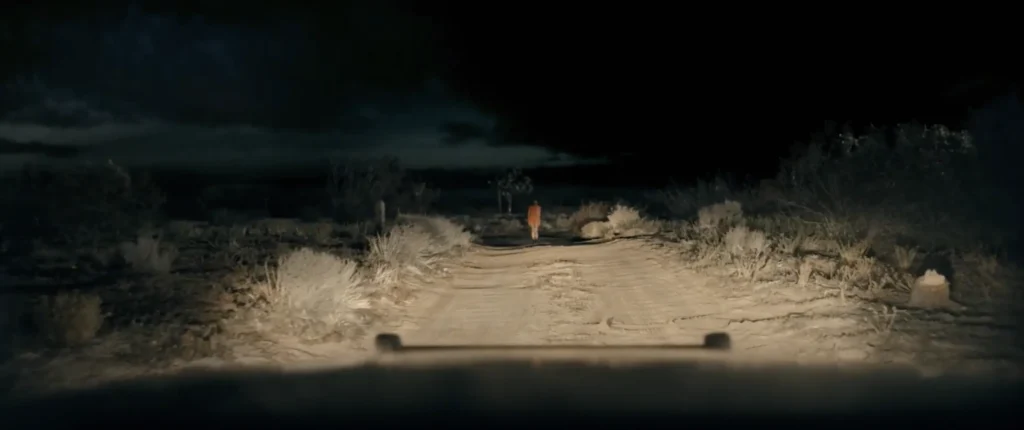
The vulnerability of being far from home. The uncertainty of encountering someone whose intentions you cannot understand. The realisation that the landscape around you offers no protection.
Those are powerful cinematic ideas because they connect with fears that exist beyond the screen.
With Blood Star, I wanted to bring those elements together in a contemporary story while retaining the uncompromising spirit of the films that helped establish the genre.
I wasn’t interested in making a nostalgic imitation of 1970s exploitation cinema. I wanted to make a film that belonged to the same tradition but felt immediate and relevant to a modern audience.
For me, that’s what makes the grindhouse spirit worth revisiting. Not the grain, the scratches or the visual references to an earlier era, but the willingness to tell a direct, uncomfortable story and trust the audience to confront it.
The American highway still represents freedom in our collective imagination. But the best road horror movies have always understood that freedom can disappear remarkably quickly.
Sometimes all it takes is one encounter with the wrong person.
And suddenly, the road ahead looks very different.
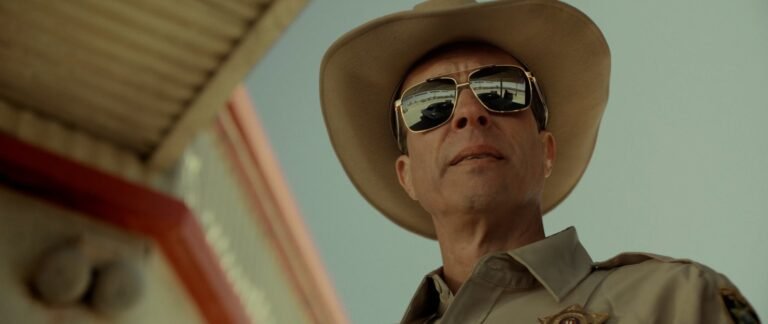
Table of Contents
- The Origins of Grindhouse Cinema and American Road Horror
- The Hitch-Hiker (1953): The Foundations of Psychological Road Terror
- Duel (1971): When the Road Becomes the Enemy
- The Texas Chain Saw Massacre (1974): The Power of Independent Horror
- Race with the Devil (1975): Paranoia on the American Highway
- The Hills Have Eyes (1977): The Desert as a Place of Survival
- The Hitcher (1986): The Psychology of the Predator
- Why I Wanted to Make Blood Star
- Making an Independent Horror Feature in Ten Days
- Why Grindhouse Horror Still Resonates Today
- A Grindhouse Road Horror Movie for a New Generation