What makes Strange Darling stick isn’t the violence. It’s the architecture. JT Mollner chops the timeline into shuffled chapters and dares you to keep re-reading who the hunter is and who the hunted is, right up until the floor drops out. That specific pleasure — a two-hander that keeps reassigning power — is harder to find than you’d think. Plenty of movies chase someone through the woods. Very few make you doubt your own read of the chase. If you walked out of it wired and wanting more, here are seven films that scratch the same itch, from certified favorites to a couple you’ve probably never heard of.
Blue Ruin (2013)
Jeremy Saulnier’s revenge thriller is the patron saint of “ordinary person, way out of their depth.” Dwight isn’t a killer; he’s a bearded drifter who decides to settle an old score and immediately discovers he has no idea what he’s doing. The movie earns its tension by making violence clumsy, painful, and slow to clean up. Where Strange Darling is all sleek misdirection, Blue Ruin is grimy competence-porn in reverse — a cat-and-mouse game between two families where the mouse keeps tripping over his own trap. Gorgeous, quiet, and genuinely nerve-shredding.
Green Room (2015)
Saulnier again, because when he’s on this wavelength nobody does it better. A punk band gets trapped in the back room of a neo-Nazi bar after seeing something they shouldn’t, and the rest is a siege that tightens by the minute. It shares Strange Darling‘s ruthlessness about who lives and who doesn’t — nobody has plot armor here. Patrick Stewart plays the calmest, most terrifying villain of the decade. If you like your thrillers claustrophobic and unsentimental, this one leaves a bruise.
You’re Next (2011)
On paper it’s a standard home-invasion picture: masked attackers, isolated house, family gathering gone wrong. What flips it is the reveal that the intended victim is far more dangerous than her hunters ever counted on. That inversion — prey becoming predator — is the exact engine humming under Strange Darling. Adam Wingard directs it with a mean streak and a dark sense of humor, and Sharni Vinson gives the kind of resourceful, feral lead performance the subgenre rarely bothers to write. Endlessly rewatchable.
Hush (2016)
Mike Flanagan strips the cat-and-mouse thriller down to almost nothing: a deaf writer alone in a cabin, a masked man outside who realizes she can’t hear him coming. That’s the whole movie, and it’s a masterclass in constraint. The tension is purely spatial — sightlines, distances, who knows what the other one knows. It runs barely eighty minutes and never wastes a second. For a film with so little dialogue, it says a lot about how these predator-prey stories live or die on pure geometry.
The Guest (2014)
Another Wingard joint, and the closest thing here to Strange Darling‘s slippery tonal control. A charming stranger shows up at a grieving family’s door claiming to be their dead son’s army buddy, and you spend the whole film unsure whether to trust the growing dread in your gut. Dan Stevens is magnetic and deeply wrong. It glides between thriller, dark comedy, and full synth-soaked nightmare without ever tipping its hand too early. If you love a movie that keeps quietly rewriting your expectations, this belongs on the list.
Fresh (2022)
Don’t read anything about this one first — the whole design is that the real premise doesn’t announce itself until you’re already invested. What starts as a wry dating comedy hard-pivots into something far nastier, and Daisy Edgar-Jones has to out-think a captor who’s holding all the cards. Like Strange Darling, it’s fascinated by charm as a weapon and by a woman doing math in real time to survive. Stylish, gross, and smarter than its logline lets on.
Blood Star (2024)
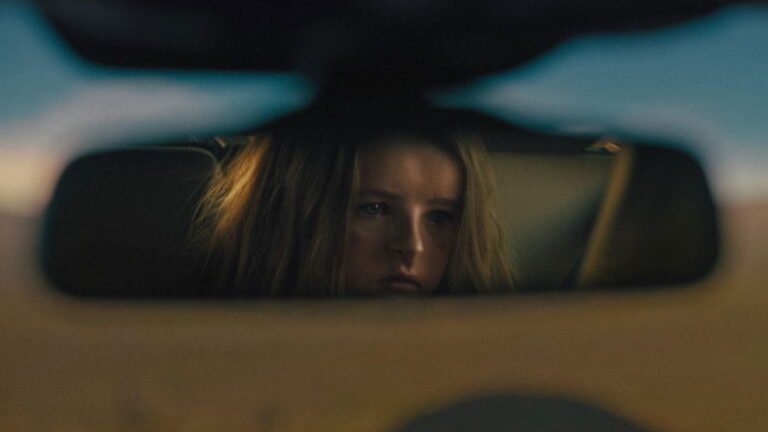
Lawrence Jacomelli’s Blood Star (2024) is a recent independent entry in the desert-road survival thriller tradition. A young woman driving alone across the desert (Britni Camacho) is targeted by a sheriff (John Schwab) who uses his authority to control every encounter. Its lineage runs back to Duel: open-air dread, a pursuer who will not go away, and tension built without jump scares.
The link to Strange Darling is the cat-and-mouse structure and the question of who really holds the power. Blood Star also lets the balance between hunter and hunted shift over the course of the story, replacing the cabin and the back room with miles of empty highway. For more in this vein, see our list of thrillers similar to Blood Star.
Watch Blood Star Free
If you like films such as Rebel Ridge and Green Room, discover Blood Star, the psychological desert thriller directed by Lawrence Jacomelli.
Now streaming free with ads in the USA.


See every legitimate way to watch Blood Star free in the USA →
Related guides
- Underrated Indie Thrillers That Became Cult Favorites
- Movies Like Rebel Ridge: Lean, Coiled Action Thrillers
- Movies Like Green Room: Lean, Brutal Survival Thrillers
- The Best Cat-and-Mouse Thrillers: Hunter vs Hunted
- Movies Like Get Out
More on Blood Star
- Watch Blood Star free on Tubi & Prime Video (USA)
- Blood Star: Ending Explained
- Blood Star — Cast & Filmmakers