Quick Answer
Director Lawrence Jacomelli names 20 films and one music video as direct influences on Blood Star: Spielberg’s Duel and Jaws gave the film its pursuit structure (the shark became a sheriff, the ocean became the desert), Jonathan Glazer’s “Karma Police” video provided its literal opening image, and road-thriller lineage like The Hitcher, Breakdown and Wolf Creek shaped a villain who is frightening because he understands the territory better than his victim. Visual influences include Badlands, Paris, Texas, The Shining and Once Upon a Time in the West; psychological ones include The Vanishing and Funny Games.
Key Takeaways
- Blood Star’s core structure comes directly from Spielberg reusing his own Duel framework for Jaws — Jacomelli did the same: the shark became a sheriff, the ocean became the desert.
- The film’s opening shot is an openly acknowledged homage to Jonathan Glazer’s 1997 music video for Radiohead’s “Karma Police.”
- The Hitcher, Breakdown and Wolf Creek share one idea: the antagonist is dangerous because he understands the territory better than the victim does.
- Badlands, Paris, Texas and Once Upon a Time in the West shaped the film visually — beauty and violence coexisting in the same daylight frame.
- The Vanishing and Funny Games shaped the sheriff’s psychology: a calm, controlled predator rather than a chaotic monster.
- Jacomelli’s view of influence: an image only matters if it’s transformed to serve a new dramatic purpose, not simply copied because it looks impressive.
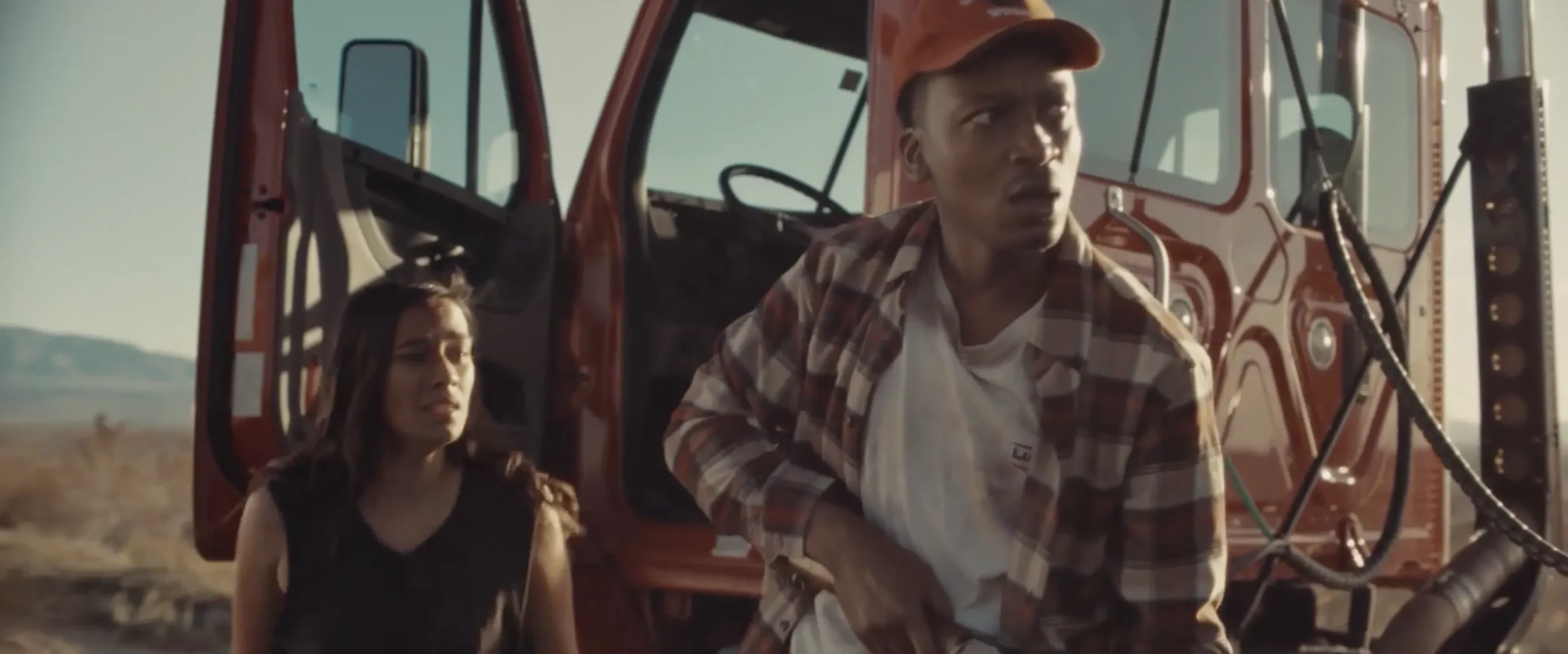
The 20 Films That Inspired Blood Star
Jaws
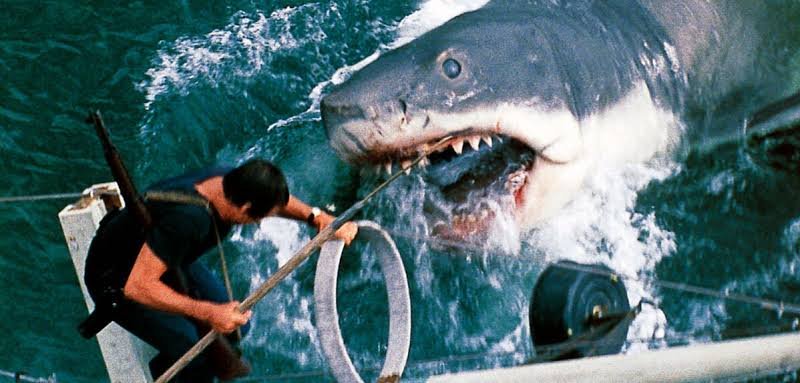
The single biggest influence on Blood Star was Jaws. It remains my favourite horror film, but its influence went beyond tone, suspense or the simple idea of an unseen threat. What fascinated me was the relationship between Jaws and Steven Spielberg’s earlier film, Duel.
Spielberg himself acknowledged the similarity between the two films: in Duel, an ordinary man is pursued by a seemingly unstoppable truck, while in Jaws, a coastal community is terrorised by a seemingly unstoppable shark. The threat changes, the location changes and the scale becomes much larger, but the dramatic engine is remarkably similar. Both films take something familiar, place an ordinary person in its path and build tension through pursuit, anticipation and the gradual removal of every possible escape. (BFI)
When I realised that, something clicked. Spielberg had taken the essential dramatic framework of Duel and reimagined it for Jaws. I thought that if Spielberg could return to his own framework and transform it into something new, then perhaps I could use that same underlying structure to make Blood Star.
The shark became a sheriff. The ocean became the desert.
The shark became a sheriff. The ocean became the desert. Instead of a man being pursued by a truck or a town being threatened by a great white shark, Blood Star follows a young woman trapped on an empty highway and targeted by the one person who should represent safety and authority.
That was the starting point. I was never interested in copying the surface details of Jaws or Duel. What inspired me was their purity. Both films are built around a simple, almost primal situation: something is coming for you, it understands its environment better than you do, and eventually you will have to stop running and fight back.
That is the central framework of Blood Star.
Duel
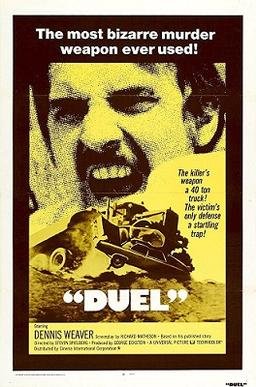
If Jaws gave me the confidence to use a familiar dramatic framework, Duel provided the clearest structural blueprint.
There is almost nothing unnecessary in the film. A man is driving through the desert. A truck begins following him. The pursuit escalates. The driver is never properly seen and the threat is never explained. Spielberg does not burden the story with motive, psychology or an elaborate backstory. The truck simply becomes a force of aggression.
That simplicity was enormously important to Blood Star. We wanted the film to feel stripped down and immediate. Bobbi is travelling alone. She encounters the sheriff. A line is crossed, and from that moment onwards the landscape becomes hostile.
Like the truck in Duel, the sheriff is frightening partly because he controls the road. He knows the territory, understands where help is available and can appear almost anywhere. Bobbi is not only being pursued by a man; she is being pursued by someone who belongs to the environment through which she is trying to escape.
The desert also functions in a similar way. It appears vast and open, but that openness is deceptive. There is nowhere to hide, nobody close enough to help and no certainty that the next building or vehicle will offer safety. The road promises freedom while steadily removing every option.
Duel taught me that a road thriller does not need a complicated plot. It needs escalation, geography and a threat that feels increasingly impossible to escape.
Radiohead – Karma Police
One of the most direct visual influences on Blood Star did not come from a feature film at all. It came from Jonathan Glazer’s music video for Radiohead’s “Karma Police.”
The video is built around an extraordinarily simple image: a car moving slowly along a dark road while a man runs ahead of it, illuminated by the headlights. The camera remains connected to the vehicle, turning the pursuit into something hypnotic, threatening and strangely detached. Glazer places the viewer inside the pursuing car, making us complicit in what is happening. (Pitchfork)
That image became the foundation of the opening scene of Blood Star.
We repurposed it for our own story, changing the circumstances, the characters and ultimately the meaning of the scene. But the basic idea is there: darkness, headlights, a vehicle moving forward and a vulnerable human figure trapped directly in its path.
Was I worried about pinching a shot? Not particularly.
That is how filmmaking works. Images pass from one filmmaker to another, are absorbed, altered and placed into new contexts. Jonathan Glazer himself was working within a much longer visual tradition, and most of the shots that influence modern filmmakers can ultimately be traced back through other films, paintings and photographs.
Eventually, so many of those visual paths lead back to the masters, and very often they lead back to Stanley Kubrick.
The important question is not whether an image has been used before. The question is what you do with it.
For Blood Star, the “Karma Police” image was not simply an attractive reference. It contained the entire film in miniature. A vehicle approaches through the darkness. A person is trapped in its headlights. The road offers no protection. The person inside the vehicle holds all the power.
I believe the opening frame of a film has a responsibility. It should establish the tone, create an immediate question and give the audience a reason to keep watching. Ideally, it should also contain the DNA of the story that follows.
The opening two minutes of Blood Star do exactly that. They introduce the road, the predator, the victim and the central visual language of the film. More importantly, the sequence makes a promise to the audience—a promise that the film eventually fulfils when the same balance of power returns in a different form at the end.
The opening is not merely a prelude. It is the whole movie compressed into one scene.
Did You Know?
Jonathan Glazer’s video for Radiohead’s “Karma Police” — the direct source of Blood Star’s opening image — won the MTV Video Music Award for Best Direction in 1997.
The Hitcher
The Hitcher was an unavoidable influence because it understands the road as a psychological space rather than simply a location.
Like Duel, the film begins with an ordinary journey that is invaded by a figure who seems almost supernatural. Rutger Hauer‘s John Ryder does not behave like a realistic criminal with a clear plan. He appears and disappears, anticipates every attempt to escape and seems less interested in killing Jim immediately than in testing him.
That relationship was important when developing the sheriff in Blood Star. A conventional villain simply wants to catch the protagonist. A more disturbing villain wants to control the emotional rhythm of the pursuit. He wants the victim to understand that he can reach her whenever he chooses.
The sheriff does not only chase Bobbi. He plays with her sense of safety, presents himself as reasonable and repeatedly forces her to question how much danger she is actually in. His authority allows him to move between protector and predator without changing his outward appearance.
The Hitcher also understands that the road can feel dreamlike. Towns, petrol stations, diners and police vehicles appear briefly before vanishing behind the characters. The journey becomes disconnected from ordinary life, as though the protagonist has entered a separate world governed entirely by the pursuer.
That feeling was central to Blood Star. Once Bobbi enters the sheriff’s territory, normal rules stop applying.
Badlands
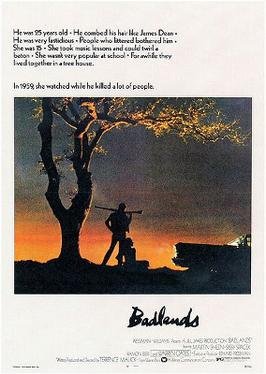
Terrence Malick’s Badlands influenced the film in a very different way. It was not a structural model so much as a tonal and visual one.
The landscapes in Badlands are beautiful, but the beauty never excuses the violence occurring within them. Malick allows open skies, fields, roads and empty horizons to exist alongside murder without forcing the visuals to become conventionally dark or threatening.
That contradiction was something we wanted in Blood Star. The desert is not photographed as an obviously evil place. It is expansive, luminous and often beautiful. The threat comes from what people are capable of doing within that space.
There is something more unsettling about violence in bright sunlight. Darkness allows an audience to imagine that danger is concealed. Daylight removes that protection. Everything is visible, yet nobody is there to intervene.
Badlands also showed how Americana can become strange without losing its authenticity. Cars, roadside buildings, police uniforms and open highways are familiar images, but when isolated and carefully framed they take on a mythic quality.
We wanted Blood Star to feel grounded in a recognisable American landscape while also existing slightly outside everyday reality.
The Texas Chain Saw Massacre
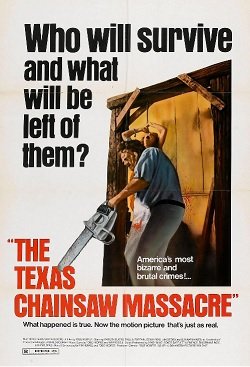
The influence of The Texas Chain Saw Massacre was not about chainsaws, masks or explicit horror iconography. It was about the feeling that civilisation can suddenly disappear.
The film begins with young people travelling through an apparently ordinary rural landscape. Gradually, they discover that the social rules they rely upon no longer protect them. Houses are not safe, strangers are not helpful and authority is absent.
That same fear runs through Blood Star. Bobbi is still in America. She is travelling on public roads, passing petrol stations and encountering a uniformed police officer. Everything appears normal, yet the systems that should protect her have quietly failed.
The horror comes from isolation, but also from disbelief. A victim in this situation does not immediately understand that the ordinary rules have stopped functioning. She continues trying to behave rationally within a world that has become irrational.
Tobe Hooper‘s film also proved that heat, daylight, dust and physical exhaustion could be as frightening as darkness. The environment does not merely surround the characters; it wears them down.
That idea was essential when making a survival thriller in the desert.
No Country for Old Men
No Country for Old Men influenced both the visual language of Blood Star and its treatment of pursuit.
Anton Chigurh is terrifying because he moves with complete certainty. He does not rush, panic or lose control. The tension comes from watching a person who appears to have already calculated every outcome.
That quality informed the sheriff. He is most dangerous when calm. His uniform, measured voice and apparent confidence create the impression that he controls not only the situation but the story that will later be told about it.
The Coen brothers also understand the power of withholding music. Long stretches of No Country for Old Men rely on footsteps, vehicles, wind, doors and the minute sounds of people trying not to be discovered. That restraint makes every sound feel meaningful.
Visually, the film finds menace in distance. A vehicle on the horizon, a figure standing far away or a light appearing in darkness can become more frightening than a conventional close-up of the villain.
That approach strongly influenced the way we photographed the desert in Blood Star. The landscape allows the audience to see danger coming, but seeing it does not necessarily provide a way to escape.
Breakdown
Breakdown is one of the purest examples of an ordinary person discovering how vulnerable they become when stranded far from home.
The film begins with a mundane mechanical problem and steadily reveals a larger system of threat. Its effectiveness comes from plausibility. There is no supernatural force and no elaborate mythology. The protagonist is simply in the wrong place, surrounded by people who know the territory and understand how to exploit outsiders.
That dynamic was central to Blood Star. Bobbi’s vulnerability is not based on stupidity. She is vulnerable because she is travelling through someone else’s world. The sheriff knows the roads, the distances, the local people and the limits of his own accountability.
Breakdown also influenced the pace at which danger becomes undeniable. At first, there is uncertainty. The protagonist senses that something is wrong but cannot yet prove it. By the time the truth is clear, escape has become much more difficult.
A good thriller often depends on that delay between instinct and certainty.
Wolf Creek
Wolf Creek demonstrated how effectively an apparently friendly local figure can become a source of terror.
Mick Taylor initially presents himself as helpful, humorous and familiar. He understands the landscape and appears to offer the stranded travellers exactly what they need. The horror comes from the gradual revelation that his hospitality is a form of control.
The sheriff in Blood Star operates differently, but the principle is related. His badge gives him immediate credibility. Bobbi has been conditioned to see him as someone who can help, which means the threat can approach her without resistance.
The film also influenced our sense of desert isolation. In Wolf Creek, distance is not simply measured in miles. It becomes a form of power. The characters have no idea where they are, while the antagonist understands every road and hiding place.
The person who controls the landscape controls the encounter.
Death Proof
Quentin Tarantino‘s Death Proof influenced the film’s relationship between cars, violence and female resistance.
The car is not merely transport. It becomes an extension of the predator and eventually a weapon. The road itself becomes the arena in which control changes hands.
What I particularly admired was the way Death Proof allows its female characters to move from being watched and pursued to becoming active participants in the confrontation. The reversal is not neat or polite. It is physical, angry and satisfying.
That emotional shift was important for Bobbi. Blood Star begins with a woman being observed and controlled. The film’s destination is not simply her survival, but her recognition of how the sheriff’s power works and her decision to turn that power against him.
A cat-and-mouse thriller becomes much more satisfying when the mouse stops behaving like prey.
The Vanishing
George Sluizer‘s original 1988 version of The Vanishing is one of the most disturbing thrillers ever made, largely because of how calmly it approaches evil. The film is not driven by spectacle or conventional suspense. Its power comes from obsession, inevitability and the terrifying ordinariness of the man responsible.
Raymond is not presented as a theatrical monster. He is intelligent, organised and outwardly unremarkable. He studies his own behaviour almost scientifically, as though committing an appalling act is simply a problem to be solved. That restraint makes him far more disturbing than a villain who constantly announces his cruelty.
This was relevant when developing the sheriff in Blood Star. He does not think of himself as chaotic or out of control. He has created a system in which he can operate with confidence. He understands how people respond to his uniform, how far away help is and how easily a victim’s story can be discredited.
The other major influence was the film’s understanding of obsession. In The Vanishing, the need to know becomes as dangerous as the original crime. The protagonist cannot accept uncertainty, even when the truth may destroy him.
That idea is central to many effective thrillers. The audience wants an explanation, but the desire for complete understanding can become a trap. Sometimes the most disturbing thing a filmmaker can do is provide the answer.
Blood Simple
The Coen brothers’ Blood Simple was an important influence on the desert-noir elements of Blood Star. It is a film in which relatively simple actions become increasingly complicated because nobody fully understands what anyone else has done.
The characters lie, misinterpret evidence and make decisions based on incomplete information. Every attempt to regain control creates another problem. The violence is not grand or heroic. It is awkward, physical and often made worse by panic.
That escalation was something I wanted in Blood Star. The film begins with a clear imbalance of power, but as Bobbi starts resisting, the situation becomes more unstable. The sheriff may believe he understands exactly how the encounter will unfold, yet every act of control creates the possibility of reversal.
Visually, Blood Simple also turns familiar American spaces into something strange. Roads, bars, fields and empty rooms become morally charged because of what has happened within them. The night feels thick and oppressive, while even ordinary objects seem capable of exposing a secret.
The Coens understand that noir is not simply a visual style. It is a world in which people are trapped by their own decisions. Once the first mistake has been made, the story becomes a series of consequences.
Paris, Texas
Paris, Texas is not a thriller, but it had a significant influence on how I wanted to see the American landscape.
Wim Wenders and cinematographer Robby Müller photograph the Southwest as both real and mythological. The desert appears vast, beautiful and emotionally empty. Characters are often separated from one another by roads, windows, buildings and enormous areas of open space.
That visual loneliness was important to Blood Star. We did not want the desert to function merely as a picturesque backdrop. It needed to express Bobbi’s isolation. The wider the landscape becomes, the more exposed she appears within it.
The film also uses roadside Americana brilliantly: motels, petrol stations, neon, anonymous buildings and long stretches of highway. These are recognisable elements of American life, but when framed with enough precision they become dreamlike.
As a British filmmaker approaching the American desert, I was very conscious of avoiding a generic tourist’s view of the landscape. Paris, Texas demonstrated how an outsider could photograph America with fascination while still finding something emotionally truthful within it.
The desert in Blood Star is beautiful, but that beauty offers no protection. It makes the threat feel larger because there is so much space and so little help.
The Shining
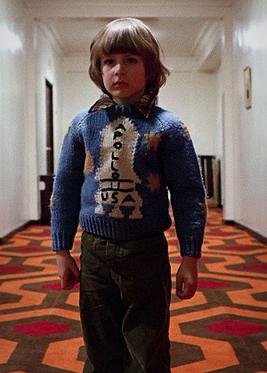
Stanley Kubrick’s influence sits behind an enormous amount of modern cinema, whether filmmakers acknowledge it or not. The Shining was particularly important because of its controlled compositions, its use of architecture and the feeling that the camera possesses a knowledge beyond that of the characters.
Kubrick’s frames are rarely casual. The symmetry, perspective and movement create the impression that every character has been placed inside a larger design. Even before anything explicitly frightening happens, the visual order itself feels oppressive.
That sense of control influenced Blood Star. The sheriff believes he controls the road, the town and the people moving through his territory. We often framed him with a degree of stillness and authority, while Bobbi’s experience becomes more fractured and unstable as the situation develops.
The use of central framing was also important. There is something inherently confrontational about placing a figure directly in the middle of the image. It can make a character appear powerful, trapped or both at once.
Kubrick’s work also reminds filmmakers that borrowing an image is only part of the process. Most compositions have histories. They travel through painting, photography and cinema before arriving in a new film. The task is not to pretend that every shot has been invented from nothing. It is to understand why an image works and then make it serve a new dramatic purpose.
Psycho
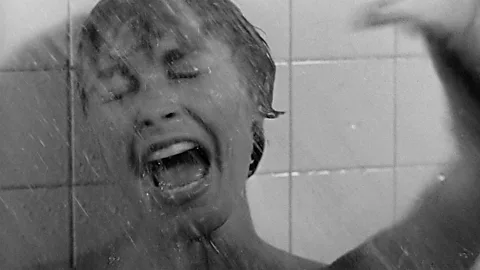
Psycho remains one of the great examples of a film manipulating audience identification.
Hitchcock begins by making us believe we understand the story. We follow Marion Crane, become involved in her crime and assume that her journey will provide the film’s central narrative. Then the structure changes completely.
That disruption was influential because it demonstrates how much an audience depends on familiar storytelling rules. Viewers naturally assume that the person they are following will remain at the centre of the film. When that assumption is removed, the audience becomes vulnerable.
Although Blood Star does not repeat the same structural trick, it does play with expectations around victims, predators and control. The film introduces a familiar road-thriller situation, but the opening sequence also establishes that the sheriff has done this before. Bobbi is entering a story already in progress.
Psycho also understands the power of visual implication. The shower scene is remembered as intensely violent, yet much of that violence is created through editing, sound and the audience’s imagination. Hitchcock gives the viewer fragments and allows the mind to complete the act.
That principle remains essential, especially in lower-budget filmmaking. Suggestion is not simply a financial compromise. Used correctly, it can be more powerful than explicit imagery because the audience becomes responsible for constructing the horror.
The Night of the Hunter
Charles Laughton’s The Night of the Hunter transforms a human predator into something close to a mythological figure.
Robert Mitchum‘s Harry Powell is a murderer, but he is presented with the force and simplicity of a nightmare. His silhouette, his voice and even the songs he sings announce his presence before he enters the frame. He feels less like an ordinary criminal than a dark story being passed from one generation to another.
That quality influenced the sheriff in Blood Star. Although the film remains grounded, there are moments when he seems to belong to the road itself. He appears at the right time, understands the landscape completely and carries the authority of someone who has repeated the same ritual before.
The Night of the Hunter also uses stylisation without losing emotional intensity. Its landscapes, shadows and interiors sometimes feel deliberately artificial, yet that artificiality creates a deeper psychological truth.
The film understands that realism is not the only route to fear. A thriller can remain believable while allowing certain images to become heightened or symbolic.
The road, the river and the night landscape all become part of the children’s emotional experience. In Blood Star, the desert operates in a similar way. It is a physical place, but it also becomes the arena of Bobbi’s fear, exposure and eventual resistance.
Nocturnal Animals
Tom Ford’s Nocturnal Animals was an influence through its use of the road as a place where social protection suddenly disappears.
The central highway sequence is terrifying because it begins with something relatively small: another car behaving aggressively at night. The situation escalates through hesitation, pride, misunderstanding and the growing realisation that the family has entered a confrontation governed by completely different rules.
What makes the sequence so effective is the feeling of helplessness. The road is open, yet there is nowhere to go. The characters are inside a vehicle, but the vehicle no longer protects them. They are technically still within civilisation, yet no authority is present to intervene.
That contradiction is central to Blood Star. Bobbi is not lost in an uncharted wilderness. She is driving on public roads through recognisable America. Her vulnerability comes from the fact that systems only protect people when someone is present and willing to enforce them.
Nocturnal Animals also understands the psychological violence of humiliation. The threat is not simply physical. It comes from being watched, controlled and forced to recognise one’s own powerlessness.
The film uses the West Texas landscape to make the characters appear isolated long before the situation becomes overtly violent. Darkness removes the horizon, headlights reveal only fragments and every decision feels irreversible.
That combination of road, masculinity, intimidation and delayed violence was highly relevant to Blood Star.
Thelma & Louise
Thelma & Louise influenced the film’s understanding of the American road as both freedom and danger.
At the beginning, the journey represents escape. The two women leave behind restrictive lives and experience the road as a space in which different versions of themselves might become possible. That freedom is gradually complicated by violence, pursuit and the knowledge that the world will interpret their actions through a system already weighted against them.
Bobbi’s journey in Blood Star is very different, but the road carries a related contradiction. It promises independence while exposing her to danger. She is free to travel, yet that freedom means little when the person pursuing her controls the surrounding territory.
The film was also important in thinking about female resistance. Thelma and Louise are not presented as invulnerable action heroes. Their transformation comes through fear, anger, loyalty and the gradual refusal to return to the roles assigned to them.
That emotional progression was important for Bobbi. Her survival should not depend on suddenly becoming a different person. It comes from recognising the reality of the threat, understanding how the sheriff operates and deciding that compliance will not save her.
The road changes her because it forces her to act.
Once Upon a Time in the West
Sergio Leone’s Once Upon a Time in the West influenced the scale, patience and visual grammar of Blood Star.
Leone understood the relationship between the human face and the landscape better than almost anyone. He could move from an extreme close-up of a pair of eyes to an enormous widescreen environment and make both images feel equally dramatic.
That contrast was important in the desert. Wide shots establish isolation and geography, but close-ups reveal the psychological struggle occurring within that space. The landscape tells us how difficult escape will be; the face tells us when the character understands it.
Leone was also unafraid of duration. He allowed characters to wait, listen and watch. Tension came from anticipation rather than constant movement. The opening railway-station sequence is built almost entirely from time, sound and the expectation that someone will arrive.
That confidence influenced the slower moments in Blood Star. A road thriller cannot operate at maximum intensity from beginning to end. It needs silence, observation and pauses in which the audience senses that the balance of power is changing.
Leone’s use of sound was equally important. Wind, machinery, footsteps and distant noises become part of the composition. They do not simply accompany the image; they determine its rhythm.
The influence is not about making Blood Star resemble a western. It is about understanding how westerns turn landscape, faces and waiting into narrative action.
Funny Games
Michael Haneke’s Funny Games was an important influence because it confronts the audience’s relationship with screen violence.
The film appears to offer the framework of a home-invasion thriller, but Haneke repeatedly refuses to provide the expected pleasures of the genre. The attackers are calm, polite and almost absurdly controlled. They do not simply terrorise the family; they seem aware of the audience watching them.
That complicity is deeply unsettling. The film asks why viewers seek out violent stories, what kind of satisfaction they expect and whether a filmmaker has a responsibility to deliver it.
I was not interested in adopting Haneke’s full strategy for Blood Star, which is deliberately confrontational and anti-entertainment. However, his understanding of the relationship between predator, victim and viewer was highly relevant.
The sheriff often performs. He chooses how he speaks, how he presents himself and how much of his real nature to reveal. His cruelty is partly dependent on controlling the narrative of the encounter. He wants Bobbi to understand that he is in charge, but he also wants to preserve the outward appearance of legitimacy.
Funny Games also demonstrates that violence can be more disturbing when it is delayed, interrupted or kept outside the frame. The anticipation of an act may become more unbearable than the act itself.
Most importantly, Haneke refuses to let genre conventions become morally invisible. He reminds filmmakers that every decision about how violence is framed affects the audience’s relationship to it.
That was something I kept in mind throughout Blood Star. The film needed to be tense, entertaining and ultimately satisfying, but the sheriff’s violence could never become harmless spectacle.
How to Watch the Influences
Group them the way Jacomelli does: structural (Jaws, Duel, The Hitcher, Breakdown, Wolf Creek) for the pursuit mechanics, visual (Paris Texas, Badlands, The Shining, Once Upon a Time in the West) for landscape and framing, and psychological (The Vanishing, Funny Games, Nocturnal Animals) for how the sheriff’s calm becomes the real threat.
Influence, Borrowing and Making Something New
Looking back over these influences, it is obvious that Blood Star did not emerge from a vacuum. No film does.
Some references were structural. Jaws and Duel demonstrated how a simple pursuit framework could sustain an entire film. The Hitcher, Breakdown and Wolf Creek showed how the road becomes terrifying when the antagonist understands the territory better than the victim.
Other influences were visual. Paris, Texas, Badlands, The Shining and Once Upon a Time in the West shaped the way I thought about landscape, framing, colour and the relationship between faces and empty space.
Films such as The Vanishing, Funny Games and Nocturnal Animals influenced the psychology of threat: the calm predator, the delayed act of violence and the frightening moment when familiar social protections cease to function.
Then there are references that are almost direct, particularly Jonathan Glazer’s “Karma Police” video. The opening image of Blood Star clearly carries that influence. I have no interest in pretending otherwise.
Was I worried about pinching a shot? Not really.
Filmmaking has always involved images passing between artists. Directors absorb films, paintings, music videos, photographs and fragments of real life. Those influences are then altered by a new story, a new location, a different performer and the practical realities of production.
Most visual ideas lead backwards through other filmmakers, and many eventually arrive at the masters. Kubrick was borrowing. Hitchcock was borrowing. Spielberg was borrowing, including from himself.
The important distinction is between imitation and transformation. Copying an image because it looks impressive is rarely enough. The image has to perform a new function inside the film being made.
The opening of Blood Star takes the basic visual premise of “Karma Police”—a human figure trapped in the headlights of an approaching car—and turns it into the central promise of our story. The sequence introduces the predator, the road, the imbalance of power and the pattern that will return at the end.
Those first two minutes contain the entire film in miniature.
That is what influence should do. It should not simply reveal what a filmmaker has watched. It should become part of the machinery of the new story.
That is what influence should do. It should not simply reveal what a filmmaker has watched. It should become part of the machinery of the new story.
Frequently Asked Questions
Jaws, and specifically its relationship to Spielberg’s own earlier film Duel — director Lawrence Jacomelli realised that if Spielberg could reuse his own pursuit framework and transform it, the same underlying structure could become Blood Star, with the shark becoming a sheriff and the ocean becoming the desert.
Yes. Jacomelli has openly said the opening image — a vehicle’s headlights trapping a vulnerable figure on a dark road — is repurposed from Jonathan Glazer’s 1997 music video for Radiohead’s “Karma Police.”
The Hitcher, The Vanishing, No Country for Old Men, The Night of the Hunter and Funny Games all contributed — the common thread is a predator who is most frightening when calm, controlled and confident rather than chaotic.
No. He argues that filmmaking has always involved images passing between artists, and that the real question isn’t whether an image has been used before but what a filmmaker does with it — imitation copies an image, transformation gives it a new function.
Spielberg directed both, and acknowledged their shared dramatic engine: an ordinary person pursued by a seemingly unstoppable threat that understands its environment better than they do — Duel with a truck, Jaws with a shark.
Not literally, but it borrows a technique from Once Upon a Time in the West: alternating between extreme close-ups and vast widescreen landscape shots, using patience and silence rather than constant movement to build tension.
Learn More About Blood Star
If you’re interested in how independent filmmakers create ambitious thrillers on limited budgets, you can explore more about Blood Star, including its cast, production and behind-the-scenes story.
If you’d like to watch the film, visit the Blood Star Watch Page to see where it’s currently available to stream or purchase.
Related: real-world questions about authority and institutional trust — beyond its cinematic influences.
Watch Blood Star
Blood Star is a psychological desert road thriller about Bobbi Torres, a young woman travelling alone across the American Southwest who becomes the target of Sheriff Bilstein, a predatory lawman whose badge, patrol car and knowledge of the territory allow him to control the hunt.


See every legitimate way to watch Blood Star free →
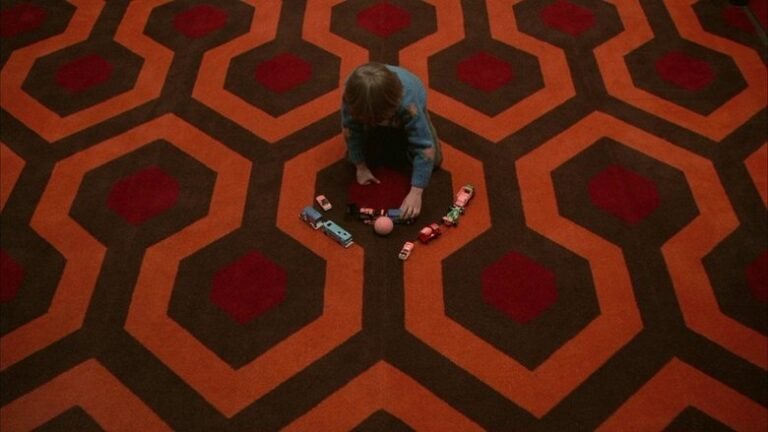
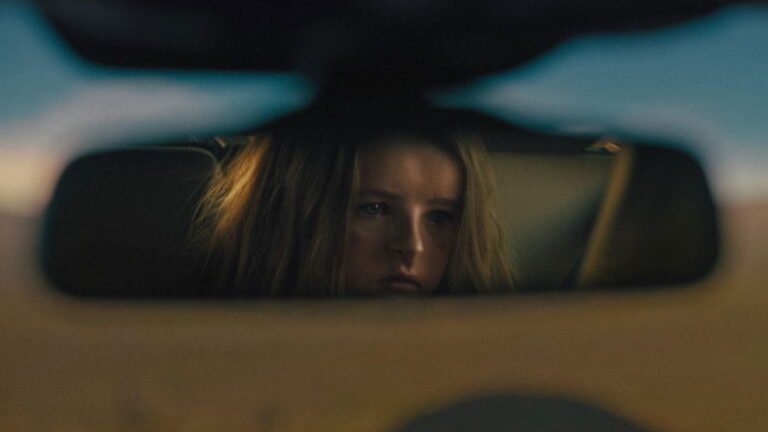
Table of Contents
- The 20 Films That Inspired Blood Star
- Jaws
- Duel
- Radiohead – Karma Police
- The Hitcher
- Badlands
- The Texas Chain Saw Massacre
- No Country for Old Men
- Breakdown
- Wolf Creek
- Death Proof
- The Vanishing
- Blood Simple
- Paris, Texas
- The Shining
- Psycho
- The Night of the Hunter
- Nocturnal Animals
- Thelma & Louise
- Once Upon a Time in the West
- Funny Games
- Influence, Borrowing and Making Something New
- Learn More About Blood Star
- Watch Blood Star