Quick Answer
Blood Star was shot in only 10 principal photography days in the desert — half the schedule of a typical low-budget horror film, using two RED Gemini cameras and one RED Komodo working simultaneously, a crew of roughly 15 to 20 people, real desert locations and disciplined pre-production. Director Lawrence Jacomelli and writer-producer Victoria Taylor built the schedule around a contained two-character conflict, a strong location and a three-camera system planned as a coordinated setup rather than three separate viewpoints — the same underlying principle low-budget breakouts like Paranormal Activity and The Blair Witch Project used before it.
Key Takeaways
- A 10-day schedule (roughly 10 script pages per day) was only possible because the story, locations, camera system and crew were all designed around the same limitation from the start.
- Three cameras (two RED Gemini, one RED Komodo) worked as a coordinated system, capturing a wide shot, a close-up and a complementary angle simultaneously to protect performance and reduce repeated takes.
- Real desert locations provided scale, texture and atmosphere that would have been expensive or impossible to build artificially.
- A small crew of 15-20 people reduced friction on remote desert locations, but the production still needed full department coverage — camera, sound, lighting, art, makeup, costume, safety and continuity.
- Blood Star shares its core production principles with other low-budget breakouts — Obsession, Paranormal Activity, The Blair Witch Project — even though all four films look completely different: an immediately explainable concept, a limited cast, locations that create narrative value, and performance carrying the weight spectacle would otherwise need to.
How Blood Star Was Shot in Just 10 Days
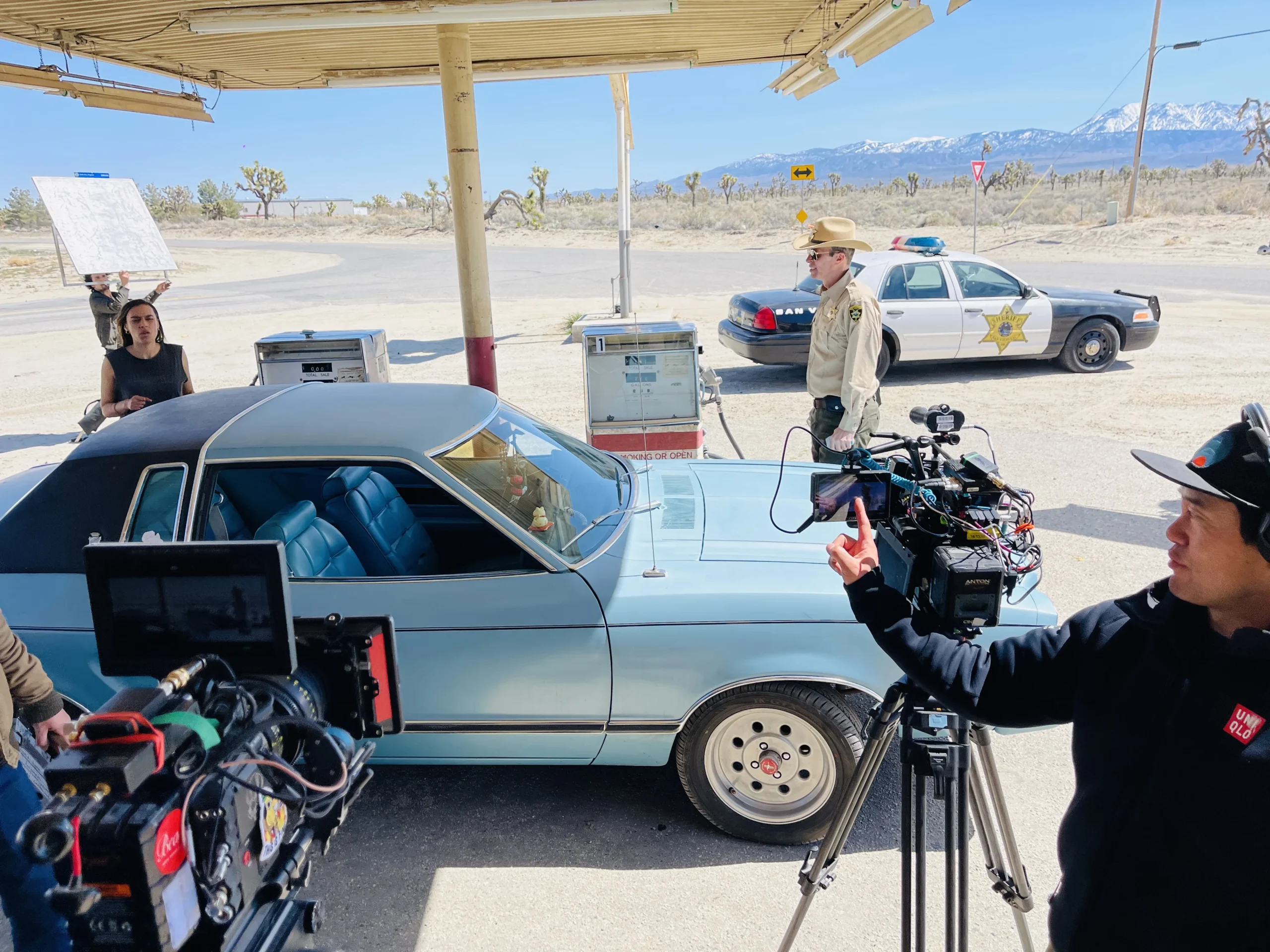
Blood Star was shot in only 10 principal photography days in the desert.
That figure sounds almost impossible when compared with a conventional feature-film schedule. Many independent movies shoot for between three and five weeks. Larger productions may spend several months on principal photography. Even the breakout low-budget horror film Obsession, directed by Curry Barker, was reportedly filmed over 20 days on a budget of approximately $750,000.
Blood Star had half that shooting time.
The production regularly completed more than 10 screenplay pages per day, using a small crew, three cameras and real desert locations. The film was directed by first-time feature filmmaker Lawrence Jacomelli and written and produced by Victoria Taylor, with the husband-and-wife team applying lessons learned through years of international commercial production.
The aim was not simply to finish a feature quickly. It was to create a visually controlled psychological road thriller that did not look hurried, compromised or dramatically thin.
That required the production to be designed around its limitations from the beginning.
The 10-day schedule was not achieved through improvisation or by assuming every problem could be fixed later. It depended on preparation, a contained story, experienced collaborators, carefully selected locations and a technical system specifically created for speed.
British Cinematographer described Blood Star as a lean desert horror feature made in 10 days without the infrastructure normally surrounding a conventional production. It also reported that the visual strategy was built around two RED Gemini cameras and a RED Komodo working simultaneously.
This is how the film was made.
The Story Had to Support the Production Model
The most important decision in low-budget filmmaking is often made before the budget exists.
It is the choice of story.
A film designed around large crowds, extensive company moves, complicated stunts, multiple period locations and constant visual effects cannot usually be compressed into a 10-day shoot without severe consequences. Either the schedule expands, the budget grows or the film loses the qualities that made the screenplay exciting.
Blood Star was built around a more concentrated dramatic engine.
The story follows Bobbi Torres, a young woman travelling through the desert who crosses paths with Sheriff Bilstein. What begins as a roadside encounter becomes a psychological pursuit in which authority, isolation and manipulation gradually close around her.
The film has a limited number of principal characters. Its tension comes from their behaviour, power and changing relationship rather than from large-scale action.
There are moments of violence and several significant set pieces, but the film does not require a new spectacle every few minutes. Its strongest production asset is the central conflict between Bobbi and the sheriff.
That same principle can be seen in many successful low-budget films.
Paranormal Activity centred its story on a couple, one house and the repeated expectation that something might happen during the night. It was filmed in director Oren Peli‘s home over approximately seven days, using its apparent limitations as the film’s entire visual and dramatic system.
The Blair Witch Project used three principal performers, inexpensive cameras and an eight-day shoot in the woods. Its lack of visible spectacle was not treated as a problem. The unseen threat became the film’s defining idea.
More recently, Obsession used a strong supernatural premise, a focused central relationship and a small number of major horror sequences. Its success did not depend on building an enormous world. It depended on the consequences of one wish and the increasingly dangerous behaviour between Bear and Nikki. The film was shot in 20 days, demonstrating again that a clear concept and strong character dynamic can carry a feature without a conventional studio schedule.
The lesson is not that every low-budget film should have one location or two actors. It is that the concept must create value more quickly than the production spends money.
For Blood Star, the value came from the road, the desert and the conflict between two characters whose goals were completely opposed.
Preparation Replaced Shooting Time
A 10-day schedule leaves almost no room for discovery through repetition.
On a longer shoot, a director may explore several approaches to a scene, change blocking repeatedly or capture a large amount of coverage before deciding how the sequence should work in the edit.
That was not possible on Blood Star.
The film needed to arrive on set already understood.
Scenes had to be analysed in advance for:
- Dramatic purpose;
- Character movement;
- Camera position;
- Eyelines;
- Continuity;
- Required coverage;
- Performance beats;
- Practical effects;
- Vehicle positioning;
- Sun direction;
- Location access; and
- The minimum material necessary to edit the scene properly.
This did not mean treating the screenplay mechanically. Performance still had to feel alive, and the actors needed space to respond truthfully. But the production could not spend half a day discovering where a scene should happen or what visual language it required.
Preparation allowed the filmmakers to distinguish between decisions that could remain flexible and decisions that had to be settled before the cameras rolled.
That distinction is central to efficient filmmaking.
The emotional temperature of a performance may evolve on set. The placement of three cameras beside a remote highway, the direction of travel, the available sunlight and the number of usable takes cannot be left entirely unresolved.
Three Cameras Were Used to Protect Performance and Speed
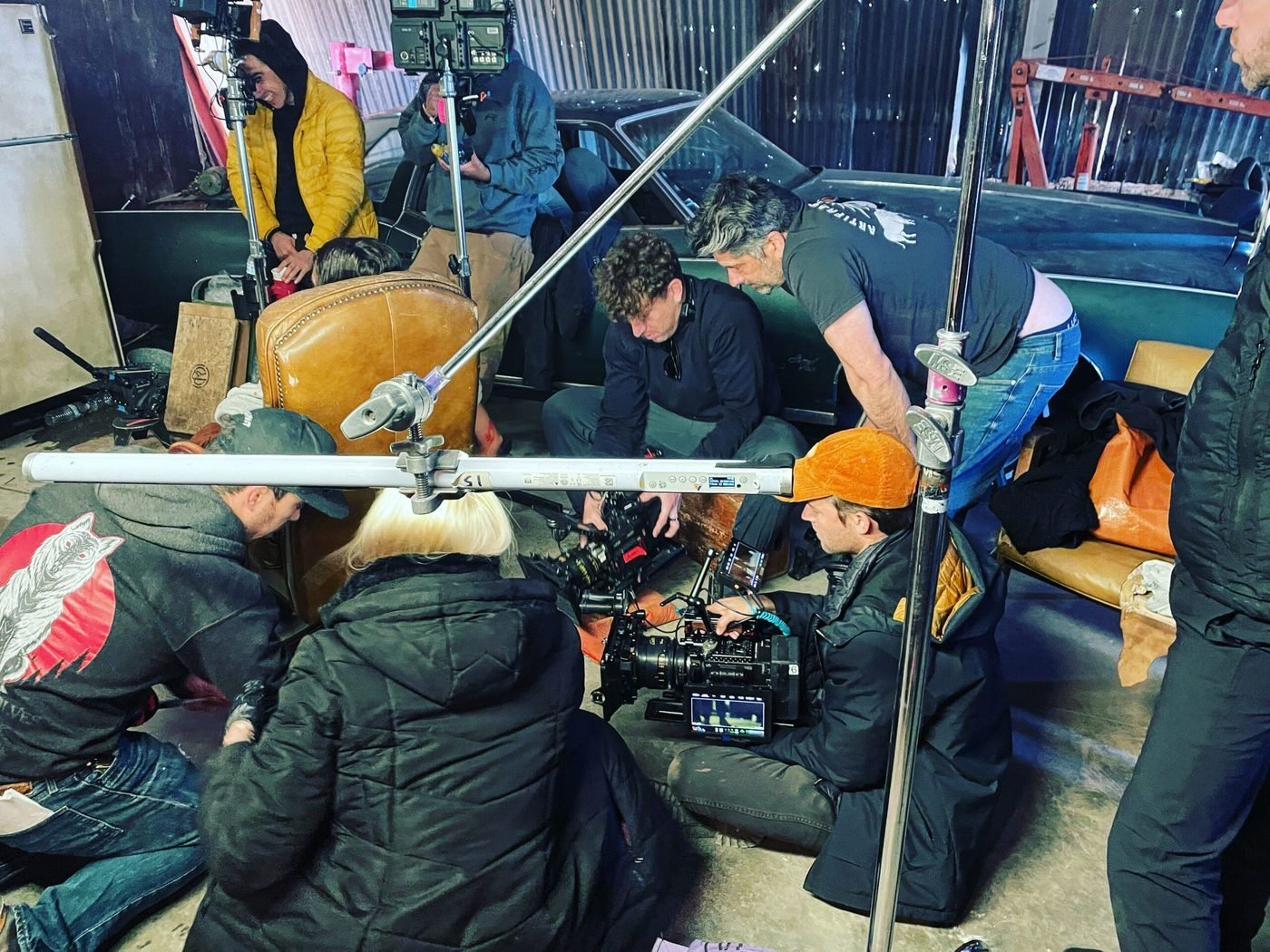
The three-camera system was one of the most important parts of the production strategy.
Blood Star was photographed using two RED Gemini cameras and one RED Komodo. The cameras could cover different angles or image sizes during the same performance, reducing the need to rebuild scenes repeatedly.
On a conventional single-camera production, a dialogue scene may be filmed in stages:
- A wide master;
- One actor’s medium shot;
- The other actor’s medium shot;
- Close-ups;
- Inserts;
- Additional reactions; and
- Any specialist angles.
Each new setup takes time. Lights may need to move. The actors must repeat the scene. Continuity must be checked. Focus, marks and eyelines may have to be reset.
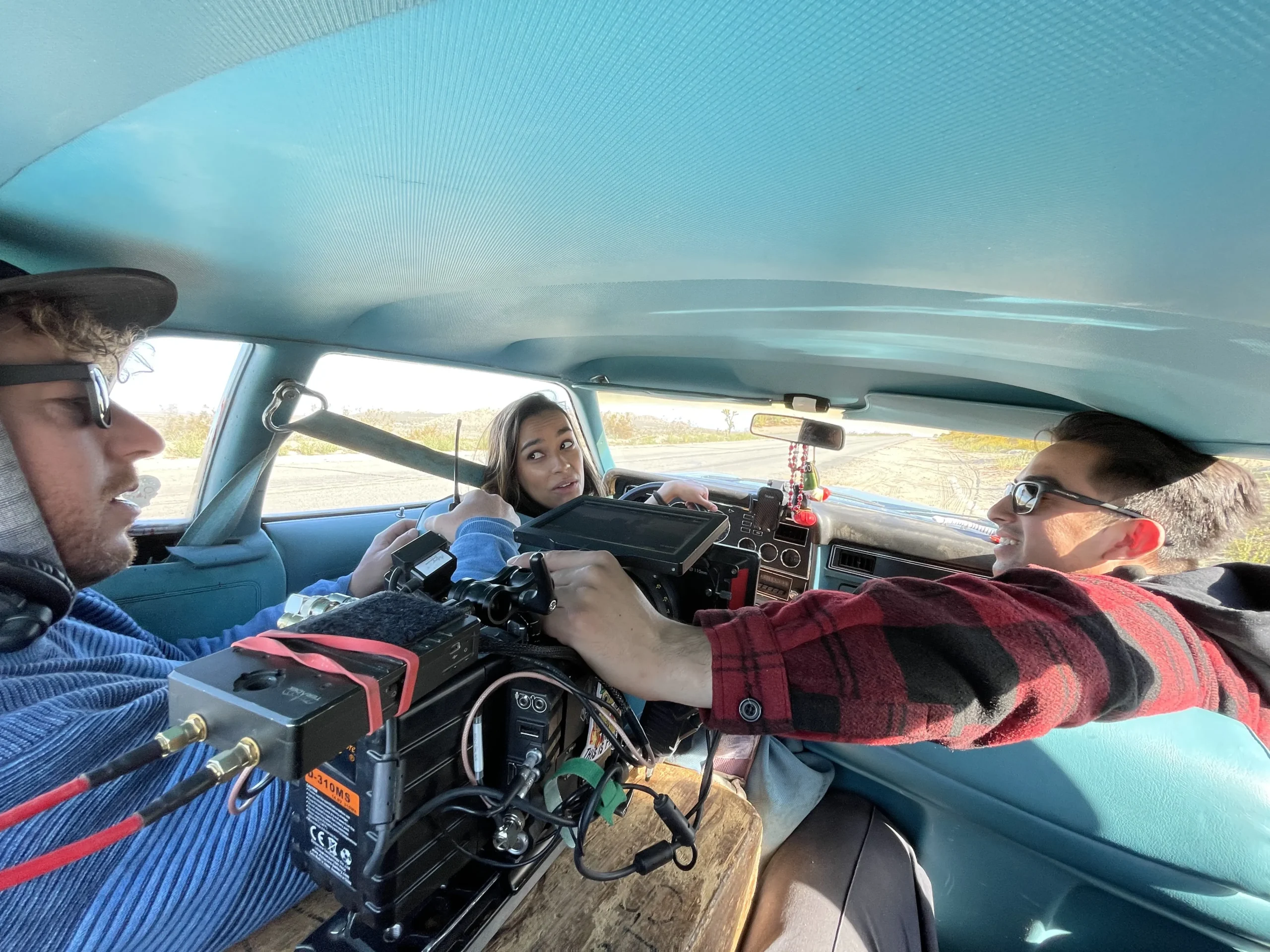
With three cameras, the production could sometimes capture a wider composition, a close-up and a complementary angle simultaneously.
This did more than increase the number of usable shots.
It helped preserve the energy of the performance.
In a psychological thriller, the most important moment may be a hesitation, a reaction or a shift in control between characters. Asking an actor to recreate that exact moment repeatedly from several camera positions can dilute it. Capturing multiple perspectives at once gives the editor access to the same emotional event.
The system also reduced the risk attached to limited takes. When only a small number of performances can be completed before moving on, each take must generate as much useful material as possible.
Three-camera shooting is not automatically faster. Poorly planned multi-camera coverage can create lighting compromises, cameras appearing in one another’s frames or several angles that are too similar to be useful.
The method only works when camera positions are chosen as a coordinated system rather than as three independent viewpoints.
The Desert Created Scale Without Building It
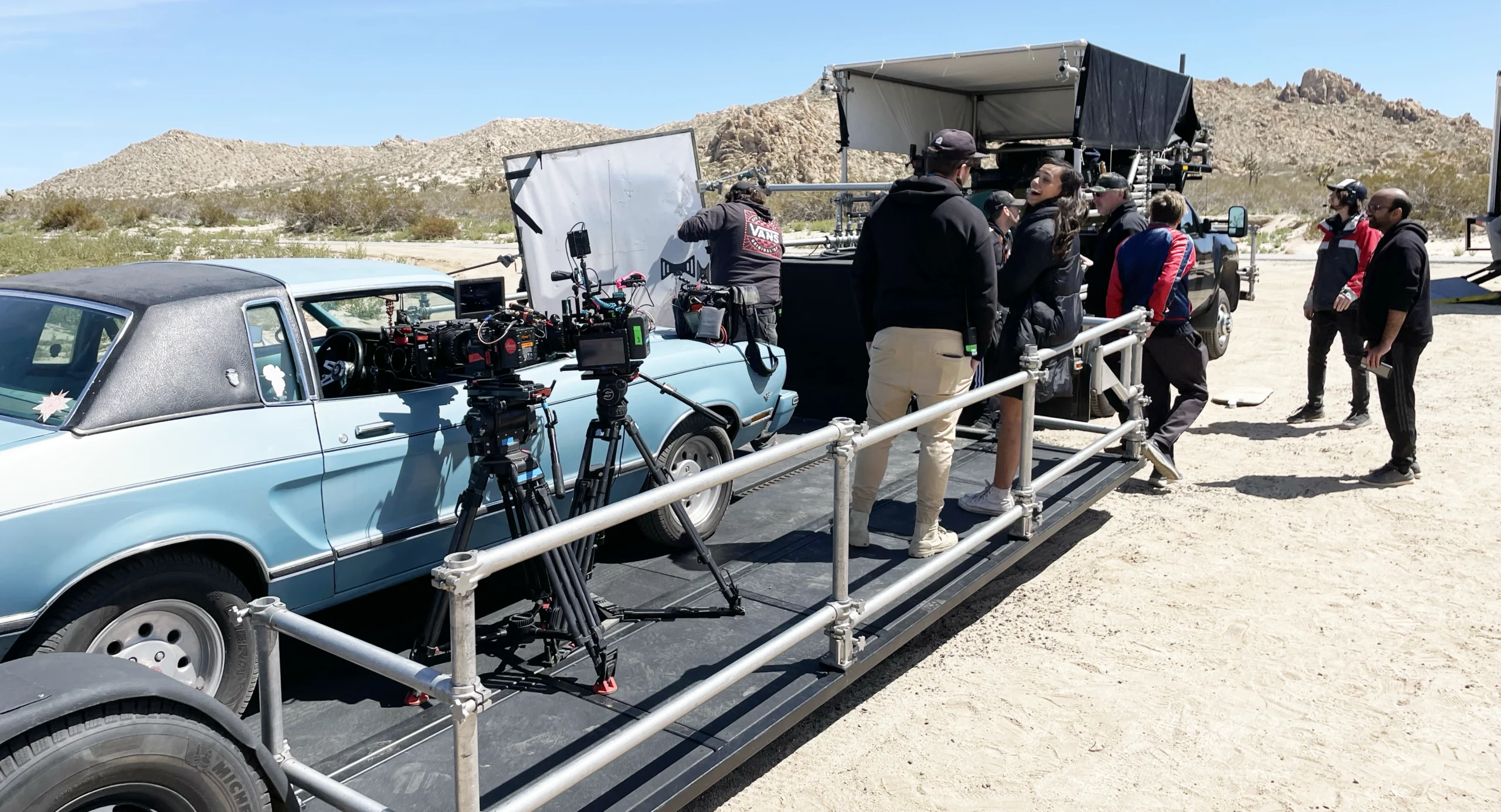
One of Blood Star’s greatest production assets was the landscape.
The film was shot on location in the desert, with its roads, open horizons, isolated structures and intense natural light contributing directly to the story. MovieMaker reported that the film was completed over 10 days, while British Cinematographer described the production as a desert shoot designed around a lean technical approach.
For a low-budget filmmaker, a real location can provide a level of visual scale that would be impossible to construct.
An empty highway stretching into the distance does not need digital extension. A desert horizon does not need a studio wall. Weathered roadside buildings, petrol stations and remote landscapes carry texture that would be expensive to reproduce artificially.
The location therefore performs several jobs at once:
- It establishes the film’s visual identity;
- It creates production value;
- It isolates the protagonist;
- It limits the possibility of help;
- It gives the antagonist territorial power; and
- It makes movement through the landscape part of the suspense.
This is a familiar strength of resourceful independent cinema.
The Texas Chain Saw Massacre used the oppressive Texas heat, rural roads and an isolated farmhouse to create an environment that felt contaminated before the central violence fully began.
The Blair Witch Project made its forest both location and antagonist. The characters could walk continuously without appearing to get closer to safety.
Paranormal Activity turned an ordinary suburban house into a recognisable, repeatable arena for fear.
In each case, the location was not selected simply because it was available. It was fused with the concept.
The same was true of Blood Star. The desert was not an inexpensive substitute for a more ambitious setting. It was the correct setting for the story.
The location was not selected simply because it was available. It was fused with the concept.
The Schedule Averaged More Than 10 Pages Per Day
A feature screenplay may commonly contain around 90 to 110 pages, although the relationship between screenplay length and final running time is never exact.
Completing a feature in 10 days can therefore require an average of approximately 10 screenplay pages per day.
That is a demanding rate.
Many conventional productions may complete only a few pages in a day, particularly where scenes involve significant lighting, stunts, effects, crowds or company moves.
The page count on Blood Star was only possible because not every page carried the same production weight.
A long dialogue scene in one controlled location may cover several script pages relatively efficiently. A brief stunt or effects moment occupying only a fraction of a page can take far longer.
The schedule therefore could not be constructed by dividing the script into ten equal page totals.
It had to account for complexity.
Scenes were grouped according to:
- Location;
- Cast availability;
- Day or night requirements;
- Vehicle access;
- Makeup and costume continuity;
- Practical effects;
- Stunt requirements;
- Light conditions; and
- The time required to move and reset the production.
The objective was to balance difficult days with more achievable material, while reducing unnecessary movement between locations.
This is one of the differences between a short schedule and a rushed schedule.
A rushed production simply tries to work faster.
An efficient production redesigns the order and method of work so fewer minutes are lost.
The Film Relied on Performances, Not Constant Spectacle
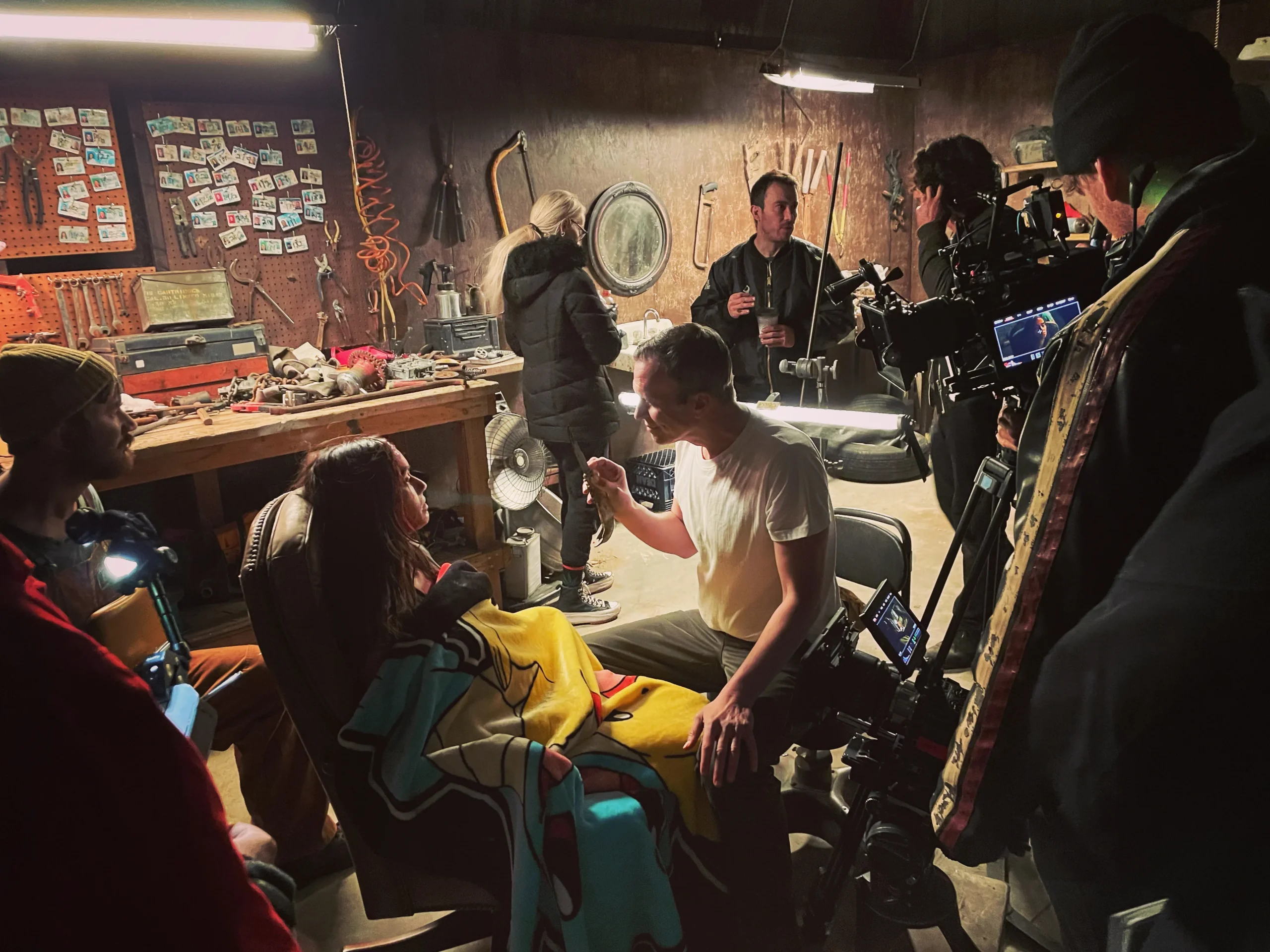
Low-budget horror is sometimes discussed as though its only advantage is cheap violence.
But many of the strongest independent genre films are carried primarily by performance.
The central tension in Blood Star depends upon Britni Camacho as Bobbi and John Schwab as Sheriff Bilstein. The film needs the audience to recognise the changing balance of power between them: when the sheriff is testing her, when Bobbi understands the danger, when apparent politeness becomes coercion and when survival requires her to act rather than merely react.
A weak central relationship could not be repaired by adding more desert landscapes or more violent set pieces.
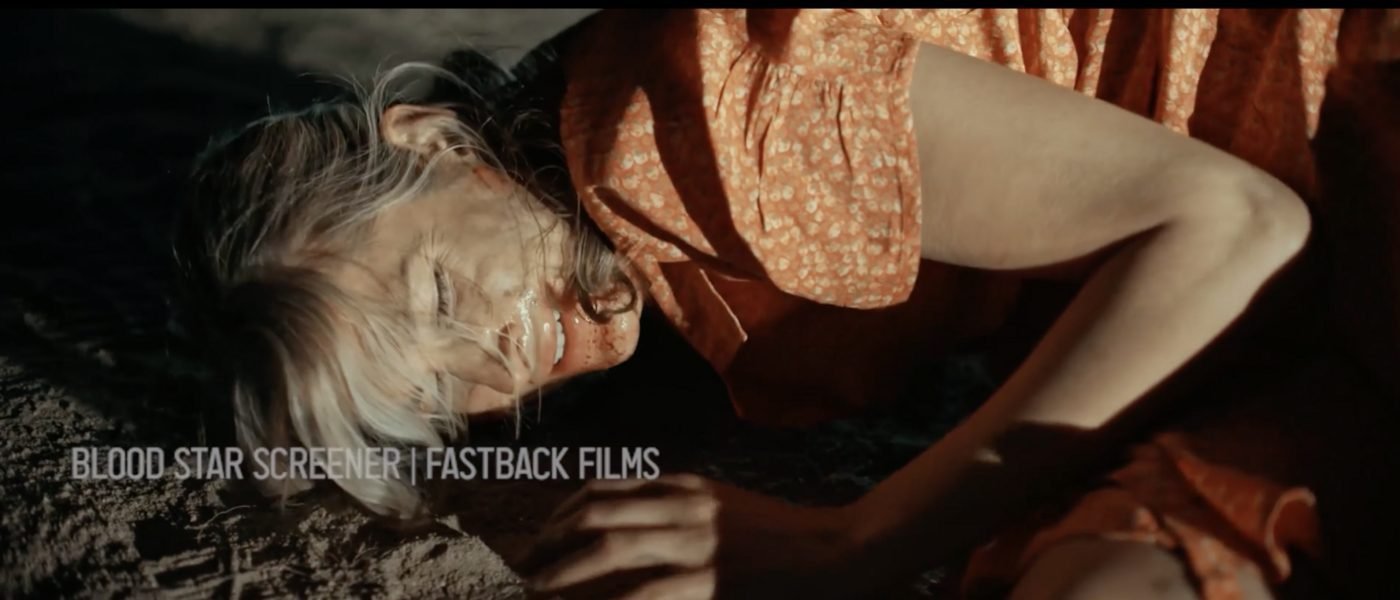
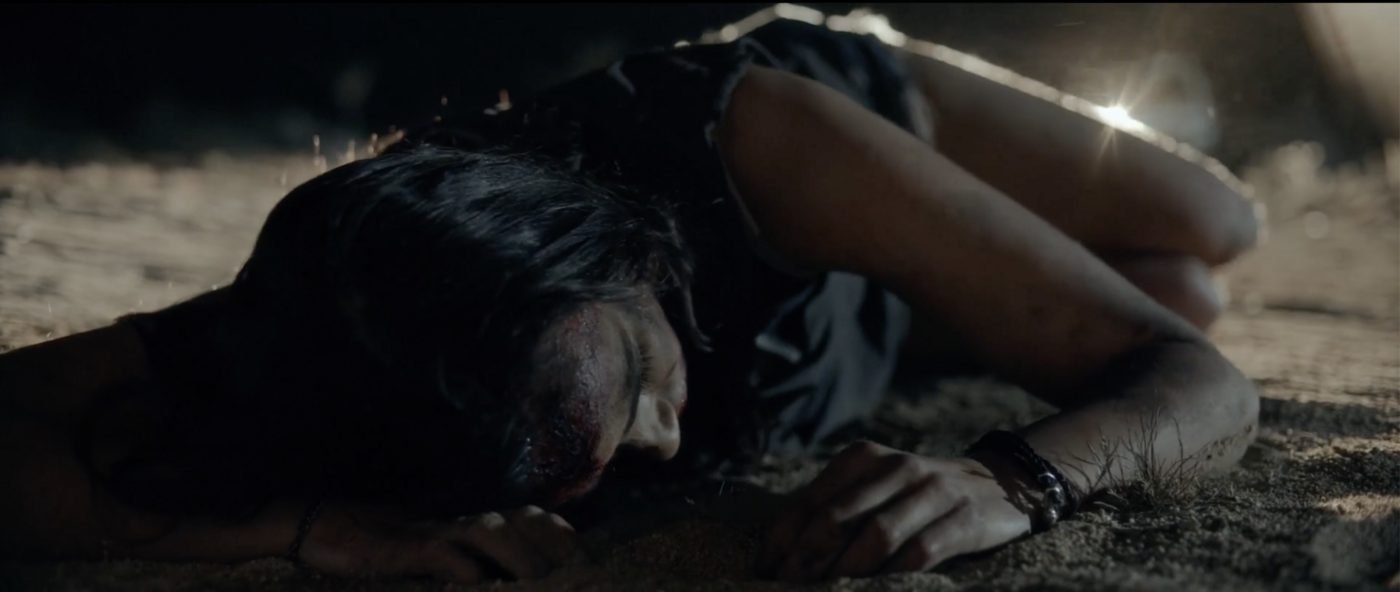
This is another point of comparison with Obsession. That film has a supernatural hook and several striking horror moments, but the concept only works because the audience believes in Bear’s need, Nikki’s transformation and the emotional consequences of the wish. Its relatively contained structure places enormous weight on Michael Johnston and Inde Navarrette.
The original Saw is remembered for its traps, but much of the first film is built around two men confined in a room, trying to understand the situation and one another.
Paranormal Activity depends on the credibility of its couple. Without a believable domestic relationship, the night-time footage would be only a technical exercise.
The lesson is clear: spectacle can attract attention, but character sustains a feature.
For Blood Star, the limited number of central characters was not merely a budget decision. It allowed the production to concentrate screen time, preparation and dramatic pressure on the people carrying the story.
A Small Crew Reduced Friction
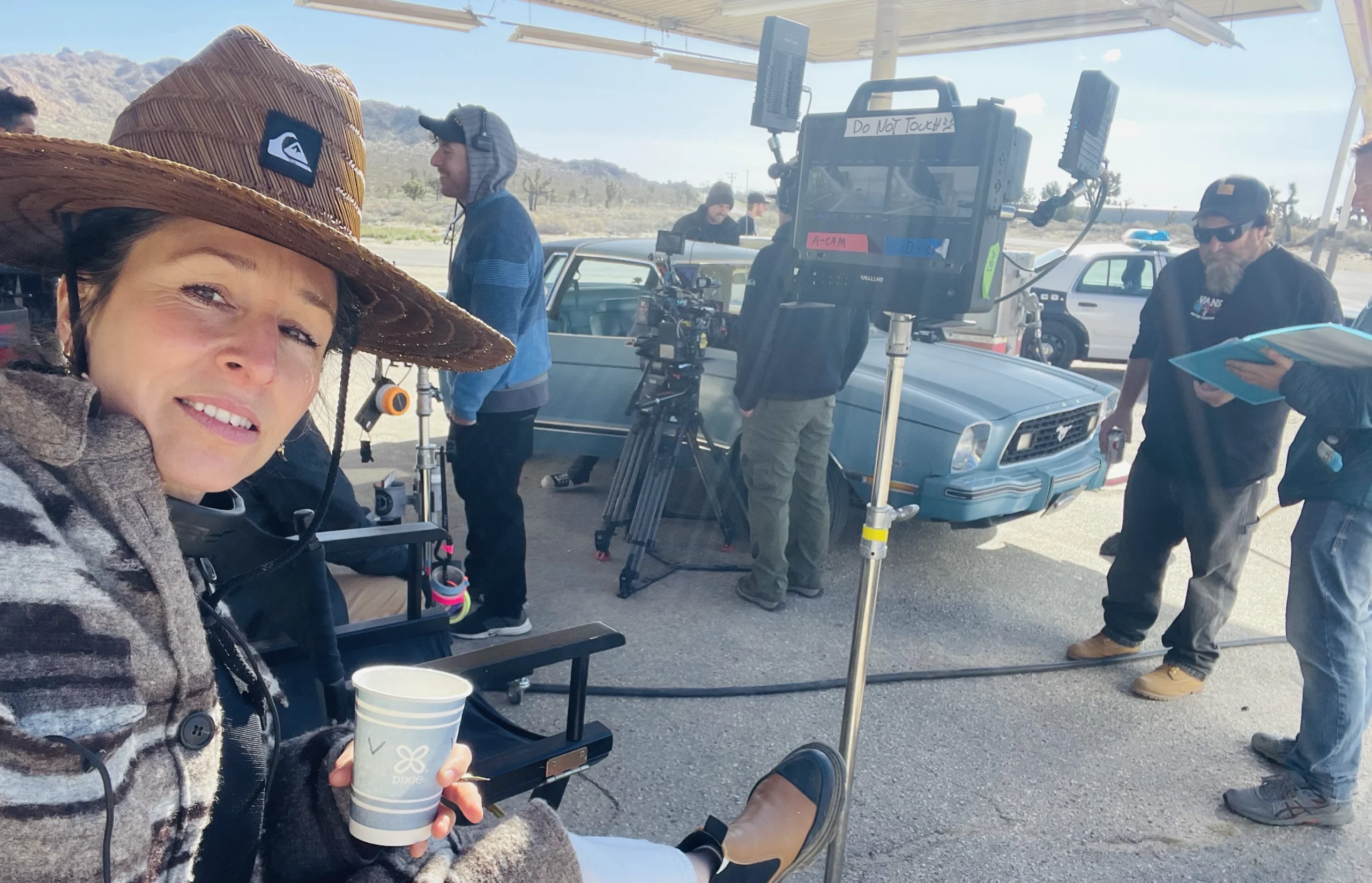
A small crew is not automatically an efficient crew.
If essential skills are missing, fewer people can actually slow the production down. Crew members become overloaded, mistakes increase and departments are forced to wait for one another.
The advantage comes from having a compact team in which each person understands the production model and can make decisions quickly.
Blood Star was made with a crew of roughly 15 to 20 people, depending on how the production team is counted. Published accounts have described it as approximately 20 people, while the filmmakers’ own production narrative emphasises the exceptionally small core team, according to Wikipedia.
On remote desert locations, a smaller unit offered practical benefits:
- Fewer vehicles;
- Faster company moves;
- Less equipment to transport;
- Shorter setup chains;
- Easier communication;
- Lower catering and accommodation requirements;
- Less disruption to locations; and
- Greater flexibility in confined roadside spaces.
But the production still required specialists.
Camera, sound, lighting, art direction, makeup, costume, production, safety and continuity do not disappear simply because the budget is limited. Their responsibilities must still be covered.
The goal was not to pretend those jobs were unnecessary. It was to construct a team capable of covering them without the layered hierarchy of a much larger production.
Commercial Filmmaking Experience Helped
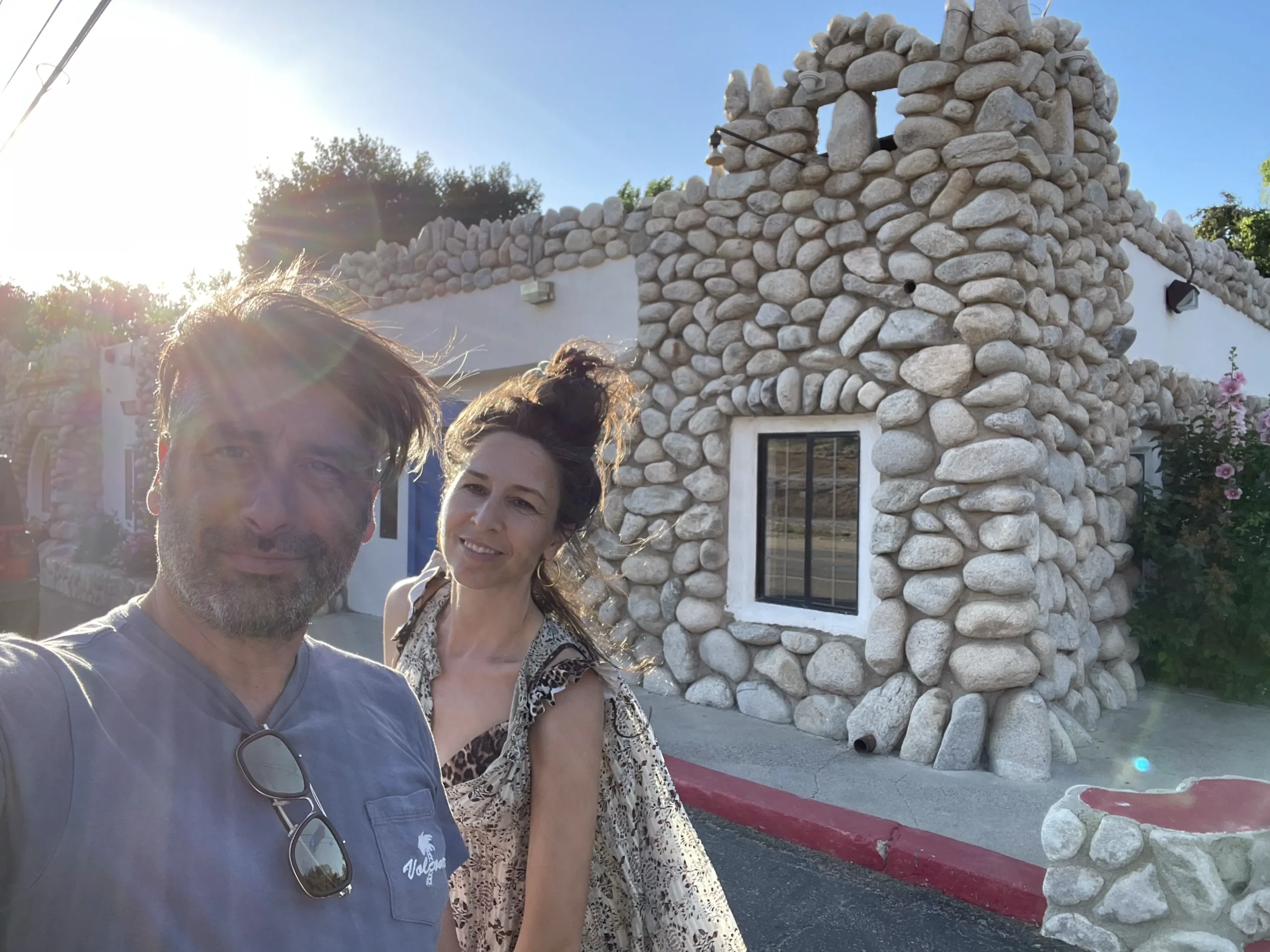
Although Blood Star was Lawrence Jacomelli’s first feature as director, it was not his first production.
Years of directing commercials had created a working method based around preparation, visual communication and making decisions within fixed schedules.
Commercial productions are not identical to features. A 30-second advertisement may have a larger daily budget than an entire independent movie, and the rhythm of short-form production is very different from sustaining character across a feature.
However, several disciplines transfer directly:
- Previsualising shots;
- Communicating clearly with a cinematographer;
- Knowing what must be captured;
- Working within daylight restrictions;
- Making locations look their best;
- Prioritising the most valuable material;
- Maintaining visual consistency;
- Solving problems quickly; and
- Understanding that indecision consumes money.
The feature required a different emotional and narrative endurance, but the commercial mindset helped the team approach each day with a defined visual objective.
MovieMaker noted that Blood Star was Jacomelli’s first feature—and that he had not previously directed a short film—making the 10-day production an unusually ambitious debut.
The Production Did Not Depend on Fixing Everything in Post
Fast productions can create a dangerous assumption: shoot whatever is possible and repair the consequences later.
That approach often moves cost rather than removing it.
Poor coverage creates editorial problems. Inconsistent eyelines require compromises. Missing inserts force awkward cuts. Uncontrolled backgrounds create visual-effects work. Weak sound can require extensive dialogue replacement.
On Blood Star, the production needed to capture usable material at speed, not merely generate footage.
That meant monitoring:
- Continuity;
- Focus;
- Exposure;
- Sound;
- Performance;
- Vehicle positions;
- Screen direction;
- Costume and makeup;
- Practical blood effects;
- Background activity; and
- The relationship between all three cameras.
Post-production remained crucial, but it could not become a rescue operation for a production that had failed to record the story.
This is another characteristic shared by effective low-budget films. Their concepts may be economical, but their execution is usually deliberate.
The apparent simplicity of Paranormal Activity depended on controlling what changed within a static frame.
The improvisational appearance of The Blair Witch Project still emerged from a clearly designed production method, with the actors receiving instructions and the filmmakers shaping their journey over an eight-day shoot.
Economy works best when the filmmaking rules are precise.
What Blood Star Shares With Other Low-Budget Breakouts
Blood Star, Obsession, Paranormal Activity and The Blair Witch Project are very different films, but their production models share several principles.
1. A concept that can be explained immediately
A lone driver is pursued by a corrupt sheriff.
A man makes a wish that turns romantic desire into horror.
A couple records unexplained activity in their house.
Three filmmakers disappear while investigating a legend.
Each concept creates a clear audience promise.
2. A limited number of essential characters
The stories concentrate attention on a small central group rather than distributing resources across a huge ensemble.
3. Locations that create narrative value
The desert, house and forest are not passive settings. They determine the type of danger the characters face.
4. Selective set pieces
The films do not attempt to stage expensive sequences continuously. They build anticipation between carefully chosen moments.
5. Performance as production value
The actors carry suspense that might otherwise require larger action, effects or spectacle.
6. A recognisable visual system
Found footage, static surveillance-style framing, centre-composed discomfort or multi-camera desert cinematography gives each production a coherent identity.
7. Discipline rather than imitation
None of these films needed to reproduce the scale of a studio blockbuster. Their success came from making the restrictions feel intentional.
Could Every Feature Be Shot in 10 Days?
No.
A 10-day schedule is not a universal production model, and it should not become a target simply because it sounds impressive.
Some screenplays require more time.
A film involving children, animals, elaborate prosthetics, complex stunts, crowd scenes, period design, extensive night work or emotionally demanding performances may become unsafe or creatively compromised if forced into an inappropriate schedule.
Even Obsession, despite its contained concept and low budget, used 20 shooting days—twice the schedule of Blood Star.
The correct question is not:
“How quickly can this film be shot?”
It is:
“What schedule does this particular film require, and how can the screenplay and production method make that schedule achievable?”
For Blood Star, 10 days became possible because the screenplay, locations, camera system and crew structure were aligned around the same goal.
Had any one of those elements worked against the others, the schedule could have failed.
Did You Know?
Even IMDb’s own production notes and trade coverage of Blood Star point to the same underlying pattern as Obsession and other recent low-budget breakouts: a tightly contained cast lets the whole schedule be built around performance rather than scale.
The Main Lessons From the Blood Star Shoot
The production offers several practical lessons for filmmakers planning a low-budget feature.
Design the film before reducing the schedule
A short schedule should emerge from the screenplay and production plan. It should not simply be imposed on a film designed for twice the time.
Spend preparation to save shooting days
Locations, coverage, equipment and logistics should be settled as early as possible.
Build around one strong dramatic engine
A compelling relationship or pursuit can provide more sustained value than a collection of disconnected set pieces.
Use multiple cameras with purpose
Additional cameras help only when their positions, lenses and editorial roles are planned.
Treat real locations as production value
The right landscape or building can provide scale, texture and atmosphere that cannot be afforded artificially.
Keep the crew small but complete
Remove unnecessary hierarchy, not essential expertise.
Protect the performances
Fast filmmaking must not reduce actors to props moved between camera positions.
Capture material that can actually be edited
Speed is meaningless when the footage lacks continuity, sound or dramatic clarity.
Final Thoughts
Shooting Blood Star in 10 days was not an attempt to prove that feature films should be made as quickly as possible.
It was a response to the realities of independent filmmaking.
The production did not have unlimited money, time or infrastructure. What it did have was a clear concept, a cinematic landscape, an experienced production partnership and a willingness to design every part of the process around what could genuinely be achieved.
The result belongs to a long tradition of low-budget genre filmmaking.
The Blair Witch Project turned an eight-day woodland shoot into a global phenomenon. Paranormal Activity used a house, a couple and seven days of production to create an enduring franchise. Obsession used a $750,000 budget, 20 shooting days and a strong character-driven concept to become a major contemporary horror success, per The Guardian.
Blood Star followed the same fundamental principle without copying their methods: identify what the film can do exceptionally well, then organise the entire production around that strength.
For Blood Star, that meant two central performances, a corrupt authority figure, a woman fighting to survive, three cameras and a desert landscape that made the film feel far larger than its resources.
The film was not completed in 10 days because time did not matter.
It was completed in 10 days because every minute did.
Frequently Asked Questions
Blood Star was shot in 10 principal photography days in the desert — about half the schedule of a typical low-budget horror film, and half of Obsession’s 20-day shoot.
Two RED Gemini cameras and one RED Komodo, running simultaneously as a coordinated three-camera system rather than three independent setups.
Lawrence Jacomelli directed the film in his feature debut; Victoria Taylor wrote and produced it. The two are a husband-and-wife filmmaking team who previously worked together in commercial production.
Roughly 15 to 20 people, depending on how the production team is counted — small enough for fast company moves and easy communication on remote desert locations, but still covering every essential department (camera, sound, lighting, art, makeup, costume, safety, continuity).
No. A 10-day schedule only works when the screenplay, locations, camera system and crew structure are all designed around that limitation from the start. Films involving children, animals, elaborate prosthetics, complex stunts, crowd scenes or extensive night work may become unsafe or creatively compromised if forced into too short a schedule.
Learn More About Blood Star
If you’re interested in how independent filmmakers create ambitious thrillers on limited budgets, you can explore more about Blood Star, including its cast, production and behind-the-scenes story.
If you’d like to watch the film, visit the Blood Star Watch Page to see where it’s currently available to stream or purchase.
Related: a much wider catalogue of independent movies streaming free on Tubi
Related: independent movies available through Prime Video
Related: real questions around authority and abuse of power
Watch Blood Star
Blood Star is a psychological desert road thriller about Bobbi Torres, a young woman travelling alone across the American Southwest who becomes the target of Sheriff Bilstein, a predatory lawman whose badge, patrol car and knowledge of the territory allow him to control the hunt.


See every legitimate way to watch Blood Star free →

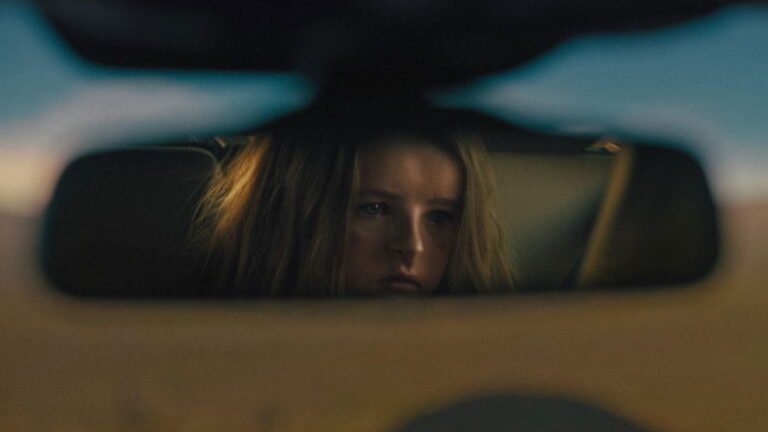
Table of Contents
- How Blood Star Was Shot in Just 10 Days
- The Story Had to Support the Production Model
- Preparation Replaced Shooting Time
- Three Cameras Were Used to Protect Performance and Speed
- The Desert Created Scale Without Building It
- The Schedule Averaged More Than 10 Pages Per Day
- The Film Relied on Performances, Not Constant Spectacle
- A Small Crew Reduced Friction
- Commercial Filmmaking Experience Helped
- The Production Did Not Depend on Fixing Everything in Post
- What Blood Star Shares With Other Low-Budget Breakouts
- 1. A concept that can be explained immediately
- 2. A limited number of essential characters
- 3. Locations that create narrative value
- 4. Selective set pieces
- 5. Performance as production value
- 6. A recognisable visual system
- 7. Discipline rather than imitation
- Could Every Feature Be Shot in 10 Days?
- The Main Lessons From the Blood Star Shoot
- Design the film before reducing the schedule
- Spend preparation to save shooting days
- Build around one strong dramatic engine
- Use multiple cameras with purpose
- Treat real locations as production value
- Keep the crew small but complete
- Protect the performances
- Capture material that can actually be edited
- Final Thoughts
- Learn More About Blood Star
- Watch Blood Star