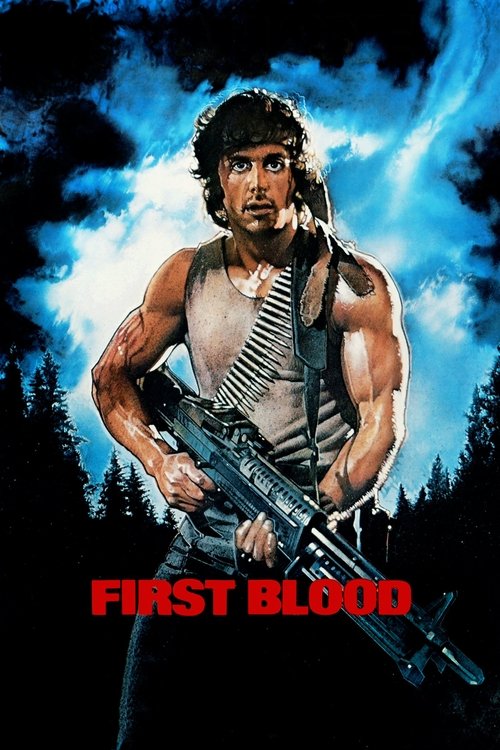
There is a simple assumption built into a huge amount of thriller cinema: if the protagonist is in danger, eventually they can go to the police. First Blood destroys that assumption almost immediately. The 1982 film, often casually referred to as Rambo: First Blood because it introduced Sylvester Stallone’s John Rambo, begins not with a war or an elaborate act of violence, but with a man walking into the wrong town.
Rambo is a Vietnam veteran drifting through rural America after discovering that another member of his former unit has died. Then Sheriff Will Teasle sees him, and from that moment a minor encounter becomes a catastrophe. That is one of the reasons this film is particularly interesting alongside Blood Star. The films are very different in genre, scale and period, but both are built around a disturbing reversal of authority: the person wearing the badge is not the person the protagonist can turn to for protection. He is the person creating the danger.
First Blood Begins With an Abuse of Authority
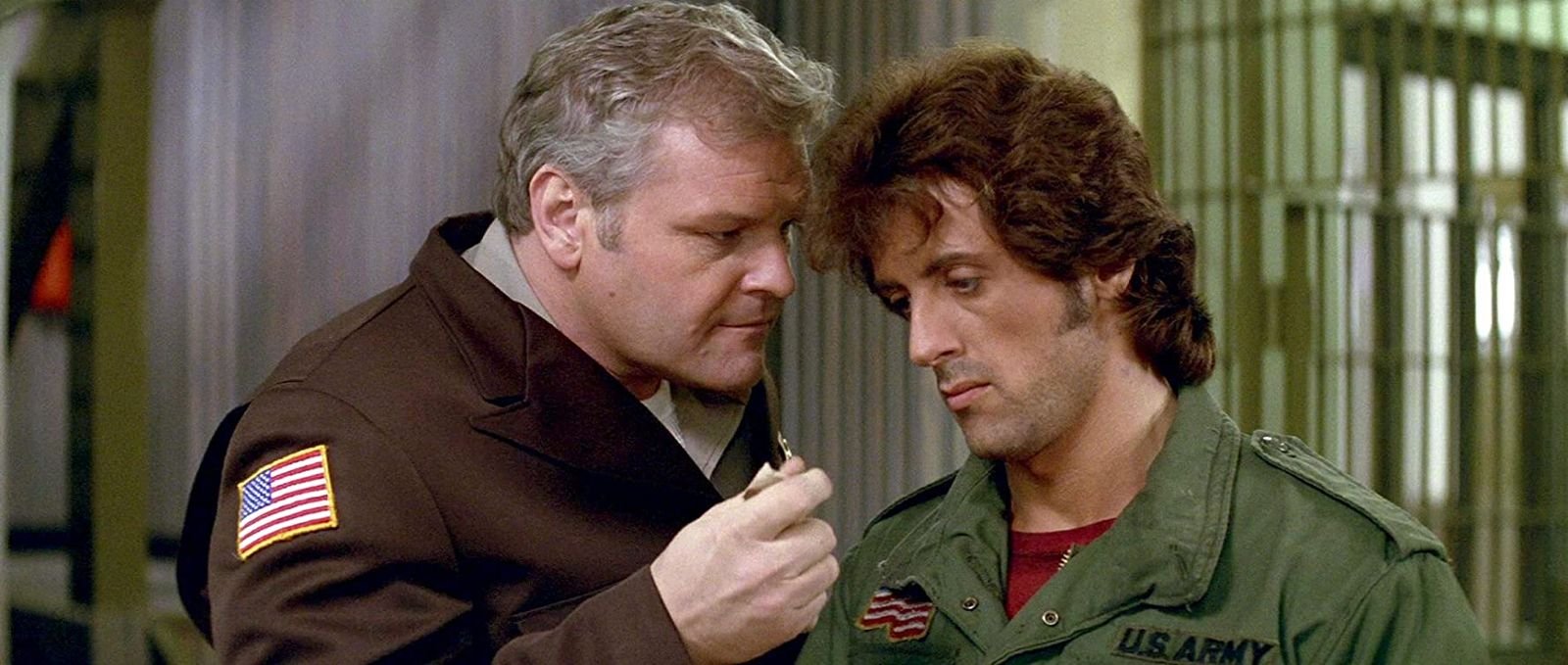
What is striking about the opening of First Blood is how little Rambo actually does to create the conflict. He walks into Hope, Washington, looking for food. Teasle picks him up and drives him outside the town limits. Rambo turns around and walks back. That is enough for Teasle to arrest him.
The escalation comes almost entirely from the sheriff’s refusal to allow an outsider to challenge his authority. The movie goes to great lengths to establish that violence is not where the confrontation begins. It begins with power: a sheriff sees someone vulnerable, decides he has the authority to remove him and expects compliance.
Rambo Is an Outsider in Someone Else’s Territory
The idea of territory is central to First Blood. Hope is Teasle’s town — he knows the deputies, the roads and the local institutions. Rambo has none of those advantages. He is alone, transient and immediately treated as suspicious because he does not fit into the social environment around him.
That is one of the strongest connections to Blood Star. Bobbi Torres is also travelling through someone else’s territory. She does not know the local people, the roads or the institutions around her, but Sheriff Bilstein does. When he stops her, the imbalance exists before she understands anything about him personally.

Blood Star Takes the Corrupt-Sheriff Idea Somewhere Much Darker
The major difference between Sheriff Teasle and Sheriff Bilstein is important. Teasle is not secretly a serial killer — his corruption is rooted in arrogance, prejudice and the abuse of local authority. Bilstein operates on a far darker level. In Blood Star, the abuse of authority has become part of a predatory system. Bilstein understands what the uniform allows him to do, and he uses that understanding deliberately.
A lone traveller is far more likely to stop for a sheriff than for a suspicious stranger. Bilstein weaponises that assumption. That makes him frightening in a different way from a conventional serial killer: he does not need to hide from authority. He is the authority.
The Badge Becomes Part of the Trap
Thrillers often use uniforms as shorthand for safety. A police car appears, a sheriff enters, and the protagonist appears finally to have reached help. Films about corrupt cops reverse that visual language. That is central to both First Blood and Blood Star — Rambo initially has nowhere to appeal because the man escalating the situation is the sheriff himself, and Bobbi faces an even more terrifying version of that problem: if the sheriff is the predator, who exactly is she supposed to call?
Sheriff Teasle and Sheriff Bilstein Are Different Kinds of Cop Villains
Teasle is frightening because his actions feel plausible. Brian Dennehy plays him without turning him into a cartoon villain — Teasle believes he is defending his town and maintaining order, and that belief is precisely what makes him dangerous. Sheriff Bilstein is different because the justification has disappeared. He understands exactly what he is doing. The badge has become camouflage.
When the Hunted Man Reaches the Wilderness
One of the smartest structural moves in First Blood happens when Rambo escapes the town and reaches the mountains. Inside Hope, Teasle controls the environment. In the wilderness, Rambo understands the terrain better — he knows how to move quietly, camouflage himself and predict the people pursuing him. That reversal is one reason First Blood connects so naturally to hunter-versus-hunted movies such as Predator.
Landscape is just as important in Blood Star, although the balance operates differently. Sheriff Bilstein begins with the territorial advantage and keeps it for most of the film — the apparent openness of the desert becomes deceptive. Bobbi can see for miles, but that does not mean there is somewhere meaningful to escape to.
The Hunter’s Greatest Strength Can Become His Weakness
In First Blood, Rambo’s advantage comes from Teasle’s assumption that numbers and legal authority guarantee control. They do not. In Blood Star, Bilstein’s weakness is psychological — he has repeated his ritual often enough that he believes he controls the ending. Bobbi’s survival depends on understanding that certainty and making his confidence work against him.
Movies Where the Police Are the Villains
First Blood and Blood Star belong to a broader tradition of thrillers that ask what happens when law enforcement becomes part of the danger rather than the solution — from Cop Land and Training Day to Unlawful Entry and, more recently, Rebel Ridge. The variations are different, but the underlying fear is similar: what happens when the person authorised to enforce the rules is the person breaking them?
First Blood Is Really a Manhunt Movie
Although First Blood eventually became the beginning of one of cinema’s most recognisable action franchises, the original film is fundamentally a manhunt thriller. That makes it structurally closer to Predator, The Fugitive, Apocalypto and even No Country for Old Men than to many of the later Rambo films. Teasle controls the town. Rambo controls the wilderness. Then the conflict keeps expanding because neither side is willing, or able, to return the situation to where it began. For more films built on that same structure, see our guide to the best manhunt movies.
Rambo and the Myth of the Action Hero
It is worth remembering just how vulnerable Rambo is in First Blood. This Rambo is exhausted, lonely, traumatised and unable to find a place inside the country he served. Teasle defines Rambo as trouble before Rambo has actually caused any — and once that definition is established, almost everything that follows is interpreted through it.
The Real Question Both Films Ask
Underneath the action, suspense and pursuit, both First Blood and Blood Star ask a very simple question: what happens when someone in authority decides that the rules no longer apply to them? Both stories remove one of the basic protections audiences normally assume a protagonist possesses. The sheriff is not coming to save you. The sheriff is already here.
Movies Like First Blood: Manhunt Thrillers, Corrupt Cops and Hunted Outsiders
For viewers searching for movies like First Blood, the closest matches are often not conventional military action films. The better comparisons are stories about outsiders being hunted, abusive authorities and wilderness pursuit. Rebel Ridge is one of the strongest modern comparisons, and Predator reverses the structure by beginning with professional hunters who discover they have entered someone else’s territory. The Hitcher transforms the road itself into a hunting ground, while Breakdown similarly traps an outsider in a landscape where local knowledge belongs to other people.
Why First Blood Still Matters
More than four decades later, First Blood remains surprisingly contemporary because its strongest ideas are not dependent on the action genre. It is about power, trauma, institutional arrogance, the treatment of outsiders and how rapidly authority can escalate a situation when admitting a mistake becomes harder than continuing it. Both films understand that one of the most frightening situations imaginable is not simply being hunted — it is being hunted by someone whose badge tells the rest of the world that he is supposed to be the good guy.
Watch Blood Star
Blood Star is a psychological desert road thriller about Bobbi Torres, a young woman travelling alone across the American Southwest who becomes the target of Sheriff Bilstein, a predatory lawman who uses his badge, patrol car and knowledge of the territory to control the hunt. If you respond to First Blood as a story about an outsider confronting abusive law enforcement and hostile territory, Blood Star takes that fear into much darker psychological territory. For more on how Bilstein was conceived, see Making Blood Star.


See every legitimate way to watch Blood Star free →
Film poster via TMDB.
More on Blood Star
- Sheriff Bilstein: The Predator Behind the Badge
- Movies Like The Hitcher
- Movies Like Breakdown
- Blood Star — Cast & Filmmakers

Table of Contents
- First Blood Begins With an Abuse of Authority
- Rambo Is an Outsider in Someone Else’s Territory
- Blood Star Takes the Corrupt-Sheriff Idea Somewhere Much Darker
- The Badge Becomes Part of the Trap
- Sheriff Teasle and Sheriff Bilstein Are Different Kinds of Cop Villains
- When the Hunted Man Reaches the Wilderness
- The Hunter’s Greatest Strength Can Become His Weakness
- Movies Where the Police Are the Villains
- First Blood Is Really a Manhunt Movie
- Rambo and the Myth of the Action Hero
- The Real Question Both Films Ask
- Movies Like First Blood: Manhunt Thrillers, Corrupt Cops and Hunted Outsiders
- Why First Blood Still Matters
- Watch Blood Star
- More on Blood Star