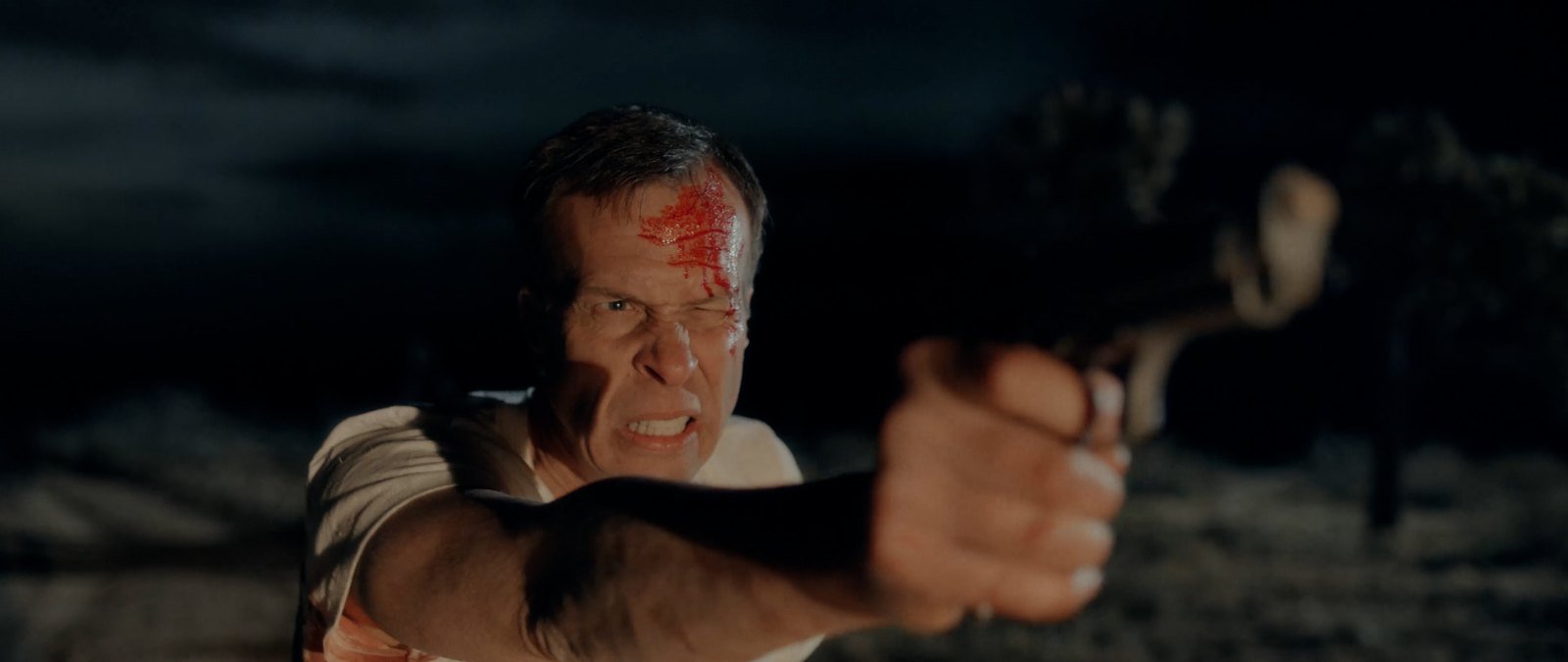
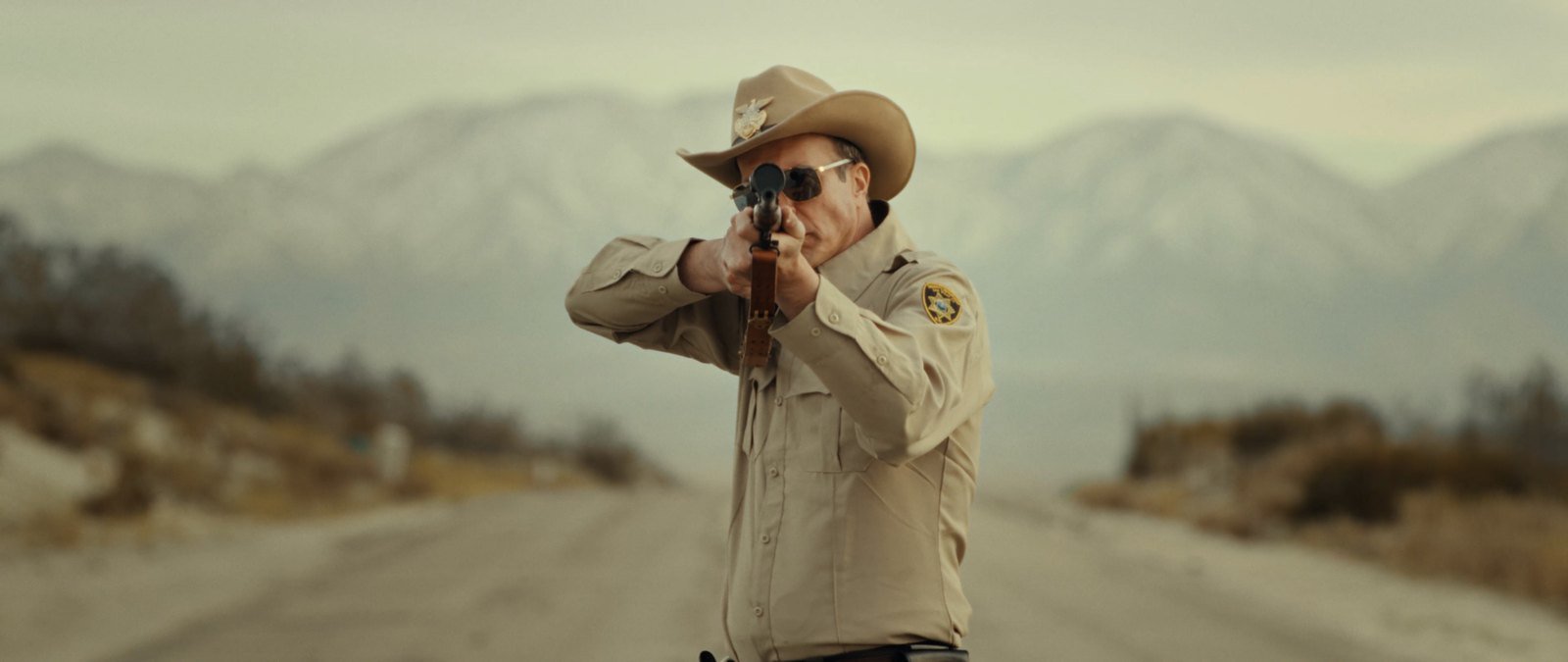
Sheriff Bilstein is the central threat at the heart of Blood Star, but what makes him disturbing is not simply that he is violent. It is that he operates from a position of authority. He wears a uniform, drives a police vehicle and occupies a role that should represent safety, order and protection. Instead, he uses that authority to isolate, intimidate and control the people who cross his path. For Bobbi, the young woman at the centre of the film, the danger begins with something completely ordinary: an encounter with a sheriff on a remote American road.
That ordinary beginning is what makes Bilstein effective. A police officer stopping a driver is a familiar event. Most people understand the rules instinctively: pull over, remain calm, answer questions and assume that however uncomfortable the situation may feel, the person approaching the vehicle represents legitimate authority. Blood Star gradually dismantles that assumption. The tension comes from the slow realisation that the rules governing the encounter may not protect Bobbi at all.
Bilstein is therefore different from many conventional movie killers. He does not need to hide from the law because, outwardly at least, he represents it. His uniform gives him access, legitimacy and credibility before Bobbi even knows that she is in danger.
Who Is Sheriff Bilstein in Blood Star?
Sheriff Bilstein is a small-town lawman operating across an isolated stretch of the American Southwest. He appears to have enormous freedom within the territory around him, and that freedom becomes central to the film’s tension. Bobbi is travelling alone when she enters his world — unfamiliar with the area, far from anyone she knows and dependent upon the same systems of authority that Bilstein represents.
That immediately places her at a disadvantage. Bilstein understands the roads, the distances and the rhythms of the local environment. Bobbi does not. He knows how people respond to a police uniform and how much authority that uniform allows him to exercise without immediately appearing suspicious. Bobbi is mobile but vulnerable. Bilstein appears rooted, established and protected by the position he occupies.
Why Sheriff Bilstein Is More Frightening Than a Conventional Serial Killer
Many serial-killer films begin with the threat already identified. The audience understands that the stranger is dangerous and waits for the protagonist to realise the same thing. Blood Star creates a different kind of tension because Bobbi’s first problem is not simply escaping Bilstein — it is deciding whether she is justified in fearing him in the first place.
A sheriff is supposed to be someone a stranded traveller can approach for help. That expectation works in Bilstein’s favour: he can ask questions that would immediately appear intrusive coming from a stranger, demand that Bobbi stop her vehicle, and interpret nervousness as suspicious behaviour and non-compliance as guilt. The badge becomes a weapon before Bilstein ever needs to use physical violence.
Sheriff Bilstein and the Abuse of Authority
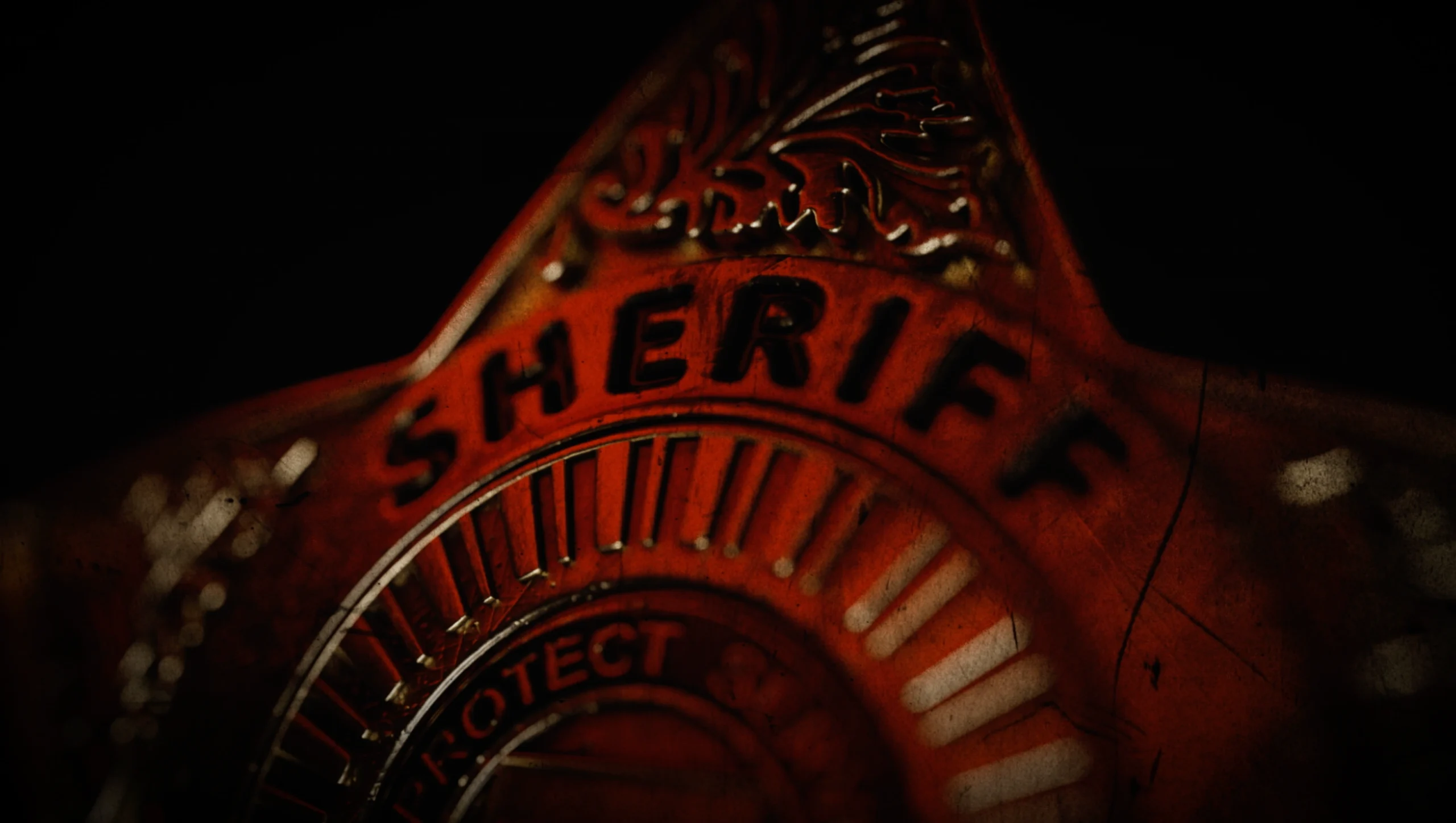
At the centre of Blood Star is a simple but disturbing question: what happens when someone in authority abuses the power they have been given? Bilstein represents an extreme version of that idea. He does not initially appear to Bobbi as a stranger stepping out of the darkness — he arrives with the visual language of authority already attached to him: uniform, police cruiser, badge, questions and commands.
Bilstein turns that expectation against his victims. His power does not come only from what he is willing to do. It comes from the fact that the people he encounters have been conditioned to cooperate with him. He begins from a position of trust and converts that trust into control.
Bobbi and Sheriff Bilstein
The relationship between Bobbi and Bilstein gives Blood Star its central cat-and-mouse structure. Bobbi is not a detective trying to expose him or an armed hero deliberately entering his territory — she is simply travelling through the wrong place at the wrong time.
That ordinariness matters because Bilstein’s initial advantage is enormous. Bobbi is forced to respond to him according to normal social rules while he is operating according to completely different ones. The tension grows as Bobbi gradually stops treating him as an authority figure and begins treating him as what he really is: a predator.
The Moment Authority Becomes Threat
One of the most effective ideas in Blood Star is the gradual transformation of Bilstein’s police uniform. At the beginning, it carries the usual associations of law enforcement. As Bobbi becomes increasingly suspicious, the meaning of the uniform changes: the badge no longer represents protection, it represents access. The police car no longer represents help, it represents pursuit.
Bobbi has to overcome not only the physical danger Bilstein represents, but also the deeply ingrained instinct to trust the role he occupies. The gap between the image of authority and the reality behind it is where the character becomes most disturbing.
Sheriff Bilstein and Anton Chigurh
There are obvious differences between Sheriff Bilstein and Anton Chigurh in No Country for Old Men, but both characters draw power from the environments in which they operate. Chigurh moves through the vast spaces of West Texas with extraordinary confidence, where motels, highways and borders offer only temporary protection from him.
Bilstein’s advantage is different. He possesses geography and authority at the same time. Chigurh appears frightening because he exists beyond the law. Bilstein appears frightening because he hides behind it. He does not need to behave like an outlaw because his uniform gives him the outward appearance of legitimacy.
Sheriff Bilstein and John Ryder in The Hitcher
The comparison with John Ryder in The Hitcher is even closer in terms of structure. Both films turn the open highway into a hunting ground and both antagonists repeatedly reappear even when the protagonist believes they have escaped.
John Ryder’s power comes from unpredictability — he appears and disappears across the road network. Bilstein creates a similar sensation of being trapped inside a landscape, but his advantage is more complicated because he belongs to the world Bobbi is travelling through. Ryder pursues his victim from outside the system; Bilstein can use the system as part of the pursuit.
Sheriff Bilstein and Mick Taylor in Wolf Creek
There is also a strong comparison with Mick Taylor in Wolf Creek. Mick initially appears friendly when stranded travellers encounter him, understands the Outback and presents himself as someone who can help people who are vulnerable because they are far from home. The eventual horror comes from discovering that the person offering help is the danger.
Bilstein operates through a similar reversal. The sheriff should be the person who helps the stranded or vulnerable traveller. Instead, the traditional symbol of protection becomes part of the threat. Both villains also possess an intimate relationship with the landscape — the victims are travellers, the predators are locals.
Why Isolation Matters
Blood Star could not create the same tension if Bobbi encountered Bilstein in the middle of a major city. Isolation is fundamental to his power — on an empty stretch of desert road there are fewer witnesses, help takes longer to arrive, and Bobbi cannot easily know who Bilstein knows, who trusts him or how far his influence extends. That uncertainty allows Bilstein to feel much larger than one man.
Amy and the Wider World of Blood Star
Amy, the waitress, occupies a different position in the story from Bobbi. She belongs to the local world through which Bobbi is travelling, and characters like Amy are important because they remind us that Bilstein does not exist in complete isolation. People live within the territory he controls. They encounter him. They may understand aspects of his behaviour, and they may know more than they are willing or able to say.
The Small-Town Sheriff as a Thriller Archetype
Cinema has repeatedly used corrupt sheriffs and police officers because the idea contains an immediate contradiction: the person responsible for enforcing the rules is also the person breaking them. What makes Bilstein particularly effective within that tradition is the simplicity of the situation — one man has authority, one woman is passing through his territory, and the distance between them and meaningful oversight creates the opportunity for abuse.
Why Bilstein Does Not Need to Be Supernatural
Many horror films make their villains physically indestructible or supernatural. Bilstein does not need that because his power is grounded in things that exist in the real world: authority, isolation, fear, social conditioning, institutional trust and the possibility of not being believed. Bobbi can physically move away from Bilstein, but escaping his control requires more than putting distance between them — she has to recognise the structure of the trap.
The Uniform as Camouflage
A serial killer traditionally needs camouflage. Bilstein’s camouflage is unusually powerful because society has already supplied it to him. The uniform answers questions before anyone thinks to ask them — why is this man stopping cars? Because he is a sheriff. Why should Bobbi follow his instructions? Because he is a sheriff. Every one of those assumptions creates additional space for abuse.
Why Sheriff Bilstein Works as the Villain of a Road Thriller
Road movies are traditionally about freedom — a character gets into a car and can theoretically go anywhere. A road thriller reverses that promise. Sheriff Bilstein fits naturally into that world because his authority extends directly onto the road. The place that should allow Bobbi to leave becomes the place where he can stop her. The freedom associated with driving disappears the moment the person controlling the road becomes the threat.
The Horror of Ordinary Procedure
Perhaps the most disturbing element of Bilstein is how little he initially has to change. He does not need to invent an elaborate trap — he simply uses ordinary police procedure and gradually pushes it beyond its legitimate boundaries. A traffic stop becomes interrogation. Questions become intimidation. Authority becomes control. Control becomes pursuit.
Sheriff Bilstein and the Fear of Not Being Believed
One of the most powerful aspects of stories about abusive authority is the victim’s awareness that telling the truth may not immediately solve the problem. Bilstein’s badge gives him a ready-made version of events — he can describe Bobbi as difficult, suspicious or unstable. Once an authority figure controls the narrative, the victim may find herself having to prove not only that something happened, but that her own behaviour was reasonable.
Why Sheriff Bilstein Belongs Among Modern Thriller Villains
The strongest thriller villains often reflect anxieties larger than themselves. Anton Chigurh represents inevitability and moral chaos. John Ryder represents the unknowable stranger on the road. Mick Taylor represents the predator who controls a remote landscape. Sheriff Bilstein represents corrupted trust. His threat begins precisely where safety is supposed to begin — the audience does not simply fear what Bilstein might do, they fear the circumstances that allow him to do it.
Sheriff Bilstein and the Central Question of Blood Star
At its heart, Blood Star asks what happens when someone with legitimate authority decides to use that authority for predatory purposes. Sheriff Bilstein is the answer to that question. He does not need supernatural strength. He does not need to operate from the shadows. He does not need to hide behind a mask.
He needs a badge, an isolated road and a victim who has been taught that the person wearing that badge is supposed to be trusted. That is what makes him dangerous. And that is what makes him frightening.
Watch Blood Star
See Sheriff Bilstein for yourself, and find out whether Bobbi escapes the trap he has built for her. For more on how the character and the desert setting came together, see Making Blood Star.


See every legitimate way to watch Blood Star free →
More on Blood Star
- Movies With Villains Like Anton Chigurh
- Films like Blood Star: predators, pursuit and survival
- Movies Like The Hitcher
- Movies Like Wolf Creek
- Blood Star — Cast & Filmmakers


Table of Contents
- Who Is Sheriff Bilstein in Blood Star?
- Why Sheriff Bilstein Is More Frightening Than a Conventional Serial Killer
- Sheriff Bilstein and the Abuse of Authority
- Bobbi and Sheriff Bilstein
- The Moment Authority Becomes Threat
- Sheriff Bilstein and Anton Chigurh
- Sheriff Bilstein and John Ryder in The Hitcher
- Sheriff Bilstein and Mick Taylor in Wolf Creek
- Why Isolation Matters
- Amy and the Wider World of Blood Star
- The Small-Town Sheriff as a Thriller Archetype
- Why Bilstein Does Not Need to Be Supernatural
- The Uniform as Camouflage
- Why Sheriff Bilstein Works as the Villain of a Road Thriller
- The Horror of Ordinary Procedure
- Sheriff Bilstein and the Fear of Not Being Believed
- Why Sheriff Bilstein Belongs Among Modern Thriller Villains
- Sheriff Bilstein and the Central Question of Blood Star
- Watch Blood Star
- More on Blood Star