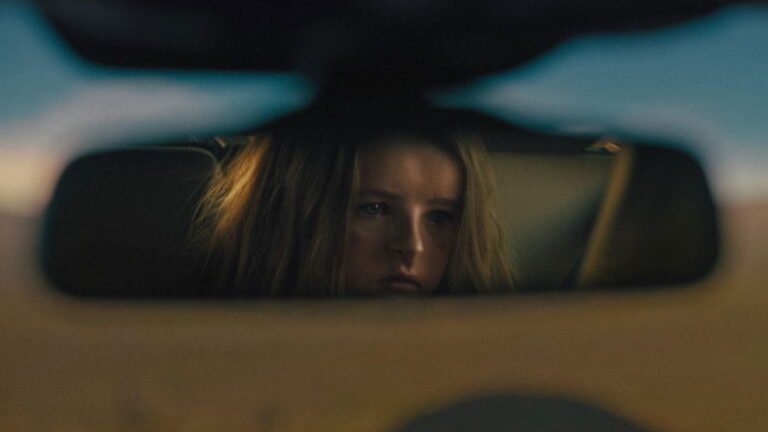
There’s a particular kind of dread that only the open road can produce. Not the jolt of a jump scare, but the slow tightening of something inevitable — a heat-shimmered highway with no exits, a horizon that never seems to arrive, the growing certainty that the next gas station is too far and the last one was too quiet. Desert noir lives in that space. It’s the place where classic film noir wandered out of the rain-slicked city and into the sun, traded shadows for glare, and discovered that an empty landscape can feel just as claustrophobic as a locked room.
The marquee titles in this tradition are well documented. No Country for Old Men turned a West Texas plain into a slaughterhouse with the weather of a parable. Duel made a single truck on a single road into one of the purest exercises in mechanical menace ever filmed. Spielberg’s debut still teaches the genre’s first lesson: you don’t need to see the threat clearly for it to ruin you. Add Badlands, The Hitcher, and Kalifornia to the canon and you have the rough coordinates of American road dread.
But the canon is the easy part. The real pleasure of this genre is what hides just past it — the slow-burn, low-key, atmospheric films that never got the festival victory lap or the streaming front page, and reward the people who go looking. Here are a handful of desert-noir and sun-bleached road-horror thrillers worth tracking down, alongside a recent independent entry in the same tradition.
Blue Ruin (2013)
Jeremy Saulnier’s revenge thriller isn’t set entirely in the desert, but it shares the genre’s DNA completely: a stripped-down narrative, an ordinary man pushed past his limits, and a director who understands that violence is most disturbing when it’s clumsy and real rather than choreographed. Blue Ruin is patient in a way modern thrillers rarely allow themselves to be. It trusts silence. It trusts the audience. If you’ve only seen Saulnier’s louder follow-up, Green Room, this is the quieter, sadder, equally tense film that announced him.
Breakdown (1997)
A married couple’s car dies on a remote highway. Help arrives. Help is the problem. Breakdown is a lean, almost mathematical exercise in escalation, and it understands something essential about Americana horror — that the most frightening landscapes are the ones that look perfectly ordinary until they don’t. Kurt Russell spends the runtime in a state of mounting, helpless panic, and the film never lets the pressure off. It’s a cat-and-mouse thriller that earns every turn.
Blood Star (2024)

Lawrence Jacomelli’s Blood Star (2024) is a recent independent entry in the desert-noir tradition. Britni Camacho plays Bobbi Torres, a young woman driving alone across the desert who draws the attention of Sheriff Bilstein (John Schwab), a lawman who uses his badge to isolate and control the women he targets. Like the 1970s road thrillers it draws on, it builds tension through distance, heat and the absence of help rather than through jump scares.
Its connection to the other films here is the way the landscape functions. As in Duel and The Hitcher, the desert is less a backdrop than a pressure system: empty highways and long distances between towns give every encounter more weight, and the one person who should represent help is the source of the threat. Viewers drawn to the sun-bleached, neo-noir mood of the titles above will recognise the same ingredients; our guide to thrillers similar to Blood Star goes further.
Wolf Creek (2005)
Trade the American desert for the Australian outback and the grammar barely changes: vast emptiness, a long way from help, a hospitality that curdles into something far worse. Wolf Creek is harsher than most films on this list, but it belongs here for how completely it weaponizes isolation. The first half is almost a travelogue. That’s the point. By the time the tone shifts, you’re as stranded as the characters.
Bone Tomahawk (2015)
A Western on its surface, a slow-march survival horror underneath, Bone Tomahawk earns a place in any desert-dread conversation. It’s deliberate to the point of meditative for long stretches, letting character and landscape breathe before the genre reveals its teeth. The patience is the strategy — it makes the eventual horror land with the weight of something that’s been waiting the whole time. Atmospheric, cinematic, and genuinely unsettling.
The Vanishing (1988)
The original Dutch-French version, not the studio remake. The Vanishing is a roadside psychological thriller about obsession, and it builds to one of the most quietly devastating endings in the genre. It’s proof that desert-and-highway dread is as much about psychology as geography — the open road as a place where someone can simply disappear, and the unbearable need to know what happened to them.
Why this genre keeps working
What unites these films isn’t gore or shock — most of them are remarkably restrained. It’s the shared understanding that dread is environmental. Put a person on a long enough road, far enough from help, under a big enough sky, and tension generates itself. The desert and the highway strip everything down to survival, and the best of these movies use that bareness as a feature, not a limitation. They’re slow-burn by design, atmospheric by necessity, and they tend to stay with you longer than the films that try harder to scare you.
That’s also why this corner of cinema is such fertile ground for hidden gems. These are character-driven, mood-first films that don’t always announce themselves loudly — which means the good ones slip through, waiting to be discovered by the kind of viewer who’ll go looking. If you’ve worked through the obvious titles and you’re hungry for more sun-bleached tension, any of the films above will scratch the itch, and newer independent films such as Blood Star show the desert-noir tradition is still being explored.
Watch Blood Star Free
If you like films such as The Hitcher, Wolf Creek and No Country for Old Men, discover Blood Star, the psychological desert thriller directed by Lawrence Jacomelli.
Now streaming free with ads in the USA.


See every legitimate way to watch Blood Star free in the USA →
Related guides
- Movies Like Wind River: Cold, Bleak Wilderness Crime Thrillers
- Movies Like The Hitcher: Highway Horror & Roadside Dread
- Movies Like The Hills Have Eyes
- Movies Like The Texas Chain Saw Massacre: Raw, Rural Horror
More on Blood Star
- Watch Blood Star free on Tubi & Prime Video (USA)
- Blood Star: Ending Explained
- Blood Star — Cast & Filmmakers