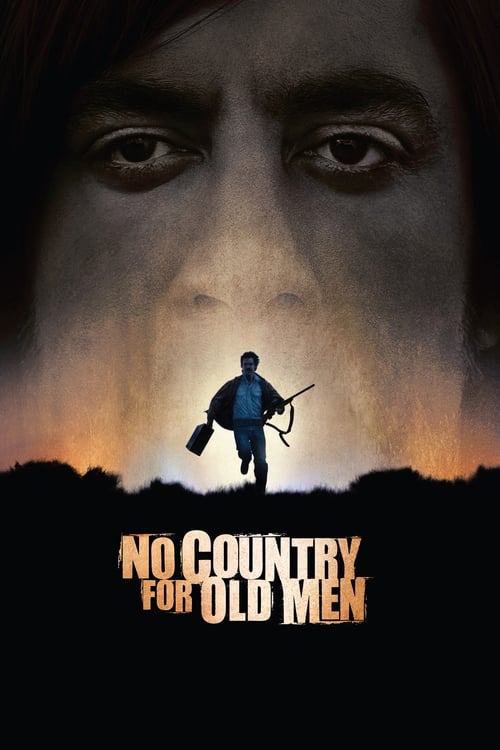
Few modern thrillers end as abruptly, strangely or memorably as No Country for Old Men. After more than two hours of pursuit, murder and escalating tension, the film does not conclude with the confrontation many viewers expect. Llewelyn Moss is already dead. Anton Chigurh survives. Sheriff Ed Tom Bell retires. Then, instead of resolving the story through action, the Coen brothers end the film with Bell sitting at a breakfast table describing two dreams about his father.
For some viewers, the ending can initially feel deliberately unsatisfying. But that refusal to provide a conventional climax is exactly what gives No Country for Old Men its power. The ending is not really about whether Chigurh is caught. It is about Bell finally accepting that the world he thought he understood may never have existed in the way he remembers it.
What Happens at the End of No Country for Old Men?
By the final act, Llewelyn Moss has spent much of the movie trying to stay one step ahead of Anton Chigurh after taking a suitcase containing two million dollars from the aftermath of a drug deal. That confrontation never comes. Moss is killed off-screen by members of the Mexican cartel, and Sheriff Bell arrives too late, left looking at the aftermath. Being clever does not guarantee survival, and being the central character does not grant anyone protection.
Chigurh later tracks down Moss’s widow, Carla Jean, fulfilling a promise he had previously made to Moss. When he offers her the familiar coin toss that has determined the fate of several characters throughout the film, Carla Jean refuses to participate. After leaving her house, Chigurh is suddenly struck by another car at an intersection — his arm is badly broken, but he remains alive. The film then cuts to Bell, now retired, talking to his wife about his dreams.
Why Does Anton Chigurh Survive?
One of the most unsettling aspects of the ending is that Chigurh is never brought to justice. Chigurh has spent the story behaving as though he is an instrument of fate, frequently removing personal responsibility from his killings by allowing a coin toss to determine whether someone lives or dies.
But the car crash exposes the weakness in that philosophy. Chigurh can pretend to control fate when he is holding the coin, but he cannot control the random actions of another driver. The accident does not kill him because the film is not interested in satisfying the audience by punishing its villain — instead, it demonstrates that Chigurh is subject to the same randomness he has imposed upon everyone else.
What Does Carla Jean’s Coin Toss Scene Mean?
Carla Jean’s final scene is one of the most important moments in the film. She refuses to call the coin, and that refusal matters because she understands something other characters have not articulated: the coin is not deciding anything. Chigurh is deciding. The ritual simply allows him to pretend that responsibility lies somewhere else.
The film does not show her death directly, but Chigurh checks the soles of his shoes as he leaves the house, strongly implying that he has killed her anyway — making him more disturbing, not less, when his philosophy is challenged.
Why Is Llewelyn Moss Killed Off-Screen?
Moss’s death is one of the most radical choices in the film. In a conventional thriller, the audience would expect Moss and Chigurh to meet for one final confrontation. By removing him without a climactic scene, the film reminds us that the story is ultimately not about Moss defeating Chigurh. It is about Bell trying to understand a form of violence he believes is fundamentally different from anything he has previously encountered.
What Does Sheriff Bell Represent?
Sheriff Bell is the emotional centre of No Country for Old Men. As the violence escalates, Bell increasingly feels that he has been left behind — Chigurh represents something he cannot explain or comfortably categorise. Yet the film quietly questions whether Bell is correct: during his conversation with his uncle Ellis, Bell complains about the brutality of contemporary life, and Ellis reminds him that terrible violence existed in earlier generations too. The problem may not be that the world has suddenly become evil. The problem may be that Bell has grown old enough to see the world without the protective mythology of the past.
What Do Sheriff Bell’s Dreams Mean?
The final scene is the key to understanding the entire film. Bell tells his wife about two dreams involving his father. In the second, far more important dream, he and his father are riding through a dark, snowy mountain pass. His father rides past him carrying fire inside a horn, travelling ahead to make a fire, and Bell understands that somewhere further into the darkness his father will be waiting for him. Then Bell wakes up.
The dream transforms the film’s final moments from pessimism into something more ambiguous. His father carrying fire can be interpreted as an image of protection, memory, morality or even death. The world may be dark, but somewhere in that darkness someone is carrying a flame.
Why Does No Country for Old Men End So Suddenly?
The ending feels sudden because the conventional thriller has already finished before Bell’s final scene begins. Moss is dead. Chigurh has escaped. The money is gone. What remains is the philosophical question: how does a decent person continue to live when the world refuses to behave according to the moral rules he believes should govern it? Bell’s retirement is the recognition that he can no longer define himself through the certainty that good men can always understand or contain evil.
What Does the Title No Country for Old Men Mean?
The title comes from W. B. Yeats’s poem Sailing to Byzantium, which begins with the line, “That is no country for old men.” Within the film, the phrase reflects Bell’s feeling that he no longer belongs in the world around him. Yet the title is also ironic — Bell imagines that he belongs to an older, more orderly America, but Ellis reminds him that this supposedly peaceful past was filled with violence too. The country has always been dangerous. What has changed is Bell’s relationship to it.
Is Anton Chigurh Really an Agent of Fate?
Chigurh certainly sees himself that way. His calm behaviour, rigid personal rules and use of the coin toss allow him to behave as though events have already been determined. But Carla Jean exposes the illusion: “The coin don’t have no say. It’s just you.” Fate may exist in the film, but Chigurh is still responsible for his decisions — and then the car crash arrives and demonstrates that randomness applies to him as well.
Fate, Randomness and the Illusion of Control
Almost every major character in No Country for Old Men tries to impose some form of order on the world. Moss believes intelligence and preparation can keep him alive. Bell believes experience and morality can help him understand crime. Chigurh believes his personal code converts murder into destiny. All three are ultimately proved wrong. That tension between control and randomness is perhaps the central idea of the film.
Why Anton Chigurh Still Feels So Frightening
Many movie villains become less frightening once their motives are explained. Chigurh becomes more frightening because he appears to have replaced ordinary human motivation with a private system of inevitability. That places him in a particular tradition of screen predators, from the mysterious truck driver in Duel to John Ryder in The Hitcher.
It is also part of the appeal of independent desert thriller Blood Star. Rather than copying Chigurh, the film uses a different form of apparently inescapable predator: a small-town sheriff whose badge gives him control over an isolated stretch of America. The danger comes not from supernatural power but from authority, geography and the terrifying possibility that there may be nobody nearby capable of stopping him.
Films to Watch After No Country for Old Men
Viewers drawn to No Country for Old Men often respond to more than its crime plot. The empty highways, desert landscapes, morally compromised characters and feeling of an unstoppable threat place it at the intersection of the neo-Western, road thriller and survival movie. Films such as The Hitcher, Duel, Breakdown, Blue Ruin, Red Rock West, Blood Simple, Hell or High Water, Sicario and Blood Star all explore parts of the same territory.
Watch Blood Star
Blood Star is a psychological desert road thriller about Bobbi Torres, a young woman travelling alone who becomes the target of Sheriff Bilstein, a predatory lawman whose authority and knowledge of the territory give him control over the hunt.


See every legitimate way to watch Blood Star free →
Film poster via TMDB.
More on Blood Star
- Movies Like No Country for Old Men
- Movies With Villains Like Anton Chigurh
- Sheriff Bilstein: The Predator Behind the Badge

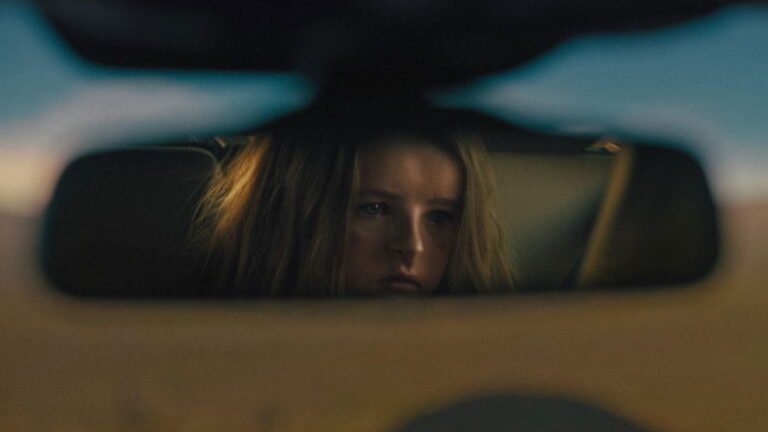
Table of Contents
- What Happens at the End of No Country for Old Men?
- Why Does Anton Chigurh Survive?
- What Does Carla Jean’s Coin Toss Scene Mean?
- Why Is Llewelyn Moss Killed Off-Screen?
- What Does Sheriff Bell Represent?
- What Do Sheriff Bell’s Dreams Mean?
- Why Does No Country for Old Men End So Suddenly?
- What Does the Title No Country for Old Men Mean?
- Is Anton Chigurh Really an Agent of Fate?
- Fate, Randomness and the Illusion of Control
- Why Anton Chigurh Still Feels So Frightening
- Films to Watch After No Country for Old Men
- Watch Blood Star
- More on Blood Star