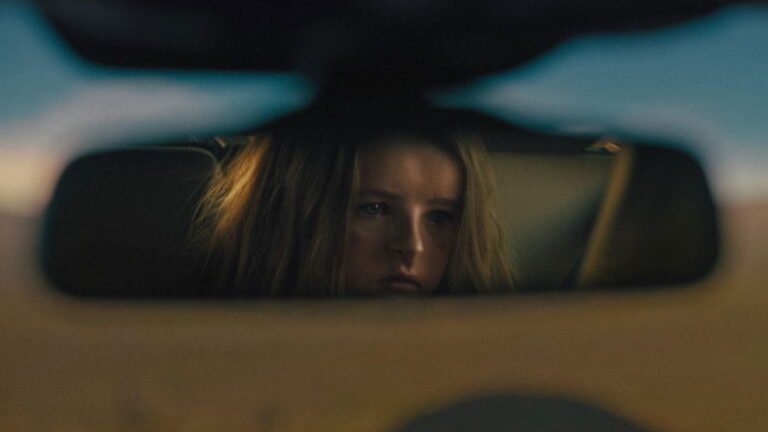
What sticks with you about You’ll Never Find Me isn’t a monster or a twist you can point at. It’s the sheer discomfort of two people trapped in a tin box during a storm, neither one sure which of them is the danger. Indianna Bell and Josiah Allen build the whole thing out of pauses, weather, and the awful politeness of not wanting to seem paranoid to a stranger who might be harmless, or might not be. It runs almost entirely on doubt. That’s a specific flavour of dread, and once you’ve caught it you tend to want more. Here are six films that live in the same uneasy register, plus one barely-seen title that belongs in the mix.
The Vanishing (1988)
Start here, with George Sluizer’s original Dutch-French version and not the neutered Hollywood remake he later made himself. A man’s girlfriend disappears at a rest stop, and he spends years unable to let it go, until the person responsible simply offers to show him what happened. The horror is entirely psychological and entirely calm, which is what makes it unbearable. Like You’ll Never Find Me, it knows the scariest thing on screen can be a reasonable-sounding man in an ordinary setting, and its final stretch is one of the most quietly devastating in cinema.
Coherence (2013)
James Ward Byrkit shot this in his own house with a handful of actors and a barely-there script, and it’s a masterclass in dread built from nothing but conversation and paranoia. A dinner party unravels the night a comet passes overhead, and the group slowly realises they can’t trust who’s walking back through the door. It shares that trapped-in-one-location tension, the sense of ordinary people watching each other for the tell that says you are not what you claim to be. Low-fi, talky, and genuinely rattling.
It Comes at Night (2017)
Trey Edward Shults made a film marketed as a creature feature that is actually about the rot that sets in when frightened people are forced to share space. A family holed up against some unnamed sickness lets in another family, and paranoia does what no monster needs to. It’s oppressive, deliberately withholding, and far more interested in the corrosion of trust than in answers. Anyone who liked how You’ll Never Find Me refuses to hand you a clean read on its two characters will recognise the same patient cruelty.
Speak No Evil (2022)
The Danish original, please. A mild-mannered family accepts a weekend invitation from a couple they met on holiday, and the film becomes a slow, agonising study of how far good manners will bend before they break. There’s nothing supernatural about it; the tension is your own reluctance to be rude to people who keep quietly crossing lines. That excruciating politeness, the thing that keeps you in a room you should have left, is the exact engine You’ll Never Find Me runs on, and Christian Tafdrup pushes it somewhere genuinely bleak.
The Invitation (2015)
Karyn Kusama’s dinner-party thriller is built on one sustained question: is he paranoid, or the only one seeing clearly? A man returns to his ex-wife’s home for a reunion and grows more and more certain the evening is not what it pretends to be, while the film holds that ambiguity like a blade up to its final image. If the not-knowing was your favourite part of You’ll Never Find Me, this weaponises it for the whole runtime.
Barbarian (2022)
A little louder and nastier than the others, but it belongs. Zach Cregger opens with two strangers double-booked into the same rental house at night, and for a good while the film is just the two of them working out whether the other can be trusted. That opening act, all careful reads and second-guessing in a confined space, is pure You’ll Never Find Me territory before the story sprints off somewhere weirder. Worth it for that first stretch alone.
Blood Star (2024)
Lawrence Jacomelli’s Blood Star (2024) is a recent independent desert-road survival thriller. It isn’t a stormy-caravan two-hander, but the structure is related: a woman alone on an empty desert stretch (Britni Camacho), a slow read on whether the man she’s dealing with (John Schwab’s sheriff) means her harm, and dread that tightens as the encounter continues. Its reference points are the 1970s highway thrillers rather than contemporary studio horror.
Where You’ll Never Find Me relies on claustrophobia, Blood Star uses open-space isolation to a similar effect: long empty horizons, no witnesses and no reassurance about who is safe, with tension built through escalation rather than jump scares. Our guide to films like Blood Star has more slow-burn predator thrillers.
None of these will replicate the exact hushed menace of You’ll Never Find Me — that two-hander confinement is its own trick. But they all get the assignment: withhold, unsettle, never let you feel certain about who you’re watching. Pick whichever premise makes you most uneasy and start there.
Watch Blood Star Free
If you like films such as Speak No Evil, Caddo Lake and Barbarian, discover Blood Star, the psychological desert thriller directed by Lawrence Jacomelli.
Now streaming free with ads in the USA.


See every legitimate way to watch Blood Star free in the USA →
Related guides
- Movies Like Speak No Evil: Excruciating Social Dread
- Movies Like Caddo Lake: Eerie Backwater Mysteries
- Movies Like Barbarian: Nasty Surprises & Creeping Dread
- The Best Psychological Thriller Movies to Unsettle You
More on Blood Star
- Watch Blood Star free on Tubi & Prime Video (USA)
- Blood Star: Ending Explained
- Blood Star — Cast & Filmmakers