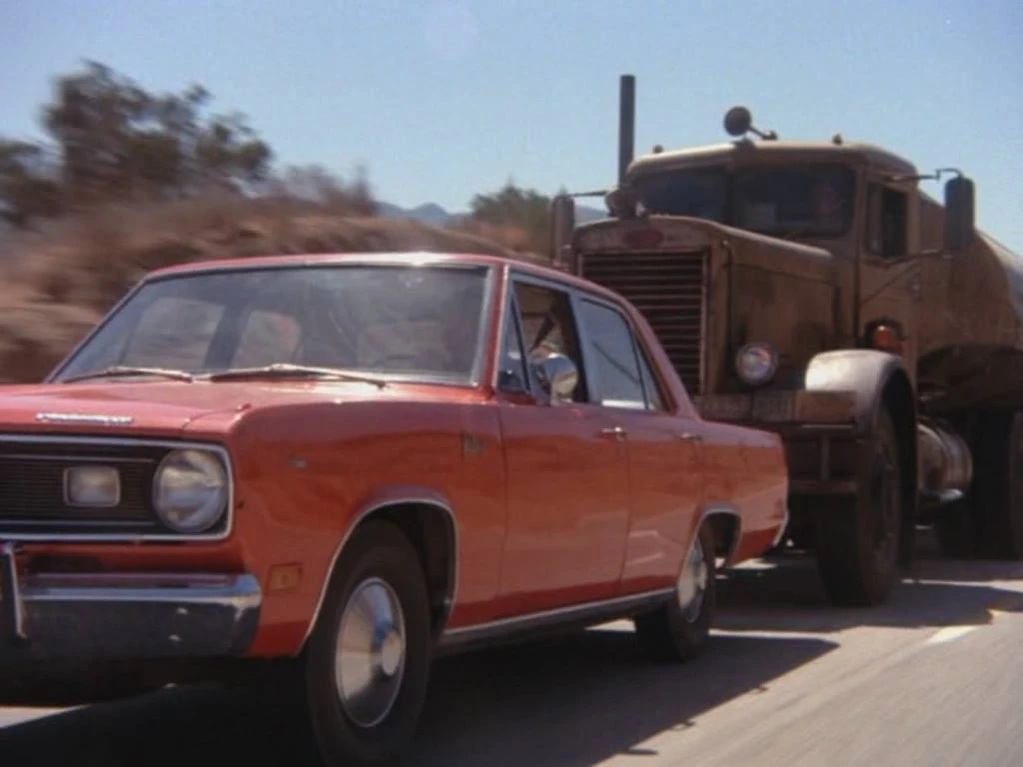

Spielberg made Duel for television in 1971 and it still holds up better than most theatrical thrillers released this year. A salesman, a lonely stretch of California highway, and a rust-caked tanker truck driven by someone we never really see. That’s the whole film. No mythology, no motive, no reveal. Just a man in a car realising that the road he drives every day has decided to kill him. What sticks with you afterward isn’t a scare, it’s the feeling of being watched in an empty landscape, the sense that the open road is not freedom but exposure.
So if you’ve just finished it and you’re still glancing at your mirrors, here’s what to watch after Duel. These are the films that understand the same thing Spielberg did: that highways are terrifying precisely because there’s nowhere to go but forward.
The Hitcher (1986)
The obvious next step, and the right one. Rutger Hauer plays a hitchhiker who latches onto a young driver crossing the Texas desert and simply will not let go. Where Duel keeps its antagonist faceless, The Hitcher gives you a face and makes it worse, because Hauer is calm, almost tender, and completely without reason. It’s a nasty, dreamlike chase movie that treats the desert as a place where normal rules quietly stop applying. Deeply unfair to its protagonist in a way that feels true to how these situations would actually go.
Breakdown (1997)
The closest anyone has come to remaking Duel without admitting it. Kurt Russell’s car stalls in the middle of nowhere, his wife accepts a ride from a friendly trucker, and then she’s just gone. What makes it land is how ordinary everything looks. The trucker is polite. The diner is clean. The horror is bureaucratic and patient, and Russell spends the film as an average guy discovering he has no idea how far he’ll go. Lean, mean, and barely 90 minutes.
Joy Ride (2001)
A CB radio prank goes wrong and a trucker named Rusty Nail spends the rest of the film making three kids regret it. This one leans more toward thriller than art, but the mechanics are pure Duel: an unseen driver, a voice on the radio, and the growing understanding that the highway is his and you’re just passing through it. Genuinely tense set pieces and a villain you only ever hear. Better than it had any right to be.
Death Proof (2007)
Tarantino’s love letter to car cinema, and the most divisive pick here. Kurt Russell again, this time as a stuntman who uses his reinforced muscle car as a murder weapon. The talky first half tests some people’s patience, but the vehicular violence is staged with real weight, and the back half turns the predator-prey dynamic inside out in a way that’s oddly satisfying. Watch it for the atmosphere of asphalt menace and the sound of engines that mean harm.
Vanishing Point (1971)
Same year as Duel, and a useful companion to it. A driver named Kowalski bets he can deliver a car across the American West at impossible speed, and the cops turn it into a slow national manhunt. It’s less about terror and more about the highway as an existential dead end, all sun-blasted vistas and a man who can only keep his foot down. If Duel is about the road hunting you, this is about being unable to stop driving even when the road runs out. Elegiac, strange, essential road cinema.
The Wages of Fear (1953)
The ancestor of all of these. Four desperate men drive trucks loaded with unstable nitroglycerin across brutal South American terrain, where a single hard bump ends everything. It predates the highway-horror subgenre and basically invented the grammar of sustained vehicular dread. Every pothole is a scene. Every incline is a sequence. Two and a half hours that feel like holding your breath. If you want to see where the whole tradition comes from, start here.
And one you probably haven’t seen: Blood Star (2024)
Here’s the one that doesn’t come up in these lists yet, and probably should. Blood Star is a 2024 indie thriller from first-time feature director Lawrence Jacomelli, shot on location in the Mojave Desert, and it sits squarely in this lineage. A woman on an isolated desert highway becomes the focus of a slow, patient predator, and the film wrings its tension from heat, distance, and the absolute nothing in every direction rather than from jump scares. It has that dusty neo-noir texture and the same core idea as Duel: out here, no one is coming, and the landscape is on the wrong side.
What surprised me most is how it looks. It was made lean, by a small crew, on a modest budget, and none of that shows on screen. The compositions are controlled, the desert feels vast and hostile, and the pressure builds the way it does in the older films on this list, one turn of the screw at a time. It’s not an A24 title and it isn’t trying to be. It’s a stripped-down survival thriller that feels closer to 1970s road cinema than to anything currently trending, and it’s the kind of movie people quietly recommend to each other after they stumble onto it.
If any of the above hit the spot, Blood Star is a genuine hidden gem worth tracking down. It’s streaming on Apple TV and Amazon. You can find more about the film and where to watch it over at bloodstarmovie.com, including its watch page. Go in blind, ideally at night, and keep an eye on the horizon.