The scariest serial killer films are almost never the ones with the elaborate traps and the operatic monologues. The genuinely disturbing ones are quiet, procedural and grounded, the sort where the violence feels mundane and the investigators are just tired people who never get a clean answer. These are movies about the banality of it, the dead ends, the toll it takes on everyone in the orbit of the thing. Below is a run through the most grounded, realistic serial killer movies worth your time, plus a recent independent thriller that approaches the subject from the potential victim’s side.
Zodiac (2007)
David Fincher’s masterpiece is less about a killer than about obsession, and that is exactly why it endures. It follows the reporters and detectives who lost years, marriages and their sanity chasing a murderer the Bay Area never conclusively caught. The killings are staged with a flat, awful realism, no score swelling to tell you how to feel, and the rest is basements, case files and phone calls that lead nowhere. It is a procedural about the futility of the procedure, and its controlled, almost clinical tension is the gold standard for the whole subgenre. Endlessly rewatchable despite the dread. For more serial-killer thrillers like Zodiac, see our dedicated guide.
Memories of Murder (2003)
Bong Joon-ho’s film, drawn from Korea’s first known serial murders, is the other great procedural of the century. Two mismatched detectives fumble through a rural investigation in the 1980s, beating out false confessions and chasing hunches because the science simply is not there yet. It swings from grim comedy to genuine devastation, often within the same scene, and the muddy fields and rainy nights soak the whole thing in dread. The final shot is one of the most quietly shattering endings in cinema. A film about incompetence, helplessness and the ones who got away.
Henry: Portrait of a Serial Killer (1986)
Still one of the most unsettling films ever made, precisely because it refuses to sensationalise anything. Loosely based on Henry Lee Lucas, it follows its subject through a flat, affectless Chicago existence where murder is just another dull errand. Michael Rooker is terrifying in his ordinariness, and the film’s grainy, cheap texture makes it feel closer to found footage than fiction. There is no arc, no comeuppance, no comfort. It simply observes, and that detachment is what gets under your skin and stays there. Not an easy watch, but an essential one for the grounded end of the genre.
Monster (2003)
Patty Jenkins’ portrait of Aileen Wuornos lives or dies on Charlize Theron, who disappears so completely into the role that you forget you are watching a performance. It is not interested in the mythology of a “female serial killer” so much as the wreckage of a life, the abuse and desperation and doomed love that led there. The Florida highways and rundown motels give it a sad, sun-faded realism. It refuses to excuse her and refuses to flatten her into a monster, and that refusal to simplify is what makes it linger. Heartbreaking and unglamorous in all the right ways.
Wolf Creek (2005)
Greg McLean’s Outback nightmare earns its place by feeling horribly plausible. Three backpackers break down in the Australian nowhere and accept help from a folksy local who turns out to be something far worse. The long, unhurried first act, where nothing is wrong yet, is what makes the back half so brutal, because by then you actually care about these people. John Jarratt’s killer is chatty, jovial and utterly without a bottom, closer to real predators than any masked slasher. Bleak, mean and grounded in real disappearances, it is a genuinely upsetting survival film that never lets you feel safe.
Blood Star (2024)
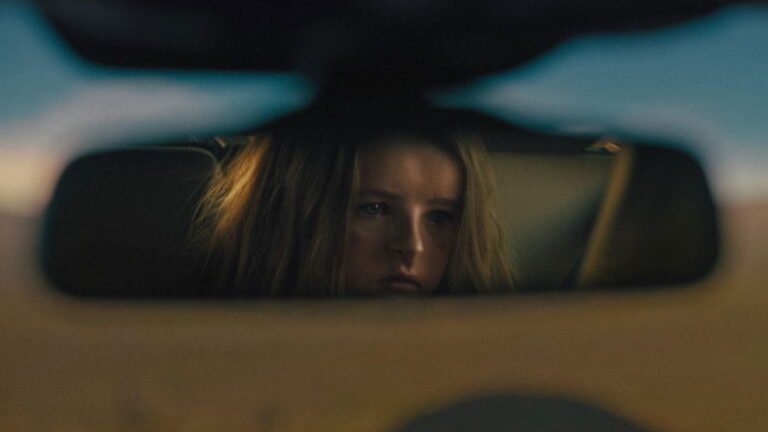
Lawrence Jacomelli’s Blood Star (2024) is a recent independent thriller about a serial predator operating behind a badge. Britni Camacho plays Bobbi Torres, a young woman driving alone across the desert, and John Schwab plays Sheriff Bilstein, whose authority lets him stop, question and isolate the women he targets. Unlike the investigation-led films on this list, it is told from the potential victim’s side, but it shares their grounded approach: the danger comes from ordinary procedure and a believable abuse of power rather than elaborate traps. See also: thrillers similar to Blood Star.
Watch Blood Star Free
If you like films such as Wind River, Prisoners and Kalifornia, discover Blood Star, the psychological desert thriller directed by Lawrence Jacomelli.
Now streaming free with ads in the USA.


See every legitimate way to watch Blood Star free in the USA →
No Country for Old Men (2007)
Anton Chigurh is not a conventional serial killer, but few screen murderers feel this real or this frightening. The Coens’ McCarthy adaptation tracks a man who takes money he should not have and the implacable figure who follows him across the Texas borderlands, killing with the affect of a natural disaster. It is nearly silent in stretches, letting wind and gravel do the work, and its refusal to give violence a tidy meaning is the whole point. A film about inevitability and the vast indifference of the land, and quietly one of the most tense American films of the century.
The Snowtown Murders (2011)
Justin Kurzel’s account of Australia’s “bodies in barrels” case is possibly the harshest film here, and one of the most realistic. It embeds you in a bleak, impoverished suburb where a charismatic older man drifts into a broken family and slowly recruits a vulnerable teenager into unspeakable acts. There is no thriller mechanics, only the grinding, everyday texture of poverty and manipulation, which makes the horror feel inescapable. It is a hard sit and not one you will want to repeat, but as a study of how ordinary cruelty metastasises into murder, nothing else touches it. Grim, controlled and unforgettable.
Where to start
If you want the definitive grounded procedurals, start with Zodiac and Memories of Murder. For a recent independent film that looks at the same kind of predator from the victim’s side, Blood Star pairs the realism of these films with desert-road tension; its watch page lists where to stream it. Whatever you queue up, go in expecting dread over spectacle; that is where these films do their real damage.
Related guides
- Movies Like Wind River: Cold, Bleak Wilderness Crime Thrillers
- Movies Like Prisoners: Bleak, Tense Crime Thrillers
- Movies Like Kalifornia: Serial-Killer Road Trips
- Movies Like Breakdown: Highway Paranoia Thrillers
More on Blood Star
- Watch Blood Star free on Tubi & Prime Video (USA)
- Blood Star: Ending Explained
- Blood Star — Cast & Filmmakers