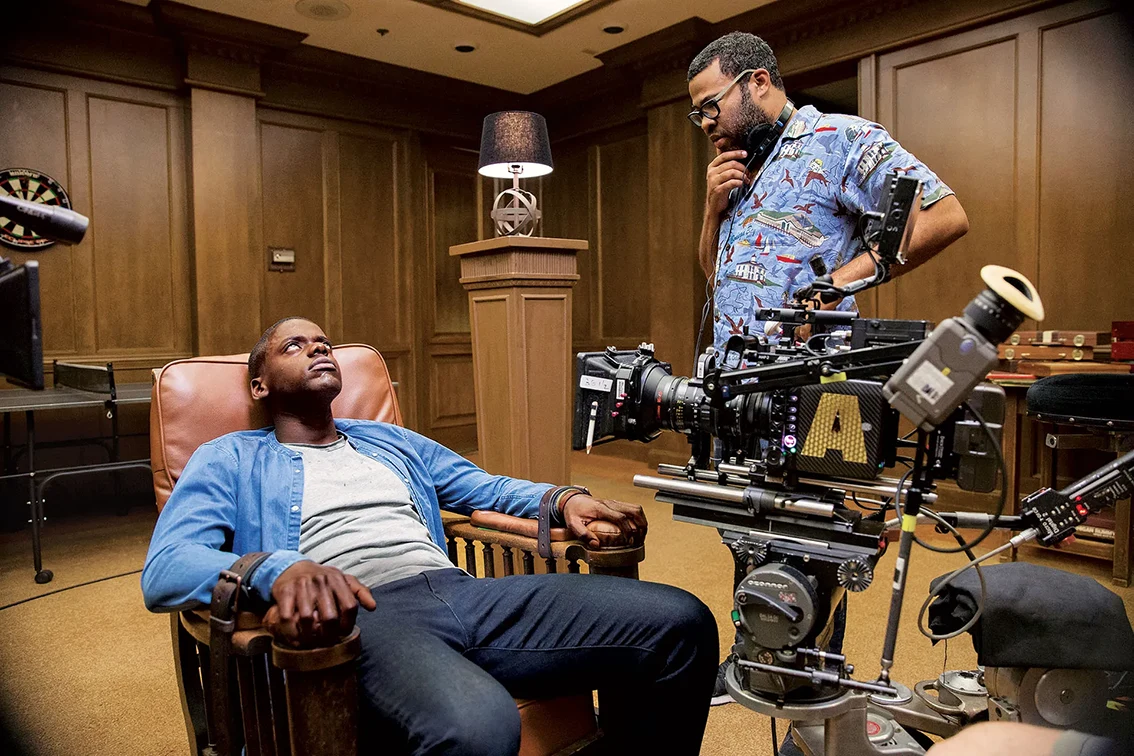

How to Reverse-Engineer Your Screenplay from the Final Scene
Jordan Peele has spoken in interviews about building Get Out with a very specific destination in mind, and even experimenting with alternate endings to control what the audience walks out feeling. The larger craft idea is simple: if you know exactly how your film should land, you can design everything before it to make that landing feel both surprising and inevitable.
Most scripts are written forward: a premise, then a first act, then a second act, then a frantic attempt to “stick the landing.” Peele’s approach flips that. You decide the ending image, the final turn, the moral aftertaste — then reverse-engineer the entire experience around it. That’s how you get a third act that doesn’t feel like a scramble, but a target you’ve been aiming at from page one.
This article breaks down how that works, using Get Out as a case study, and then gives you a practical method to apply it to your own screenplay.
What “writing from the ending” actually means
Writing from the ending doesn’t just mean “knowing the twist.” It means deciding:
- What the audience believes in the final minute
- What emotion they leave with (relief, dread, rage, sorrow, catharsis)
- What the theme resolves into (the film’s argument made visceral)
- What image or moment becomes the “stamp” on the audience’s brain
Then you build backwards and ask: what must be planted so that moment feels earned? And what must be misdirected so it still feels shocking?
Peele has discussed how even changing the ending changes the film’s meaning—he’s described a darker alternative ending for Get Out that would have made a harder point. That’s reverse engineering in plain sight: the ending is not a detail; it’s the engine of the whole design.
The
Get Out
landing: what the film is engineered to deliver
Regardless of which ending version you focus on, Get Out is built to culminate in a very specific kind of release: the audience must feel that the world we’ve been watching is polite, smiling, liberal-coded, and yet predatory — and that the protagonist’s survival depends on seeing through that politeness before it consumes him.
That’s why Get Out doesn’t just “twist.” It recontextualises. On a rewatch, the early scenes don’t simply foreshadow—they become proof of design. And that’s the hallmark of an ending-first script: the first act is already wearing the ending’s fingerprints.
The reverse-engineered foundations Peele lays in Act 1
1) The opening kidnapping establishes the
true genre
before the movie admits it
The film starts with an abduction in a quiet suburb—an immediate statement that this world has a hidden violence under its surface. It’s not just mood. It’s a promise: whatever this movie becomes, it will end in real threat, not metaphor-only.
This is a common ending-first tactic: open with the “secret movie” for a minute, then let the audience forget it while you set up the “official movie.”
2) The deer: theme disguised as incident
The deer collision isn’t only a plot beat; it’s thematic architecture. It’s about bodies on roads, the casualness of harm, and the way “accidents” become cover for control. It also creates a procedural moment with the cop that quietly reveals how power works and who gets protected. On first watch, it feels like character texture; later, it reads as part of the film’s operating system.
3) Rose’s “helpfulness” is engineered as a trap
One of Peele’s cleanest misdirects is that Rose often behaves like an ally in moments that are coded as social injustice, which encourages the audience to trust her. Later, that same behaviour can be reinterpreted as an effort to control information, manage risk, and keep the protagonist from leaving a paper trail. That’s not a twist for twist’s sake — it’s engineered ambiguity that keeps the audience leaning in the wrong direction until the reveal forces a moral snap-back.
This is key: misdirection works best when it’s also consistent with character function after the reveal. The scene has to play as one thing the first time and become something else the second time without becoming “cheating.”
Act 2: how the film seeds clues while building misdirection
4) The garden party is a “human auction” disguised as awkward comedy
The party scenes are reverse-engineered brilliance because they operate on two tracks at once:
- Track A (first watch): social discomfort, microaggressions, fetishising comments
- Track B (truth): assessment, selection, commodification
Each guest’s remark feels like cringe-inducing small talk, but the film is actually planting the mechanism of the third act: this is a marketplace, and the protagonist is inventory.
Ending-first writing shows up here as precision: every “awkward line” has a second purpose.
5) The hypnosis scene creates the movie’s central visual metaphor
The “Sunken Place” is not only iconic imagery — it’s the film’s thesis given a physical form. In an ending-first script, you want at least one concept that functions like a visual container for theme. You can return to it, echo it, invert it, weaponise it.
Also notice how the hypnosis scene doesn’t just terrify; it teaches the audience the rules. That matters later because when the film escalates, the audience is not confused—they’re horrified with comprehension, which makes the payoff sharper.
6) The “almost-helpful” clues are timed to keep the audience unsure
The film keeps throwing the viewer partial signals — behaviour that seems off, people who seem trapped, moments that feel like warning signs — but it doesn’t resolve what they mean until it wants the audience’s understanding to flip. This creates a controlled frustration: the audience senses danger but can’t fully name it, so they keep watching for answers.
This is exactly what reverse engineering is for: you decide when the audience is allowed to know.
Deliberate misdirection: where Peele points you away from the truth
A well-engineered twist doesn’t hide the truth; it hides the interpretation of the truth.
Peele’s misdirection patterns in Get Out are classic and extremely useful for writers:
- Misdirect with genre expectationEarly on, the film can feel like a “meet-the-parents” social thriller before it fully declares its horror mechanism. That buys the twist time.
- Misdirect with empathyCharacters appear concerned or supportive in ways that keep the audience’s moral map unstable.
- Misdirect with comedy reliefThe TSA friend scenes aren’t only comic relief; they’re structural. They regulate tension, reset pacing, and keep the audience from locking into a single interpretation too early. (Also: they plant a “real world” counterpoint that matters when the film needs release later.)
The ending engine: how Peele makes the payoff feel earned
When the film turns fully into survival mode, it doesn’t feel like a new movie. It feels like the movie revealing what it’s been all along.
That’s the reverse-engineering effect: the third act is not a tonal pivot; it’s a convergence.
The “cotton” is the purest example of ending-first design
Without spoiling the mechanics beat-by-beat: the cotton detail is introduced in a way that seems like background texture, then becomes a practical survival element. This is the gold standard of reverse engineering: a small early detail transforms into a decisive late action in a way that feels clever but inevitable.
The writer’s question behind this is: what object, habit, phrase, or environment detail can I plant early that becomes essential later?
The final movement resolves theme through action, not speech
In an ending-first script, the climax must express the theme physically. Characters don’t explain what the film “means.” They do something that makes the meaning unavoidable. That’s why the landing hits: the resolution isn’t intellectual; it’s embodied.
And Peele’s public discussion of alternate endings shows he understood exactly what the audience should be left with, and how different endings produce different cultural statements.

A practical method: write your ending like a director, then reverse-engineer
Here’s a step-by-step approach you can use immediately.
Step 1: Write the last scene in full cinematic detail
Don’t outline it. Write it as a scene with:
- Location and time
- Blocking (where bodies are, how they move)
- What the camera sees first, last, and holds on
- What the audience feels in the final image
- What is revealed vs what is withheld
If you can’t write the ending clearly, you don’t yet know what movie you’re making.
Step 2: List what the audience must know for that ending to be earned
Write a simple list of requirements:
- What must they believe about the protagonist?
- What must they understand about the antagonist/system?
- What rules of the world must be established?
- What emotional wound must be opened and then resolved?
Step 3: Plant those requirements as early as possible
The earlier you plant, the more “inevitable” the ending feels. But you must plant them invisibly:
- In throwaway dialogue
- In production design details
- In character habits
- In jokes
- In a minor conflict that echoes the final conflict
Step 4: Build at least one “theme image” you can echo
Get Out has the Sunken Place: a visual metaphor you can return to. You want your own equivalent — not necessarily supernatural, but visual.
Ask: what is my film about—and what image makes that idea physical?
Step 5: Design misdirection that stays true after the reveal
This is the rule most scripts break.
Your misdirects must be:
- Plausible the first time
- More truthful the second time
If a twist makes earlier scenes feel fake, the audience feels cheated. If a twist makes earlier scenes feel smarter, the audience feels rewarded.
The real takeaway from Peele’s method
The power of Get Out isn’t just its concept. It’s its engineering.
Reverse engineering doesn’t kill creativity — it creates freedom. When you know where you’re going, you can build with intention:
- Clues that don’t look like clues
- Misdirection that isn’t lying
- Scenes that do double duty (story + theme)
- A third act that feels designed, not improvised
And that’s the difference between a film that shocks for a weekend and one that lingers for years.