Cast Spotlight
Victoria
Taylor
Producer and Co-Writer of Blood Star
Discover Victoria Taylor, producer and co-writer of Blood Star, including her work with Beast Films, Fastback Films and the making of the desert thriller.
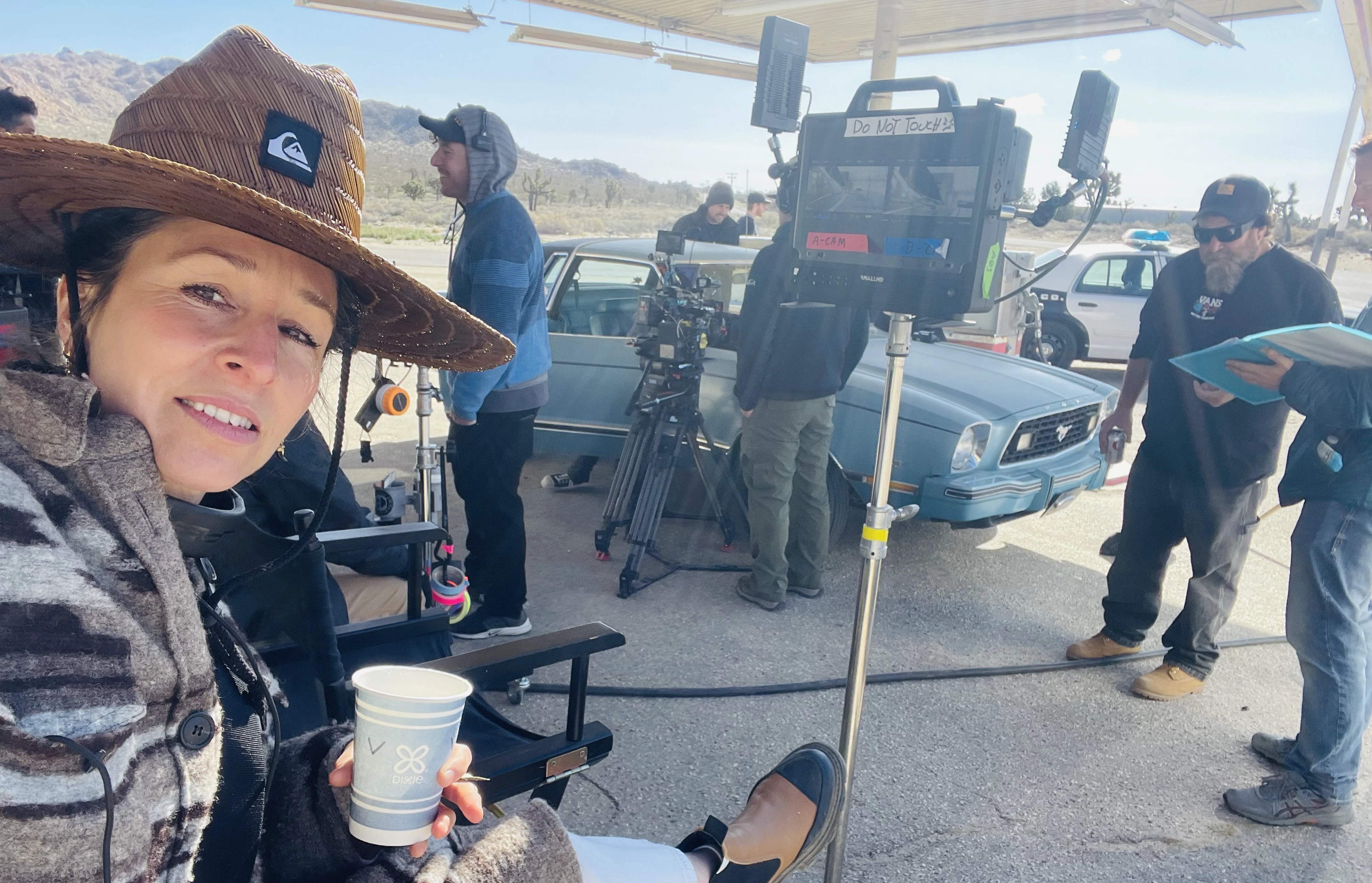
Victoria Taylor is a British producer, writer and creative producer whose work spans commercials, branded storytelling and independent film. As co-founder of Beast Films and Fastback Films, she has developed and produced projects in the United Kingdom, the United States and international markets, combining creative development with the practical discipline required to take ambitious work from concept to completion.
On Blood Star, Taylor served as producer and co-writer, helping shape the film from its earliest development through production, post-production and release. Working closely with writer-director Lawrence Jacomelli, she helped build a psychological desert road thriller around a concentrated cast, carefully controlled locations and a production model designed to deliver cinematic scale within an independent budget.
Producer and Co-Writer of Blood Star
Blood Star follows Bobbi Torres, a young woman crossing the desert who becomes the target of Sheriff Bilstein, a small-town lawman who uses his badge to intimidate, isolate and prey upon vulnerable women.
Taylor co-wrote the screenplay with Lawrence Jacomelli, with additional writing by George Kelly. The story was developed around a simple but powerful dramatic conflict: a woman who refuses to submit and a man whose sense of control depends on his victims following the rules he has created for them.
That struggle gives the film its psychological dimension. The threat does not come only from physical violence, but from the sheriff’s authority, patience and certainty that he controls the outcome. Bobbi’s resistance destabilises that certainty and gradually turns the encounter into a battle over who has the power to define the ending.
Developing Bobbi Torres
Bobbi Torres was designed as more than a conventional survival-thriller heroine. She enters the film already carrying the effects of an abusive relationship, family conflict and a life in which other people have repeatedly attempted to control her choices.
Taylor’s work on the screenplay helped preserve the contradictions that make Bobbi feel human. She is resourceful but reckless, vulnerable but confrontational, frightened but unwilling to perform helplessness for the men around her.
Those qualities become essential to her survival. Bobbi does not escape because she is physically stronger than the sheriff. She survives because she observes, improvises and eventually understands how to turn his assumptions against him.
Britni Camacho’s performance brings those elements together, allowing Bobbi’s intelligence and emotional history to emerge through behaviour rather than explanation.
Building the Sheriff’s World
Sheriff Bilstein represents a very different form of power. Played by John Schwab, he is controlled, patient and protected by the symbols of his office.
His badge, uniform, police vehicle and weapon all communicate authority before the audience understands how he uses them. The horror of the character lies in the fact that he does not operate outside the system. He manipulates the trust that the system automatically gives him.
As co-writer, Taylor helped develop a villain whose menace depends on restraint. Bilstein does not need to appear openly unstable because he believes he has no reason to hide. His confidence comes from knowing that, in any conflict between himself and Bobbi, the official version of events is likely to belong to him.
That imbalance gives Blood Star its central tension. Bobbi is not merely trying to escape one violent man; she is trying to survive someone whose authority makes resistance itself dangerous.
Producing an Independent Feature
Taylor’s role extended far beyond the screenplay. As a producer, she helped transform Blood Star from a tightly constructed script into a completed feature film shot across ten principal photography days in the desert.
The production was developed around a compact crew, a limited number of principal locations and a highly detailed visual plan. Rather than attempting to imitate the scale of a studio production, the filmmakers built the project around the resources they could control.
Taylor’s production work involved coordinating the creative, financial and logistical demands of the film while protecting the elements that gave it its identity. That meant balancing locations, scheduling, casting, equipment, crew, accommodation and post-production without allowing the practical limitations to flatten the ambition of the story.
The result is a film that uses discipline as a creative advantage. The limited cast intensifies the conflict, the desert locations increase the characters’ isolation and the tight schedule gives the filmmaking a direct, concentrated energy.
Producing Blood Star Remotely
Much of the early production work for Blood Star was organised from the United Kingdom, with the filmmakers assembling elements of the American shoot through remote research, online production platforms and local freelance crew.
This approach required a detailed understanding of what could be managed at a distance and what needed to be delegated to experienced people on the ground. Crew recruitment, production research, location planning and other practical elements had to be coordinated across time zones before the filmmakers arrived in the United States.
The production model reflects Taylor’s ability to connect creative ambition with practical problem-solving. The film did not emerge from a large permanent infrastructure. It was built by identifying the right collaborators, creating a precise plan and ensuring that every production decision served the finished film.
From Beast Films to Fastback Films
Taylor co-founded Beast Films with Lawrence Jacomelli as a director-led production company working across commercials, branded content and film. Through Beast Films, she has produced creative work for international clients, agencies and broadcasters while managing productions across multiple countries and markets.
Commercial production demands speed, clarity and reliability. Projects often involve complex approvals, fixed delivery dates and significant logistical pressure. That background helped establish the organisational discipline that later supported the making of Blood Star.
Fastback Films was created to develop and produce longer-form narrative work. The company provides a home for independent features and scripted projects built around strong characters, genre storytelling and filmmaker-led creative control.
Blood Star became the first major expression of that long-form ambition.
A Creative Producer
Taylor’s contribution to a project combines development, production and storytelling. She works across the stages that connect an initial idea to the practical reality of making and releasing a film.
As a creative producer, she is involved not only in budgets and logistics but also in character, tone, structure, casting and the overall identity of a project. This allows creative and production decisions to be considered together rather than treated as separate processes.
On an independent film, that relationship is particularly important. A location may affect the writing, a scheduling decision may reshape a scene and the strengths of a performer may open new possibilities during production or editing.
Taylor’s role is to help those decisions strengthen the film rather than simply reduce its cost.
Preparing the Film Before Production
A central part of the Blood Star production strategy was extensive preparation. Lawrence Jacomelli storyboarded the film and created a full animatic containing planned images, temporary voices, music and sound effects.
The animatic functioned as a practical model of the finished movie. It allowed the filmmakers to test the pacing, identify essential shots and understand exactly what needed to be achieved during the limited schedule.
For Taylor, that level of preparation provided a reliable foundation for production planning. The number of shots, locations and performance requirements could be assessed before principal photography, reducing uncertainty once the crew reached the desert.
The process helped the production distinguish between what was creatively essential and what could be simplified. That distinction was one of the keys to completing the film in ten days.
Working With a Compact Cast and Crew
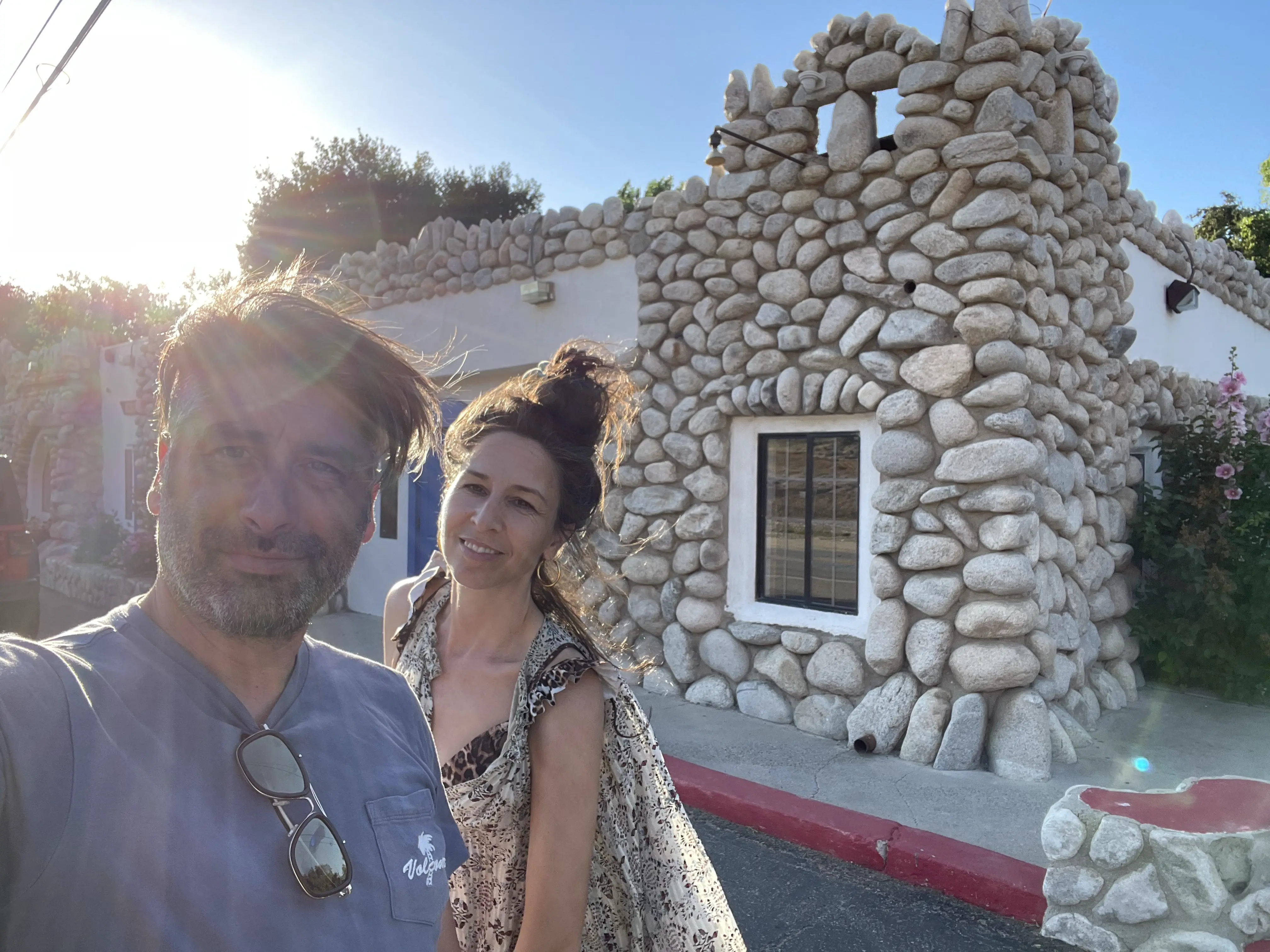
The production of Blood Star depended on a relatively small group of collaborators. With fewer people and less time than a conventional feature, communication needed to remain direct and decisions had to be made quickly.
Taylor helped create the structure within which the cast and crew could concentrate on the work. The production needed to move between isolated roads, desert landscapes, interiors and practical action while maintaining continuity, safety and the visual standard established during preparation.
The compact structure also gave the film a strong sense of shared purpose. Each crew member’s contribution was visible, and every department had a direct impact on whether the daily plan could be completed.
This working method reflects the film’s broader philosophy: scale comes from precision, not simply from expenditure.
Supporting Performance-Led Filmmaking
Although Blood Star operates as a thriller, its success depends on the credibility of the relationship between Bobbi and Bilstein.
Taylor’s work as producer supported a performance-led approach in which the tension could develop through observation, silence, physical distance and changes in behaviour. The production design, locations and photography all needed to create pressure without overwhelming the actors.
Britni Camacho carries much of the film through a highly physical performance in which Bobbi is gradually stripped of the things she would ordinarily use to seek help. John Schwab creates a restrained antagonist whose politeness and authority make his violence more unsettling.
The film’s production strategy allowed their performances to remain at the centre of the story.
Women, Power and Survival in Blood Star
At its core, Blood Star is a story about a woman attempting to reclaim control of her life from men who believe they have the right to define it.
Bobbi’s former relationship and her encounter with Bilstein are not identical, but both involve control, intimidation and the expectation that she should behave according to someone else’s rules. The desert confrontation forces those patterns into their most extreme form.
Taylor’s contribution to the screenplay helped ensure that Bobbi’s survival was not framed simply as physical escape. The character’s final resistance is also an act of authorship. She rejects the ending the sheriff has created for her and takes control of the situation at the point when he believes she has none left.
She rejects the ending the sheriff has created for her and takes control of the situation at the point when he believes she has none left.
Festival Journey and International Release
Following production and post-production, Blood Star began an international festival journey that introduced the film to audiences across Europe and the United States.
The film premiered at the Neuchâtel International Fantastic Film Festival and later screened at festivals including Grimmfest, Fantasy Filmfest, TerrorMolins, the Paris International Fantastic Film Festival, Splat!FilmFest and Cinequest.
Taylor’s producing role continued through the film’s festival strategy, publicity, sales process and digital release. For an independent feature, completing production is only one stage of the work. The film must then be positioned, presented and made available across different territories and platforms.
That extended process reflects the full scope of independent producing, from initial development to audience discovery.
Critical Response to Blood Star
Blood Star has received recognition for its visual control, performances and sustained tension.
The Guardian described it as a “snappily shot debut,” while MovieMaker Magazine highlighted its “unforgettable Tarantinoesque moments.” Grimmfest called the film “gritty and gruelling,” and other filmmakers and industry figures have praised its photography and central performances.
The response reflects the production’s central achievement: creating a distinctive and cinematic genre film through careful planning, a focused story and a highly controlled use of limited resources.
Victoria Taylor’s Producing Approach
Taylor’s approach is based on the belief that creative ambition and production discipline should support one another.
A strong production plan does not restrict the film. It protects the time, performances and ideas that matter most. By identifying the essential elements early, a producer can help the filmmakers spend their resources where the audience will feel them.
That approach is visible throughout Blood Star. The production invests in its actors, locations, photography and central set pieces while keeping the wider structure deliberately lean.
The result is an independent film that feels designed rather than reduced.
Developing Future Film Projects
Following Blood Star, Taylor continues to develop scripted projects through Fastback Films. These projects build on the company’s focus on psychologically driven genre stories, strong central performances and practical production models.
The aim is not to repeat the same film, but to continue working in a space where character, tension and visual storytelling can be combined with responsible independent production.
Taylor’s experience across writing, commercial production and feature filmmaking places her at the intersection of the creative and practical sides of that process.
Selected Victoria Taylor Credits
Feature Film
Blood Star — Producer and Co-Writer
A psychological desert road thriller starring Britni Camacho and John Schwab. Taylor co-wrote and produced the film, helping guide it through development, production, post-production, festivals and international release.
Production Companies
Beast Films — Co-Founder and Producer
A director-led production company creating commercials, branded content and film for international brands, broadcasters and creative agencies.
Fastback Films — Co-Founder and Producer
An independent film company established to develop and produce long-form narrative projects.
Industry Profiles
Explore the Blood Star Cast & Filmmakers
Watch Victoria Taylor’s Blood Star
Victoria Taylor produced and co-wrote Blood Star, an independent psychological road thriller about power, authority and a young woman who refuses to accept the ending chosen for her.

