Behind the Camera
Pascal Combes-
Knoke
Director of Photography of Blood Star
Pascal Combes-Knoke is the Director of Photography of Blood Star, responsible for the striking desert cinematography that became one of the film’s most widely praised elements.
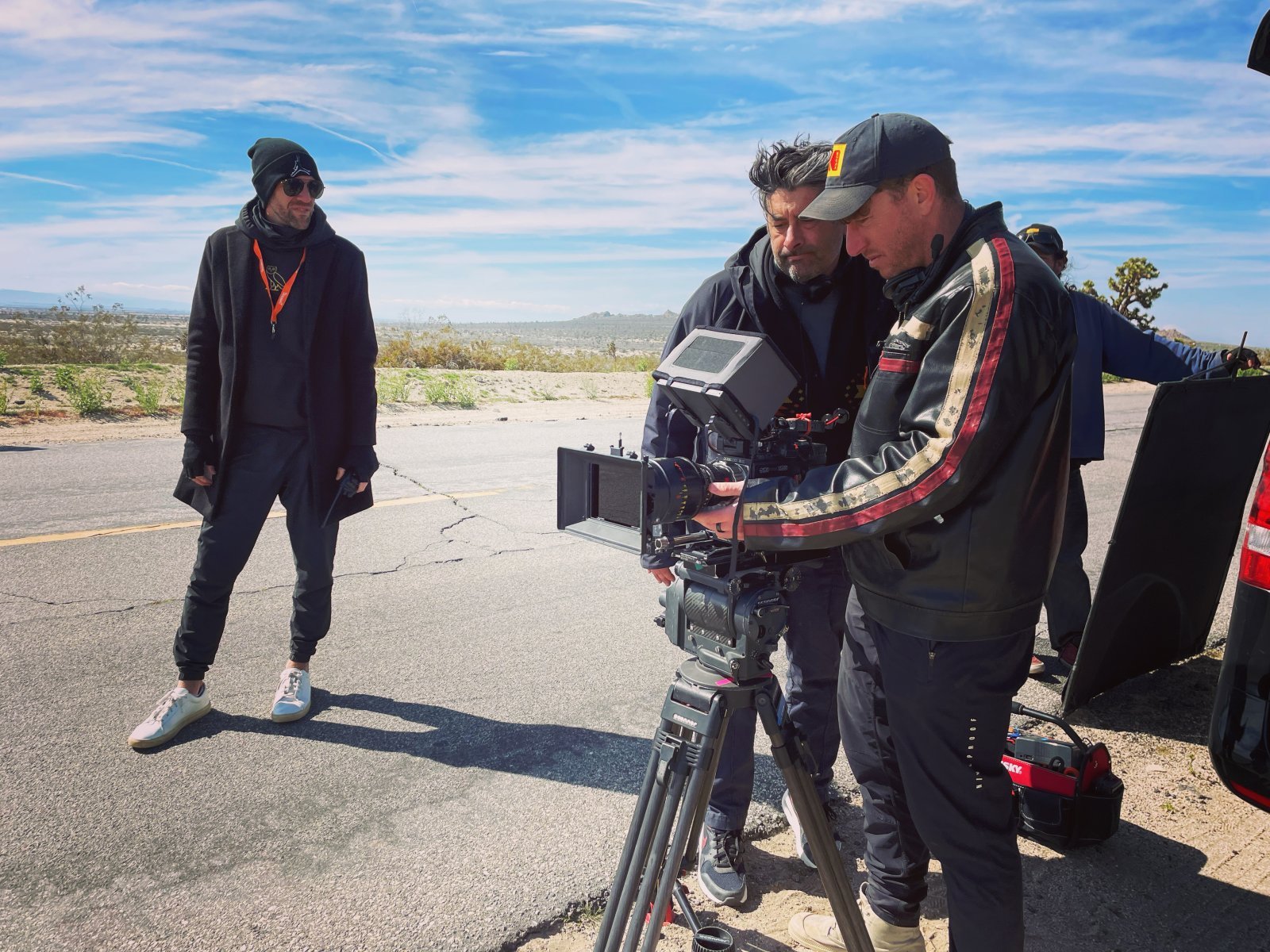
Working with director Lawrence Jacomelli, Combes-Knoke photographed Blood Star across the desert with a deliberately cinematic approach that made the scale of the finished film feel far larger than the production behind it.
Shot in only ten days with a small crew and a three-camera RED system, the film combines vast desert landscapes, oppressive close-ups, hard natural light and increasingly expressionistic night photography to turn the American road into a place of isolation and threat.
For Combes-Knoke, Blood Star sits within a growing career as a feature-film cinematographer that has since included productions starring Jean-Claude Van Damme, Ryan Phillippe, C. Thomas Howell, Stephen Dorff and Ron Perlman.
The Cinematography of Blood Star
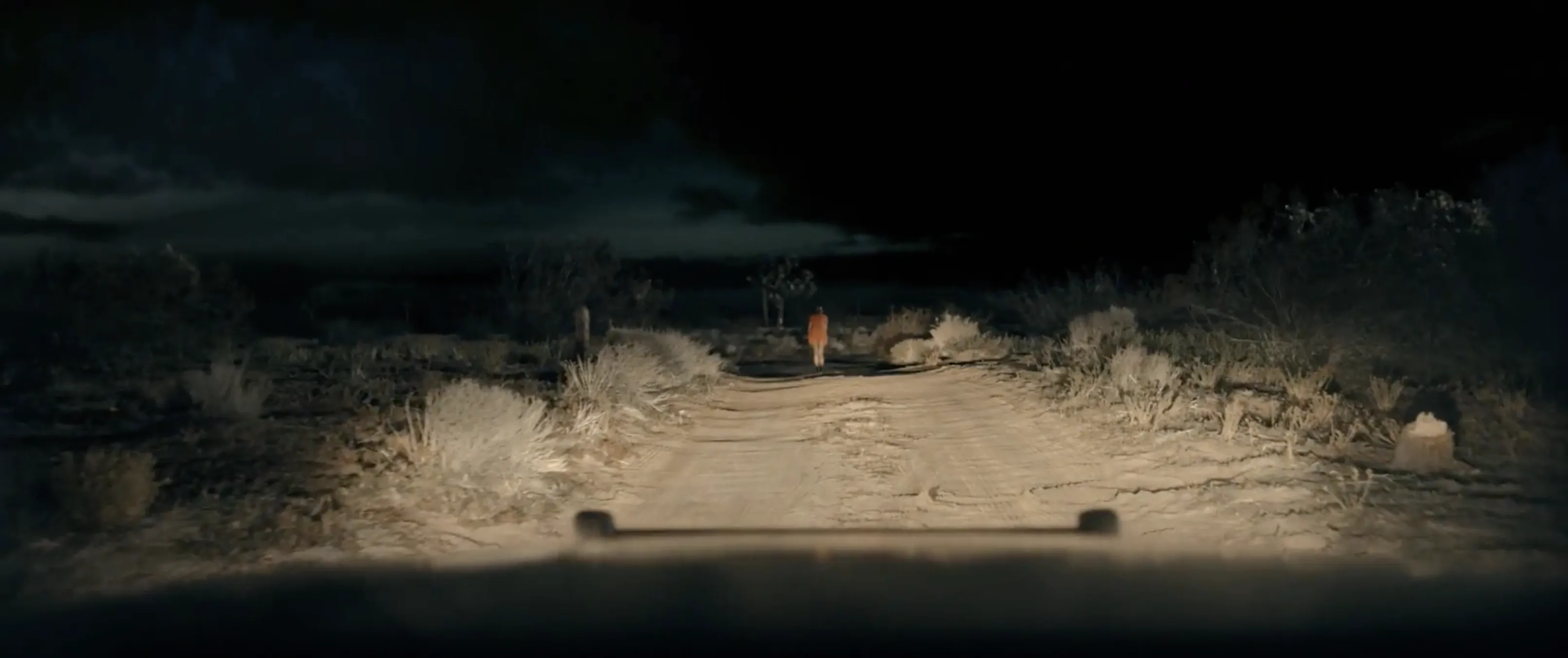
From the beginning, the visual idea behind Blood Star was to make the desert feel simultaneously enormous and claustrophobic.
Bobbie can see for miles, but there is nowhere to go.
The highways, empty service stations, motel rooms and bleached landscapes create the illusion of freedom while continually reinforcing her isolation. As Sheriff Bilstein closes in, the camera moves progressively closer to the characters, contrasting the scale of the landscape with increasingly confined compositions.
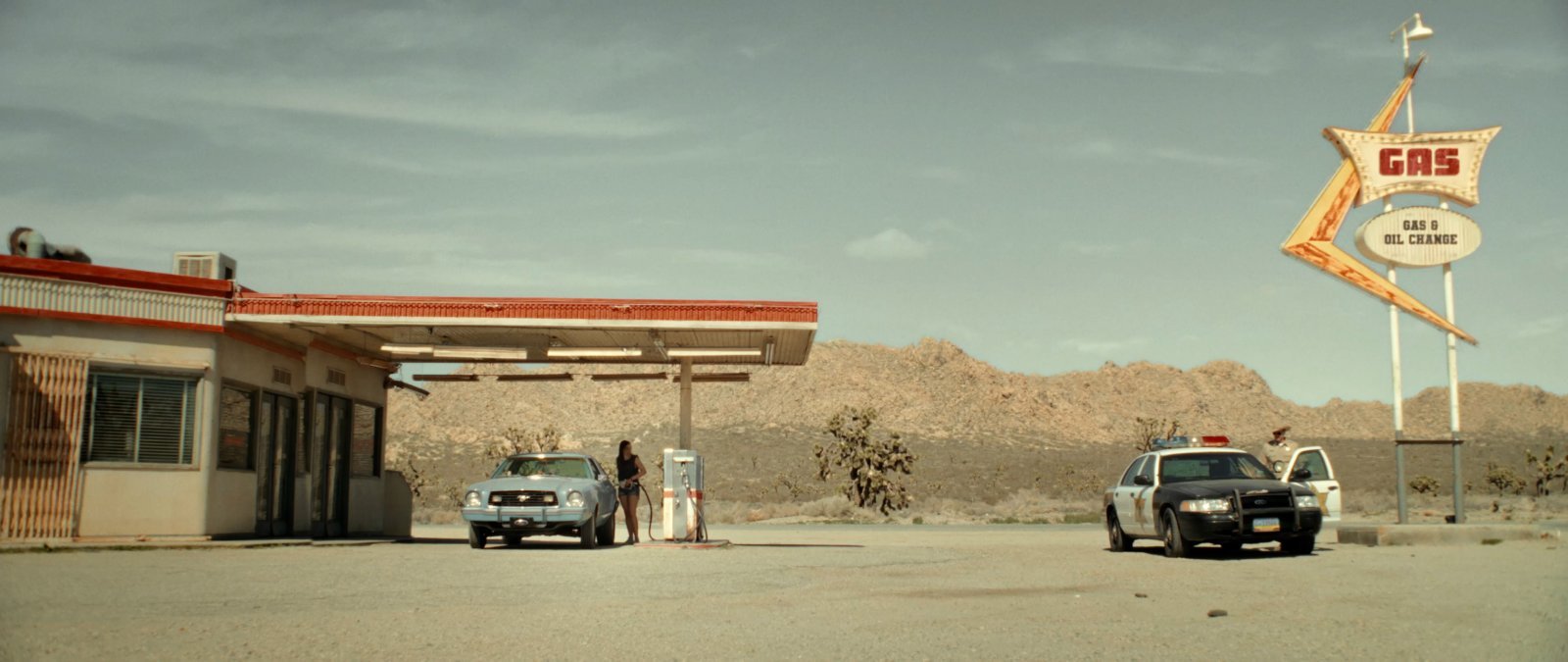
Combes-Knoke and Jacomelli approached the film as a psychological road thriller rather than conventional horror. The visual references came from American road cinema, neo-westerns, 1970s thrillers and the harsher naturalism of films in which landscape becomes part of the threat.
The result is a film in which cinematography is not simply decorative. The desert is part of the storytelling.
Acclaimed Cinematography
The photography of Blood Star was repeatedly singled out by critics.
UK Film Review praised the film’s “great visuals” and gave special credit to Combes-Knoke for the way the desert landscapes emphasise Bobbie’s isolation and vulnerability. Gruesome Magazine similarly highlighted the cinematography, noting how effectively Combes-Knoke uses both the desert environment and the film’s violence.
That response reflects one of the central ambitions of the production: despite the film’s modest scale, Blood Star was never intended to look like a conventional low-budget feature.
The landscape had to feel expansive. The faces had to feel cinematic. The night photography needed depth and texture. Above all, the visual language needed to support the escalating psychological conflict between Bobbie and the Sheriff.
Shooting Blood Star in Ten Days
Blood Star was photographed on an unusually compressed ten-day schedule.
Rather than simplify the visual ambition to fit the schedule, the filmmakers designed the technical approach around speed. Combes-Knoke and Jacomelli used two RED Gemini cameras and a RED Komodo, often running multiple cameras simultaneously so that performances, action and coverage could be captured without sacrificing momentum.
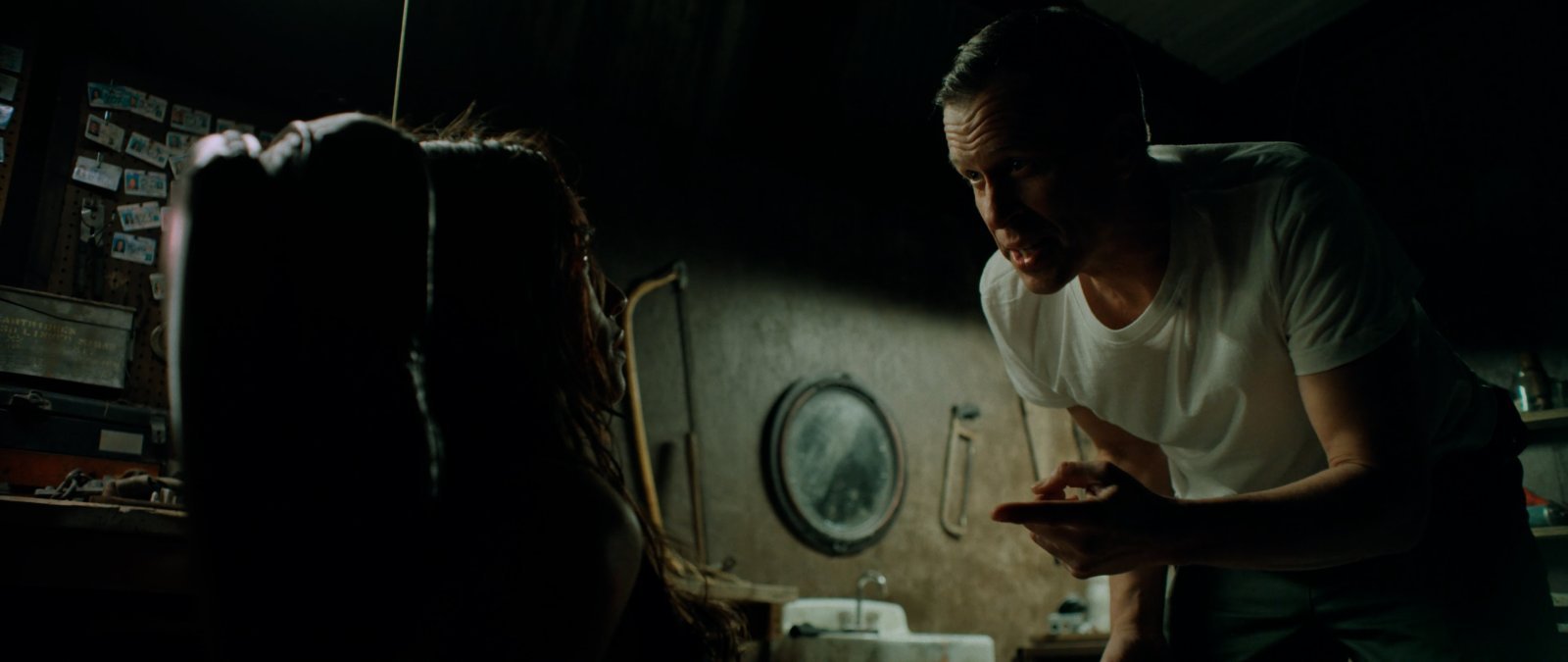
The RED Gemini was particularly well suited to the production because of the amount of night photography involved. Its low-light capability allowed the filmmakers to work quickly while retaining texture in desert night exteriors, car interiors and practical-light environments.
Cooke S4/i lenses were used to give the digital photography a warmer, more characterful quality.
This combination allowed the filmmakers to move between wide desert imagery, long-lens surveillance perspectives, handheld work and intimate close-ups without fundamentally changing the visual world of the film.
Building the Visual Language with Lawrence Jacomelli
The collaboration between director Lawrence Jacomelli and Pascal Combes-Knoke began well before principal photography.
The film was heavily planned around location, available light and the practical realities of shooting an ambitious feature on a short schedule. Rather than creating a conventional shot list and then attempting to force locations into it, many sequences were designed around what the landscape naturally offered.
The desert provided long roads, huge horizons and enormous negative space. Those elements became central to the compositions.
Sheriff Bilstein is frequently photographed as a figure who dominates his environment, while Bobbie is often isolated within the frame or observed from a distance. As the film progresses and she begins to fight back, that visual relationship starts to change.
The photography therefore tracks the balance of power between the two characters rather than simply illustrating the action.
From Wide Desert Landscapes to Extreme Close-Ups
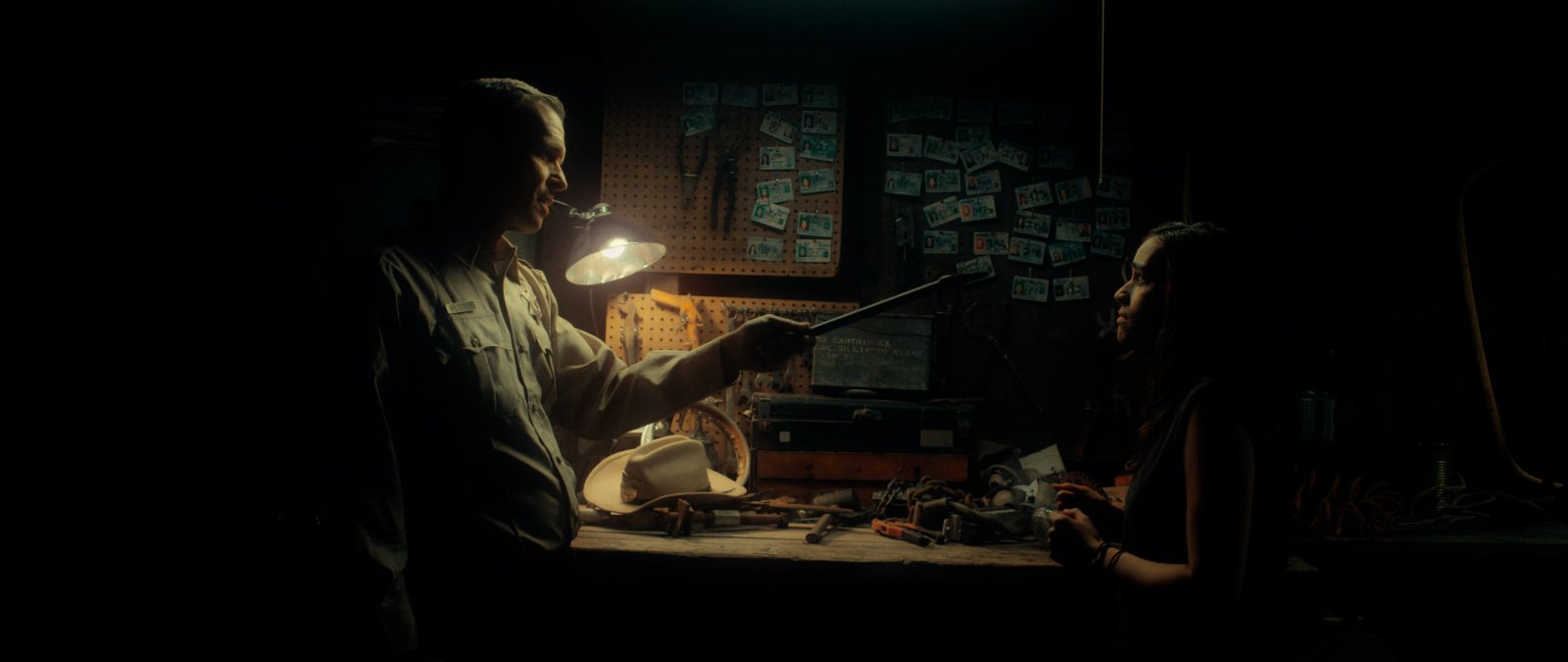
One of the defining characteristics of Blood Star is the contrast between its widescreen landscapes and its aggressive close photography.
The film can move from a vehicle appearing almost insignificant against miles of desert to an uncomfortable close-up of the Sheriff eating chicken or watching Bobbie.
That contrast was deliberate. The landscapes establish vulnerability; the close-ups create intimacy with the threat.
The Guardian later singled out the film’s imagery, including the Sheriff’s close-up and the transition between abandoned vehicles and stolen phones, as examples of the film’s strong visual instincts.
Those moments demonstrate how the cinematography and editing were designed together. The image often carries narrative information that could otherwise have required dialogue or exposition.
Pascal Combes-Knoke Before Blood Star
By the time he photographed Blood Star, Combes-Knoke was already an experienced feature-film cinematographer.
His credits before the film included Low Low, Trauma Therapy, Faith, Hope & Love, No Escape Room, Street Survivors: The True Story of the Lynyrd Skynyrd Plane Crash, American Sicario, Pups Alone, Ask Me to Dance and the horror anthology Sinphony.
That experience was particularly important to Blood Star. The production required a cinematographer who understood not only how to make strong images but how to achieve them within the limitations of independent feature filmmaking.
Combes-Knoke had already worked across thrillers, horror, drama, comedy and action, giving him substantial experience adapting visual style to different production scales.
Darkness of Man — Jean-Claude Van Damme
Among Combes-Knoke’s major feature credits is Darkness of Man, the 2024 action thriller starring Jean-Claude Van Damme.
Directed by James Cullen Bressack, the film also stars Kristanna Loken, Shannen Doherty, Spencer Breslin and Sticky Fingaz.
Combes-Knoke served as Director of Photography on the film, which was produced on a reported $5 million budget and acquired for US distribution by Saban Films.
The project represented a significant step upward in production scale and placed Combes-Knoke behind the camera on a feature built around one of international action cinema’s most recognisable stars.
One Mile — Ryan Phillippe and C. Thomas Howell
Combes-Knoke subsequently photographed One Mile, a two-part 2026 action thriller starring Ryan Phillippe, Amélie Hoeferle and C. Thomas Howell.
Directed by Adam Davidson, the project was produced by Kapital Entertainment and Nomadic Pictures and filmed on Vancouver Island.
The story was conceived and produced as two connected feature films, One Mile: Chapter One and One Mile: Chapter Two, shot together before being released digitally in 2026.
Distribution came through Republic Pictures / Paramount Global Content Distribution, placing Combes-Knoke’s cinematography within another substantially larger commercial production framework.
Bounty — Stephen Dorff and Ron Perlman
Combes-Knoke has also worked on Bounty, starring Stephen Dorff and Ron Perlman.
The project is part of the continued progression in scale of the features he has photographed following his earlier independent work. Combes-Knoke’s own professional biography lists the production alongside Darkness of Man, while Film Independent has also referenced the project as part of his recent feature-film career.
The combination of performers such as Van Damme, Ryan Phillippe, Stephen Dorff and Ron Perlman illustrates the trajectory of a cinematographer increasingly working on films with established international casts and larger production structures.
An ICG Local 600 Cinematographer
Combes-Knoke is an IATSE / International Cinematographers Guild Local 600 Director of Photography.
He studied film theory at the University of Pennsylvania before studying film production at Chapman University, subsequently working in Los Angeles as a Steadicam operator before moving into cinematography full time.
His technical background remains a significant part of his approach. In addition to conventional cinematography, Combes-Knoke has experience with Steadicam, aerial photography and drone operation and is an FAA-certified drone pilot.
He has also participated in American Society of Cinematographers Master Classes, working alongside cinematographers including Rodrigo Prieto and James Laxton.
That mixture of formal film education, camera-operation experience and feature-film production has shaped an approach built around both technical precision and emotionally motivated imagery.
Award-Winning Cinematography
Combes-Knoke won Best Cinematography at the Hollywood Reel Independent Film Festival for Street Survivors: The True Story of the Lynyrd Skynyrd Plane Crash.
He previously received a Best Cinematographer award at the Infocus Short Film Festival for El Luchador.
His work extends beyond narrative filmmaking into music videos and commercial production. His music-video cinematography includes work associated with major artists, while projects he photographed have received recognition including BET and MTV VMA nominations.
This breadth of experience is visible in Blood Star, where classical narrative cinematography sits alongside more graphic, immediate and sometimes almost music-video-like visual transitions.
The Desert as a Character
In Blood Star, the desert is not simply a location. It is part of Sheriff Bilstein’s power.
Long roads provide visibility but no protection. Huge open spaces leave Bobbie exposed. Gas stations and roadside buildings appear as potential refuges but are separated by miles of empty terrain.
Combes-Knoke’s photography repeatedly uses this contradiction. The landscape is beautiful, but its beauty makes Bobbie appear smaller.
At times she becomes a figure surrounded by negative space; elsewhere the camera compresses distance with longer lenses, suggesting that the Sheriff may be watching even when he is physically far away.
This treatment helps give Blood Star its mixture of desert noir, psychological thriller and neo-western imagery.
Natural Light and the Desert
A significant portion of Blood Star was created using available or motivated natural light.
The filmmakers embraced the intensity of the desert sun rather than attempting to soften the environment into something more conventionally flattering.
Harsh midday light, long evening shadows and rapidly changing desert skies became part of the palette.
That approach was partly practical but also thematic. Bobbie spends much of the story exposed. There are few places to hide, and the photography rarely allows the environment to feel comfortable.
When night arrives, the visual world changes dramatically. Headlights, police lights, practical fixtures and isolated pools of illumination replace the vast visibility of the daytime desert.
Blood Star and Pascal Combes-Knoke’s Feature Career
Looking at Combes-Knoke’s career now gives Blood Star an interesting place within his filmography.
He arrived on the production already experienced, having photographed numerous features, but his career has continued to expand significantly since the film was made.
Subsequent projects have placed him on larger productions with internationally recognised actors and established distributors, while Blood Star remains an example of what can be achieved when that experience is applied to an unusually compressed independent production.
The scale of the budget may change from project to project. The fundamental job remains the same: use images to make an audience feel something.
About Pascal Combes-Knoke
Pascal Combes-Knoke is a French-American Director of Photography and member of the International Cinematographers Guild, Local 600.
A graduate of the University of Pennsylvania and Chapman University, he began his professional camera career working as a Steadicam operator before establishing himself as a feature-film cinematographer. He has since been recognised by outlets including MovieMaker and Film Independent, the latter describing him as an “exceptional Director of Photography.”
His credits include Blood Star, Darkness of Man, One Mile, Street Survivors: The True Story of the Lynyrd Skynyrd Plane Crash, American Sicario, Low Low, Faith, Hope & Love, Trauma Therapy, No Escape Room, Ask Me to Dance, Sinphony: A Clubhouse Horror Anthology, Dark Feathers: Dance of the Geisha and After All.
His subsequent work includes further feature projects currently moving through production and release.
Discover More About the Making of Blood Star
Watch the Cinematography of Blood Star
Pascal Combes-Knoke photographed Blood Star, directed by Lawrence Jacomelli and starring Britni Camacho, John Schwab, Sydney Brumfield, Travis Lincoln Cox, Felix Merback and Wyomi Reed. The film was shot across the desert using RED Gemini and RED Komodo cameras with Cooke S4/i lenses.
Blood Star is now streaming free with ads in the United States.


For international availability, visit the Watch Blood Star page.