Quick Answer
Sound design creates horror tension by controlling anticipation rather than simply reacting to images: Jaws builds dread with John Williams’ two-note motif standing in for an unseen shark, while Alien turns the Nostromo’s ventilation, alarms and mechanical hum into a hostile environment in its own right. The same principles — establishing a normal sound baseline, using off-screen sound and silence, and planning sound from the screenplay stage — work identically for big-budget and low-budget horror; the difference is intention, not money.
Key Takeaways
- Sound creates anticipation before anything is seen — Jaws’ two-note motif and Alien’s mechanical Nostromo soundscape are the genre’s clearest examples.
- Establishing the “normal” sound of a location first is what makes any later change to it feel threatening.
- Off-screen sound and silence are not empty space — they force the audience to imagine a threat, which is often scarier than anything a limited budget could show.
- Sound should be considered from the screenplay stage, not fixed as decoration in post-production.
- Low-budget and big-budget horror follow the same sound principles; a single well-chosen sound can create more tension than an overloaded soundscape.
- The final mix — not just the effects themselves — is where a film’s emotional hierarchy and tension are actually controlled.

How Sound Design Builds Tension in a Horror Thriller Movie
A horror thriller movie cannot be truly frightening without sound. An image may show us a dark corridor, an empty road or a character entering a room alone, but it is the soundtrack that tells us how to feel about it. Sound creates anticipation before anything happens, suggests threats beyond the frame and places the audience inside the physical and psychological experience of the character.
For that reason, sound design should be considered equally important to cinematography. In horror, one cannot fully function without the other. A striking image may attract attention, but sound determines its tension, rhythm and emotional force. It can turn an ordinary location into a threatening space, make an unseen presence feel dangerously close or convince the audience that something terrible is about to happen even when the screen remains almost completely still.
Despite its importance, sound design is still frequently treated as an afterthought. Productions often devote considerable time and money to cameras, lenses, lighting and visual effects, only to compress the sound schedule or reduce the sound budget during post-production. This is particularly baffling in horror and thriller filmmaking, where the final emotional impact depends so heavily on what the audience hears.
The size of the budget does not change this principle. A major studio horror film and a low-budget independent thriller may have very different resources, but sound is equally important to both. In fact, strong sound design can be even more valuable to a low-budget film because it allows filmmakers to create scale, threat and atmosphere without having to show everything on screen.
Why Sound Is So Important in Horror Films
Horror is built around anticipation. The audience knows that something may happen, but it does not know when, where or in what form. Sound design controls this uncertainty.
A filmmaker can use sound to introduce danger before it appears visually. Footsteps can approach from outside the frame. A distant mechanical noise can suggest that something is moving closer. A low-frequency rumble can be felt before it is consciously recognised. Alternatively, sound can be removed almost entirely, leaving the audience waiting for the silence to be broken.
This is why effective horror sound design is rarely just a collection of loud noises. It is a carefully constructed relationship between ambience, dialogue, music, sound effects and silence. The tension comes from how these elements are introduced, repeated, altered and withheld.
A familiar sound can become increasingly disturbing through repetition. An unfamiliar sound can create anxiety because the audience cannot identify its source. A sudden silence can be more frightening than a scream because it signals that the normal rhythm of the environment has changed.
The most effective sound design makes the audience listen actively. Once viewers begin searching the soundtrack for signs of danger, the film has already placed them in a heightened state of anxiety.
Jaws: Creating Fear Before the Threat Is Seen
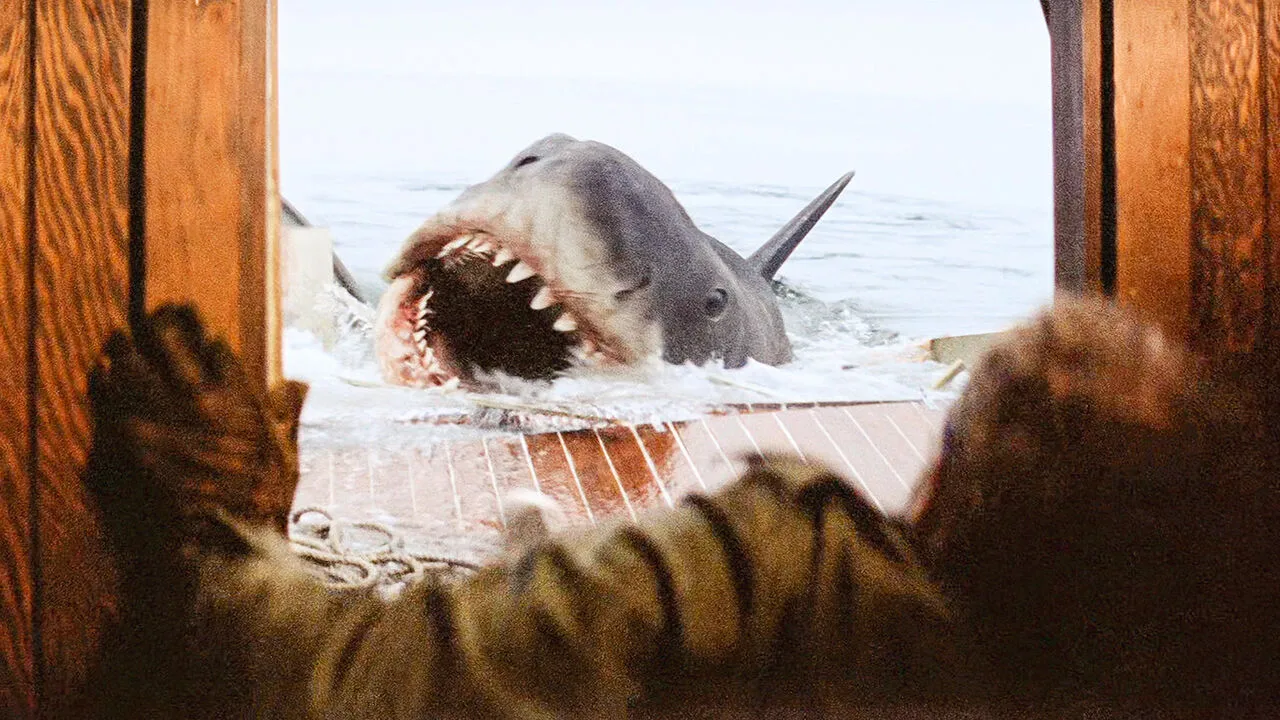
Jaws remains one of the clearest examples of how sound can create a threat before the audience sees it. The shark is frequently absent from the image, particularly during the film’s early sequences. Instead, danger is announced through John Williams‘ now-famous two-note musical pattern.
The simplicity of the idea is central to its power. The repeating notes function almost like a heartbeat or a predator’s forward movement. As the tempo increases, the audience understands that the shark is approaching, even when the water appears calm and nothing is visible beneath the surface.
The music does more than accompany the shark. It effectively becomes the shark.
The music does more than accompany the shark. It effectively becomes the shark. It gives the unseen creature presence, movement and intention. This allowed Steven Spielberg to build tension without relying constantly on a visible mechanical effect, while also encouraging the audience to imagine what might be moving beneath the water.
The soundtrack of Jaws also demonstrates how sound can train an audience. Once the musical motif has been established, viewers respond to it immediately. They recognise the threat before the characters do. This creates dramatic irony and places the audience in a state of helpless anticipation.
Just as importantly, the absence of the theme can also be used strategically. If the audience expects the motif to accompany the shark, scenes without it can create uncertainty. Sound establishes a rule, and the filmmaker can then manipulate that rule to control expectation.
Although Jaws was a major studio production, the underlying technique is available to films of any scale. A filmmaker does not need an orchestra or a large visual-effects budget to create a recognisable sonic motif. A repeated engine noise, a damaged ventilation fan, a telephone vibration or even a particular pattern of breathing can perform a similar narrative function.
Did You Know?
Spielberg’s mechanical shark, nicknamed “Bruce,” malfunctioned constantly in the saltwater off Martha’s Vineyard, which forced him to suggest the shark’s presence rather than show it. The result: the great white is on screen for a total of only about four minutes in the entire film, with sound and editing doing most of the work.
Alien: Turning an Environment Into a Threat

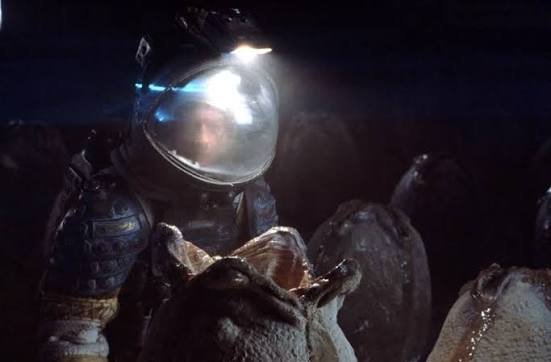
In Alien, sound design transforms the spaceship Nostromo into a living, unstable and increasingly hostile environment. The film does not rely only on the creature itself to create fear. Long before the alien is fully revealed, the audience is surrounded by machinery, ventilation systems, alarms, doors, radio interference and the constant industrial hum of the ship.
These sounds create both realism and unease. The Nostromo feels functional and physically convincing, but it also feels impossible to escape. Every corridor has its own mechanical presence. Air moves through unseen systems. Equipment clicks and pulses. Metal surfaces echo footsteps and movement. The characters are never surrounded by true silence, yet the persistent sound of the ship makes them feel more isolated rather than less.
This is one of the central lessons of Alien: horror sound design is not limited to the monster. The entire environment can participate in the threat.
The alien itself is able to disappear within this mechanical soundscape. Its movement can be confused with the noises of the ship, while industrial shapes and shadows make it difficult to separate creature from machinery. Sound supports this uncertainty. The characters and the audience must constantly decide whether a noise is part of the normal environment or evidence that something is nearby.
The film also uses contrast effectively. Loud alarms and bursts of mechanical activity create panic, while quieter passages force the audience to listen for small changes in the environment. A faint movement or unexpected noise becomes significant because the film has made the audience aware of the ship’s normal sonic rhythm.
This principle can be used in any horror thriller movie. Every location has a natural soundscape. A house may contain pipes, floorboards, appliances and distant traffic. A car has engine vibration, tyres, indicators and wind. A forest contains insects, birds and moving branches. Once the normal environment has been established, tension can be created by changing it.
The Importance of Establishing Normal Sound
Sound becomes frightening when the audience understands what is normal.
At the beginning of a scene, a filmmaker can establish the ordinary sounds of a location: a refrigerator humming, a clock ticking, rain hitting a window or tyres moving steadily across a road. These sounds may initially appear insignificant, but they provide a sonic baseline.
Once that baseline exists, any variation becomes meaningful. The refrigerator stops. The ticking clock disappears. The rain is suddenly joined by footsteps. The tyres move from smooth asphalt onto loose gravel. Nothing visually dramatic needs to happen because the soundtrack tells the audience that the situation has changed.
This technique is especially valuable in low-budget horror filmmaking. Instead of showing an expensive creature, accident or violent event, the film can present its effect through sound. A character hears something upstairs. A vehicle stops outside. A door opens somewhere beyond the frame. The audience constructs the unseen action in its imagination.
What the viewer imagines is often more frightening than anything a limited budget could show.
Big-Budget and Low-Budget Horror Use the Same Principles
A large production may have access to extensive location recording, Foley teams, specialist sound editors, original music, surround mixing and months of post-production. A low-budget film may have only a small crew and a limited schedule. However, the fundamental purpose of sound remains the same.
Both productions must decide what the audience should hear, when it should hear it and what information that sound provides.
A big-budget film can create a highly detailed sonic environment, but detail alone does not produce tension. A soundtrack filled with effects can still feel emotionally flat if those sounds are not connected to the story. Conversely, a low-budget film can create enormous tension from a single carefully selected sound.
The difference is not simply money. It is intention.
In an independent horror thriller, sound can create production value that does not exist physically. An off-screen crowd can make a location feel larger. Distant sirens can suggest a city beyond the visible set. An unseen vehicle can create danger without requiring a stunt. A threatening sound behind a wall can imply a creature, attacker or hidden space that the production never has to reveal.
Sound therefore allows low-budget filmmakers to expand the world of the film beyond the boundaries of the frame.
The danger is assuming that sound can be solved cheaply or quickly at the end of the process. A limited budget makes planning more important, not less. If a film cannot afford extensive visual spectacle, then its soundscape must be conceived carefully from the screenplay stage.
Sound Design Should Begin With the Screenplay
The greatest horror sequences are often written with sound at the centre of the action.
A screenplay should not think only in terms of what the camera sees. It should consider what the character hears, what the audience hears and whether those two experiences are the same.
A character may hear a noise but be unable to identify it. The audience may hear danger that the character has not yet noticed. Alternatively, the film may restrict the soundtrack to the character’s subjective experience, placing viewers directly inside their fear.
These choices affect the construction of the entire scene. They influence performance, camera placement, editing and pacing.
A scene built around an approaching noise should be shot differently from one built around a sudden visual reveal. A moment of silence requires room in the edit. A recurring sound motif must be introduced clearly enough for the audience to recognise it later. These decisions cannot always be added effectively after the film has been shot.
When sound is considered from the screenplay stage, it becomes part of the narrative rather than decoration applied during post-production.
Using Off-Screen Sound to Create Fear

One of sound design’s greatest strengths is its ability to extend the story beyond the visible image.
The camera shows only a limited portion of the world. Sound can suggest what exists behind the character, beyond a doorway, beneath the floor or somewhere outside the building. This creates a larger and more threatening space than the image alone can provide.
Off-screen sound is especially effective because it withholds certainty. The audience hears evidence of something but cannot confirm its size, location or intention.
A scraping sound behind a wall might be an animal, a pipe or a person. An engine heard in the distance might continue past or stop outside. A sound from another room may be harmless, but the character must investigate to discover its source.
This process makes the viewer participate in the suspense. The audience begins imagining possibilities, and each possibility may be more frightening than the eventual explanation.
Films such as Jaws and Alien understand this deeply. Their central threats are powerful not because they are constantly visible, but because they appear to exist beyond the limits of the frame.
Silence Is Part of Sound Design
Silence is not the absence of sound design. It is one of its most powerful tools.
Silence is not the absence of sound design. It is one of its most powerful tools.
True silence is rare in the real world and equally rare in cinema. What audiences perceive as silence is often a carefully controlled reduction of ambient sound, music and effects. This reduction focuses attention and creates expectation.
When a horror film becomes quiet, viewers instinctively prepare for something to break that quiet. The longer the silence continues, the greater the anticipation becomes.
However, silence is only effective when contrasted with sound. If a film remains sonically empty for too long, the audience may simply become accustomed to it. The filmmaker must create patterns of noise and quiet, tension and release.
The transition into silence is often as important as the silence itself. A machine shutting down, music disappearing or environmental noise suddenly dropping away can indicate that the world has changed. The audience may not consciously identify the exact moment, but it feels the disturbance.
Silence can also make small sounds feel enormous. A breath, a footstep or the movement of fabric becomes intensely significant when everything around it has been removed.
Low Frequencies and Physical Fear
Some sounds are experienced physically as much as they are heard.
Low-frequency sound can create unease because it produces vibration and pressure, particularly in a cinema environment. A deep rumble may suggest an approaching vehicle, a large creature, unstable machinery or a threat whose source remains unknown.
Used carefully, low frequencies can create tension without drawing attention to themselves. The audience may not consciously notice the sound, but it feels that something is wrong.
This technique is common in large-scale horror and thriller films, but it should not be mistaken for simply adding bass. Low-frequency effects must have a narrative purpose. Constant rumbling quickly loses its impact and can make the soundtrack feel blunt or exhausting.
A low-budget filmmaker may not have access to the same cinema mixing resources as a studio production, but the principle still applies. A restrained drone, engine vibration or distant industrial sound can create depth and physical tension if it is introduced at the right moment.
Sound Perspective Places the Audience Inside the Scene
Sound design also determines where the audience feels it is positioned.
A noise can sound distant and indistinct, then become clearer as a character approaches it. Dialogue can become muffled when heard through a wall. The world can become distorted during a panic attack, injury or moment of shock. Breathing and internal body sounds can move forward in the mix while the surrounding environment falls away.
These changes in sound perspective allow the audience to experience events subjectively.
In a horror thriller, this can be more effective than showing a character’s fear from the outside. Instead of simply watching someone panic, the audience hears the world as they hear it. Their breathing becomes overwhelming. External voices become difficult to understand. Ordinary noises become sharp, fragmented or threatening.
This approach is particularly valuable in psychological horror, where the audience may be uncertain whether a threat is external, imagined or both.
Music and Sound Design Must Work Together
Music and sound design are separate disciplines, but in horror they frequently overlap.
The score can provide rhythm, emotional direction and thematic identity. Sound design creates the physical world and the immediate detail of the scene. The strongest films allow the two to interact rather than compete.
In Jaws, the musical motif functions almost like a sound effect associated with the shark. In Alien, the boundary between music, mechanical ambience and abstract sound is often deliberately unstable. Both films demonstrate that tension is strongest when the entire soundtrack is conceived as one dramatic system.
Problems arise when music is used to compensate for a scene that has not generated enough tension through performance, editing or sound design. A loud score may tell the audience that a moment is frightening, but it cannot automatically make the moment frightening.
Similarly, an overloaded soundscape can reduce the impact of the music. Every element cannot occupy the foreground simultaneously. Tension depends on hierarchy: deciding which sound the audience should focus on and which sounds should remain barely perceptible.
Why Horror Sound Budgets Are Often Undervalued
Sound is sometimes undervalued because its contribution is less immediately visible during production. A camera, set or costume can be photographed and shown to investors, producers and clients. Sound work largely takes place after the images have been captured, and when it is done well, the audience may not consciously notice it.
That invisibility can lead to the false assumption that sound is secondary.
In reality, audiences notice poor sound immediately. Unclear dialogue, inconsistent ambience, weak effects or an unconvincing mix can make an otherwise polished film feel amateur. More importantly, inadequate sound design can remove the tension from scenes that were intended to be frightening.
Reducing the sound budget may save money during production, but it can significantly weaken the final film. This is especially damaging in horror because the genre depends so heavily on atmosphere, anticipation and sensory control.
A production does not necessarily need the largest sound budget, but it must allocate enough time and resources for the work to be done properly. That includes clean production recording, dialogue editing, Foley, ambience, sound effects, design, music coordination and the final mix.
Before You Shoot: A Sound Checklist
Identify your film’s core sonic motif before the shoot, not after. Establish the “normal” sound of every key location so a later change to it registers as a threat. Decide in advance which moments deserve true silence rather than music, and budget real time for the final mix — it is where the film’s tension is actually controlled, not just balanced.
Production Sound Is the Foundation
Sound design cannot always repair poor production recording.
Clean dialogue and useful location sound give the post-production team a strong foundation. When production audio is neglected, significant time may later be spent removing noise, replacing dialogue or reconstructing environments that could have been captured correctly on set.
For low-budget horror films, this is particularly important. A small production may not have the resources for extensive automated dialogue replacement or complex audio restoration. Investing in an experienced production sound recordist can therefore save money as well as protect performances.
Production sound also captures details that are difficult to reproduce later: the unique acoustics of a room, the natural movement of a vehicle, the sound of clothing, props and physical interaction within a specific location.
These recordings do not replace sound design, but they provide authentic material from which the final soundtrack can be built.
Practical Sound Design Techniques for Low-Budget Horror
Low-budget filmmakers can create effective horror sound design by concentrating on a small number of strong ideas rather than attempting to fill every moment with effects.
A recurring sonic motif can identify a threat. A clearly established room tone can make a later silence disturbing. An off-screen noise can suggest action beyond the production’s visual limits. Changes in sound perspective can place the audience inside a character’s fear. Carefully recorded Foley can make physical movement feel immediate and dangerous.
The key is specificity. A generic horror sound effect is rarely as convincing as a noise that belongs uniquely to the film’s location, character or antagonist.
A filmmaker should ask what the threat sounds like, how the environment responds to it and whether the audience should recognise that sound before the characters do.
These questions cost nothing to ask during development, but they can transform the final result.
The Final Mix Is Where Tension Is Controlled
The final sound mix is not simply a technical process of balancing levels. It is where the emotional hierarchy of the soundtrack is determined.
The mixer decides when dialogue should dominate, when ambience should become noticeable, how loudly an impact should be felt and when music should disappear. A sound effect that is powerful in isolation may need to be restrained within the full scene. A nearly inaudible noise may become the most important element in the sequence.
Horror depends on these precise decisions.
A jump scare delivered at maximum volume may startle an audience once, but sustained tension requires more subtle control. The mix must guide attention without making every intention obvious. It should allow the audience to sense danger while still leaving room for imagination.
Whether a film costs £50,000 or £50 million, this process remains essential.
Sound and Picture Cannot Be Separated
The central mistake is to think of sound as something added to a completed image.
In a successful horror thriller movie, sound and picture are conceived together. The image provides space, movement and visual information. Sound gives that image scale, rhythm, perspective and emotional meaning.
Jaws would not create the same terror without its musical warning of the unseen shark. Alien would not feel as claustrophobic without the mechanical life of the Nostromo surrounding its characters. In both films, sound is not supporting the experience from the background. It is fundamental to the experience itself.
The same is true for independent and low-budget horror. Filmmakers may not have access to elaborate sets, visual effects or large crews, but sound can create a world far beyond what appears on screen. It can make a location feel larger, a threat feel closer and an unseen event feel completely real.
A horror film cannot be scary without sound. By that measure, sound is not a secondary department and it should never be treated as an afterthought. It is one half of cinema’s language, and in horror it is often the half that frightens us most.
Frequently Asked Questions
Horror depends on anticipation — the audience knowing something may happen but not when or how. Sound controls that uncertainty directly, introducing danger before it’s visible, and can carry a scene even when the image on screen stays almost completely still.
John Williams’ two-note motif stands in for the shark itself, growing in tempo to signal its approach even when the water looks calm. Because the mechanical shark was unreliable on set, Spielberg leaned on the score and suggestion rather than showing the creature, and the shark appears on screen for only a few minutes of the film.
Where Jaws uses one musical motif tied to a single creature, Alien makes an entire environment — the Nostromo’s ventilation, alarms and mechanical hum — part of the threat, so the audience can never be sure whether a noise is the ship or the creature.
Yes. The core techniques — establishing a normal sound baseline, using off-screen sound and silence, and building a recurring sonic motif — cost nothing but planning. A low-budget film can create more tension from one well-chosen sound than a big-budget film can from an overloaded soundscape.
It should begin at the screenplay stage. Decisions like what the character hears versus what the audience hears, where a silence needs room in the edit, or how a sound motif gets introduced all affect performance, camera placement and pacing — they can’t always be fixed effectively after the film is shot.
What audiences experience as silence is usually a carefully controlled reduction of ambience, music and effects, not true silence. That reduction builds anticipation for whatever breaks it, and makes small sounds — a breath, a footstep — feel disproportionately significant.
Learn More About Blood Star
If you’re interested in how independent filmmakers create ambitious thrillers on limited budgets, you can explore more about Blood Star, including its cast, production and behind-the-scenes story.
If you’d like to watch the film, visit the Blood Star Watch Page to see where it’s currently available to stream or purchase.
Watch Blood Star
Blood Star is a psychological desert road thriller about Bobbi Torres, a young woman travelling alone across the American Southwest who becomes the target of Sheriff Bilstein, a predatory lawman whose badge, patrol car and knowledge of the territory allow him to control the hunt.


See every legitimate way to watch Blood Star free →

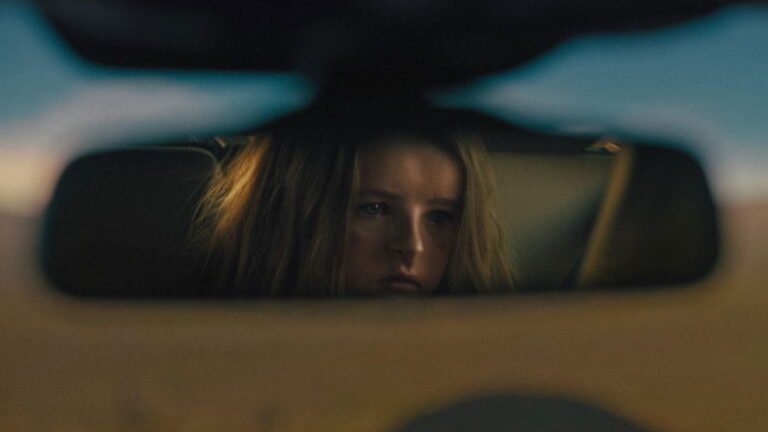
Table of Contents
- How Sound Design Builds Tension in a Horror Thriller Movie
- Why Sound Is So Important in Horror Films
- Jaws: Creating Fear Before the Threat Is Seen
- Alien: Turning an Environment Into a Threat
- The Importance of Establishing Normal Sound
- Big-Budget and Low-Budget Horror Use the Same Principles
- Sound Design Should Begin With the Screenplay
- Using Off-Screen Sound to Create Fear
- Silence Is Part of Sound Design
- Low Frequencies and Physical Fear
- Sound Perspective Places the Audience Inside the Scene
- Music and Sound Design Must Work Together
- Why Horror Sound Budgets Are Often Undervalued
- Production Sound Is the Foundation
- Practical Sound Design Techniques for Low-Budget Horror
- The Final Mix Is Where Tension Is Controlled
- Sound and Picture Cannot Be Separated
- Learn More About Blood Star
- Watch Blood Star